When summer days start to feel long, many parents and teachers ask the same question: how do you keep children busy without turning every free hour into screen time? The best summer activities for kids do more than fill the day. They build early reading, math, fine motor, and thinking skills in ways that still feel playful.
For preschoolers and early elementary learners, summer is a great time to keep routines light while protecting the progress they made during the school year. A simple activity can become a meaningful learning moment with just a small shift in focus.
Summer activities for kids that build real skills
Not every activity needs a worksheet or a formal lesson. In fact, young children often learn best when the task feels hands-on and low pressure. The goal is to blend movement, creativity, and repetition so learning stays natural.
A sidewalk chalk alphabet hunt is a great example. Write letters or simple sight words on the driveway, then call out a sound, letter, or word for your child to find. You can make it easier for preschoolers by focusing only on uppercase letters, or increase the challenge by asking early readers to say the sound and use the word in a sentence.
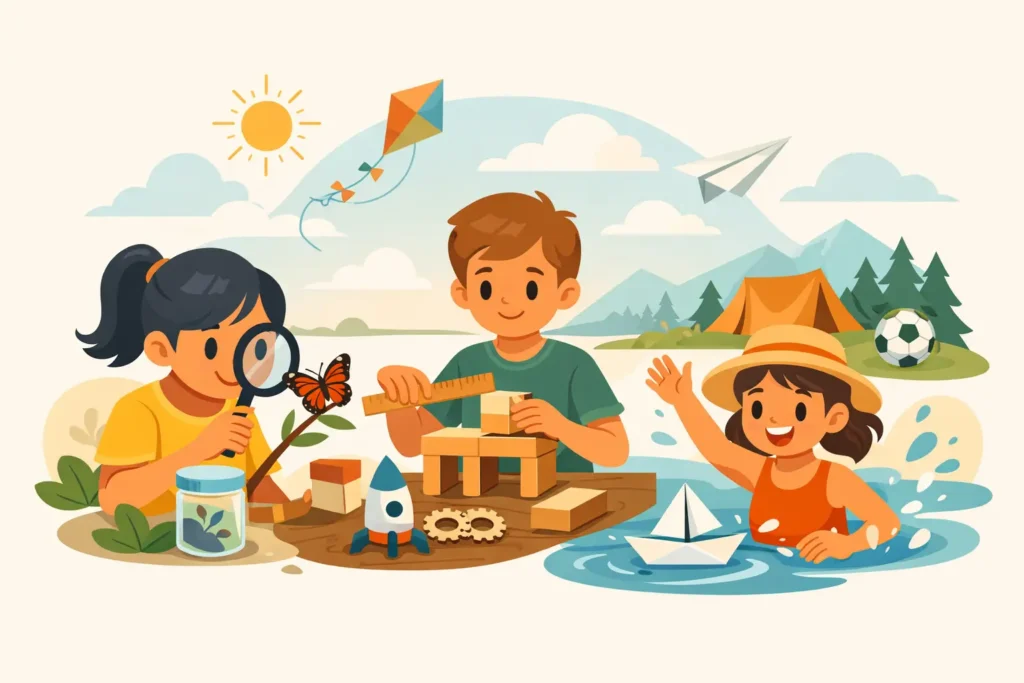
Water play can also support learning. Fill bins with cups, spoons, measuring containers, or floating alphabet letters. Children can compare full and empty, practice counting scoops, or sort letters by shape and sound. It feels like a summer game, but it quietly builds vocabulary, math awareness, and fine motor control.
Outdoor scavenger hunts work especially well for mixed ages. Ask children to find something rough, smooth, red, tiny, or shaped like a circle. That turns a walk around the yard or neighborhood into a lesson in observation, descriptive language, and early science.
Easy learning ideas for home or the classroom
If you need activities that are simple to set up, focus on ideas that use materials you already have. Paper, crayons, tape, toy cars, books, and a few kitchen tools can go a long way.
Try a letter car wash by writing letters on toy cars and matching them to letters taped on the floor or wall. This works well for children who need movement while learning. A similar idea is number parking, where kids park each car in a numbered space and count aloud as they play.
Story basket time is another easy win. Place a few themed books in a basket with simple props, such as plastic animals, leaves, or dress-up items. After reading, ask your child to retell the story using the objects. Retelling strengthens comprehension, sequencing, and vocabulary, which are important early literacy skills.
For children who enjoy creating, set up a summer journal. They can draw what they saw outside, trace letters, label pictures, or write one short sentence each day. This does not need to be perfect. The value comes from steady practice and the chance to connect ideas with print.
You can also turn snack time into math time. Count crackers, sort fruit by color, or compare which bowl has more or less. These short moments matter, especially for young learners who benefit from repeated exposure to basic concepts.
Creative summer activities for kids with educational value
Art projects are most useful when they invite children to think, describe, and make choices. Instead of only giving directions, ask open-ended questions. What colors do you want to use? How many shells did you glue on? Can you tell me about your picture?
Nature collage boards are especially effective in summer. Children can collect leaves, flowers, grass, and sticks, then sort and glue them into categories. This supports classification, vocabulary, and sensory exploration. Just make sure collected items are safe and age-appropriate.
Obstacle courses are another strong option. They help with gross motor development, listening, and sequencing. Give simple directions such as hop three times, crawl under the chair, and toss the beanbag into the basket. If your child is ready, let them design the course and explain the steps back to you.
Puppet play is helpful for language and emotional growth. Children can use socks, paper bags, or simple cutouts to act out stories, solve pretend problems, or practice social situations. This kind of play is especially useful for children who are building confidence with speaking and self-expression.
How to keep summer learning manageable
A common mistake is trying to do too much. Children do not need a full school schedule in July to keep learning. In most homes and classrooms, a short predictable rhythm works better than a packed plan.
You might choose one literacy activity, one outdoor activity, and one creative activity each day. That is enough to give structure without making summer feel overly scheduled. Some days will go smoothly, and some will not. That is normal.
It also helps to repeat favorite activities instead of constantly inventing new ones. Repetition builds confidence. A child who does the same alphabet game several times is often learning more than a child who tries a brand-new activity every day.
If you want a little more structure, Kids Learning Journey-style printable resources can fit naturally into your routine after a hands-on activity. For example, a nature walk can lead into letter tracing, simple counting practice, or a themed writing page.
The best summer learning plans are the ones you can actually keep using. Start simple, follow your child’s interests, and choose activities that make play feel purposeful. That is often where the strongest learning begins.