
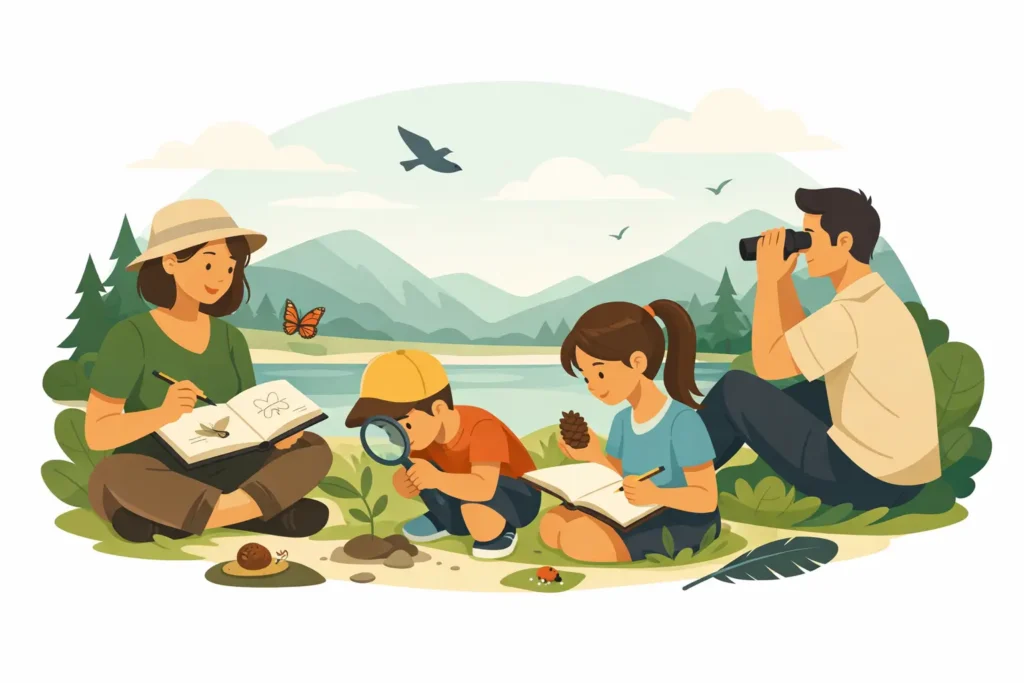
One child is crouched over an ant trail. Another is holding a leaf like it is a treasure map. You are trying to remember whether you packed crayons. That is exactly why family nature journal ideas work so well – they turn an ordinary walk into a focused learning moment without making it feel like school.
A family nature journal can be as simple as stapled paper in a folder or a notebook each child keeps in a backpack. What matters most is that it gives children a place to notice, record, compare, draw, and talk about the world around them. For preschoolers and early elementary students, that kind of guided observation supports early science, vocabulary, handwriting, and even emotional regulation.
Why family nature journals are worth trying
Nature journaling gives children a reason to slow down. Instead of rushing through a park or backyard, they begin to ask better questions. Why are these rocks different colors? Why did we hear birds but only see one? Why is this flower closed now when it was open yesterday?
That curiosity has real learning value. Young children build observation skills when they describe what they see. They practice early writing when they label pictures or dictate sentences. They strengthen fine motor skills through drawing. They also begin to understand patterns, seasons, weather, and habitats in a concrete way.
For families, there is another benefit. A journal adds gentle structure to outdoor time. If your child gets overwhelmed by open-ended play or asks for a screen the minute you step outside, a notebook and a simple prompt can make the experience feel purposeful and calm.
What to include in a simple family nature journal
You do not need fancy supplies. In most cases, a notebook, pencils, crayons, and a clipboard are enough. Some families like one shared journal, while others prefer individual journals for each child. It depends on your children’s ages and how much independence they can handle.
A preschooler may need a parent to write down observations, while a second grader may enjoy sounding out labels and short sentences alone. If siblings share one journal, it can encourage conversation and teamwork. If each child has a separate notebook, it gives them more ownership. Both approaches work.
A good page can include the date, location, weather, a drawing, and one or two observations. That is plenty. The goal is not to fill a perfect page. The goal is to help children look closely and think carefully.
Family nature journal ideas for different ages
1. Draw one thing only
If your child gets distracted easily, choose one object to draw. It might be a pinecone, feather, dandelion, bug, or smooth rock. Focusing on a single item teaches close observation better than asking children to record everything they see.
You can keep the writing simple. Try prompts like “I notice…” or “This feels…” Younger children can dictate their words while you write them.
2. Make a weather watcher page
This is one of the easiest family nature journal ideas to repeat all year. Have children record the temperature feel, cloud cover, wind, and what they need to wear outside. Over time, they begin to see seasonal patterns.
For early learners, drawing the sky may be enough. Older children can compare today’s weather to last week’s and write one sentence about what changed.
3. Track a favorite tree
Pick one tree in your yard, neighborhood, or local park and visit it regularly. Children can draw it once a month and notice changes in leaves, bark, color, shade, and animals nearby.
This works especially well because it builds long-term observation. Children start to understand that nature changes slowly and predictably in some ways, but not in others.
4. Go on a color hunt
Choose a color and search for it outdoors. Your child might look for five green things in spring or five brown things in fall. Then they can draw or list what they found.
This is excellent for preschoolers because it combines color recognition, vocabulary, and observation without requiring much writing.
5. Compare two leaves
Place two leaves side by side and ask what is the same and what is different. Shape, size, edge, color, and texture are all useful details.
Comparison is a strong early science skill. It also gives children a natural reason to use descriptive language like smooth, jagged, tiny, wide, or spotted.
6. Make a sound map
Sit quietly for one minute and listen. In the center of the page, your child writes or draws where they are sitting. Around it, they add the sounds they hear, such as birds, cars, wind, dogs, or buzzing insects.
This is a helpful option for children who are not excited about drawing plants or writing full sentences. It teaches attention in a different way.
7. Record signs of animal life
Children do not need to spot a deer to learn about animals. A feather, nest, chewed leaf, ant hill, spider web, or muddy paw print all count as clues.
Encourage them to draw the evidence and guess what animal might have been nearby. If they are not sure, that is fine. Wondering is part of the process.
8. Create a backyard scavenger page
Instead of a separate scavenger hunt sheet, let your journal become the record. Ask children to find a rough texture, something round, something moving, something yellow, and something tiny. Then they sketch each item.
This works well when you want a little more direction but still want the journal to feel personal rather than worksheet-based.
9. Press and label a nature find
If local rules allow and the item is safe to collect, children can tape a small fallen leaf or flower petal onto a page and label it. This adds a hands-on element many young learners enjoy.
Just keep expectations realistic. Some children love collecting. Others would rather sketch and keep moving.
10. Write a “notice, wonder, learn” page
This simple three-part format grows with your child. First, they write or say what they notice. Next, they share what they wonder. Last, they record something they learned after talking together.
It is a gentle way to build inquiry skills without turning the activity into a quiz.
11. Measure something in nature
Bring a ruler or let children use nonstandard measurement like hand spans or craft sticks. Measure a leaf, stick, puddle edge, or flower stem and record it in the journal.
This is a smart choice if you want to blend math into outdoor learning in a natural way.
12. Make a seasonal vocabulary page
Choose words that match the time of year, such as bud, bloom, sprout, frost, nest, or acorn. Then challenge your child to find something connected to one of those words and draw it.
This supports language development and helps early readers connect real experiences to new vocabulary.
13. Draw the life cycle clues you see
Young children may not observe a full life cycle in one afternoon, but they can still record clues. A caterpillar, chrysalis, seedling, blossom, or seed pod can start a good conversation.
This kind of page makes science feel visible and concrete.
14. Keep a “smallest thing I found” page
Children often race toward the biggest, brightest object. Invite them to search for the smallest thing instead. It could be a tiny flower, a miniature mushroom, a pebble, or a little insect.
This helps children practice patience and careful focus, which are often the hardest parts of nature study.
15. End with a reflection question
After each outing, ask one gentle question and let each child answer in their own way. You might ask, “What surprised you?” “What would you like to find next time?” or “What was your favorite part?”
Reflection builds memory and helps children connect learning to feelings, not just facts.
How to keep it manageable for parents and teachers
The biggest mistake is trying to make every outing detailed and academic. Most families do better with short, repeatable routines. A 10-minute journal stop during a walk is often more successful than planning an hour-long project that never happens.
It also helps to keep your expectations matched to your child’s stage. Some days a careful drawing and one label is enough. Some days your child may only want to dictate a sentence while you write. That still counts.
If you are working with mixed ages, give everyone the same prompt but different output. A preschooler might circle colors they see, while an older child writes three observations. This keeps the activity shared without making younger children feel behind.
You can also revisit pages later indoors. Children often enjoy adding a title, tracing over labels, or coloring in details once they are back at the table. That can be a helpful option when outdoor attention spans are short.
Making family nature journal ideas part of your routine
You do not need a forest, a field trip, or a perfect weather day. A sidewalk crack with a weed growing through it can lead to a good journal page. So can a robin in a parking lot, frost on a car window, or shadows in the backyard.
What children remember is not whether the outing was impressive. They remember that someone invited them to pay attention. That is one reason nature journaling fits so naturally with the kind of learning support families look for from Kids Learning Journey – it is simple, meaningful, and easy to repeat.
If you start small and stay consistent, your journal becomes more than a notebook. It becomes a record of how your child learned to notice the world, one page at a time.