A preschooler melts down because the blue cup is in the sink. A kindergartener bursts into tears when a worksheet feels too hard. An early elementary student gets loud, silly, or defiant right when they are actually overwhelmed. If this sounds familiar, emotional regulation for kids is likely the skill underneath the behavior.
For young children, big feelings often arrive before the words, patience, or self-control needed to manage them. That does not mean a child is being difficult on purpose. More often, it means they need support learning what to do when frustration, disappointment, worry, or excitement feels too big for their body.
The good news is that emotional regulation can be taught. Just like early reading or handwriting, it grows with modeling, practice, and repetition. Children do not learn it from one calm-down talk after a hard day. They learn it over time through steady routines, simple language, and lots of chances to try again.
What emotional regulation for kids really means
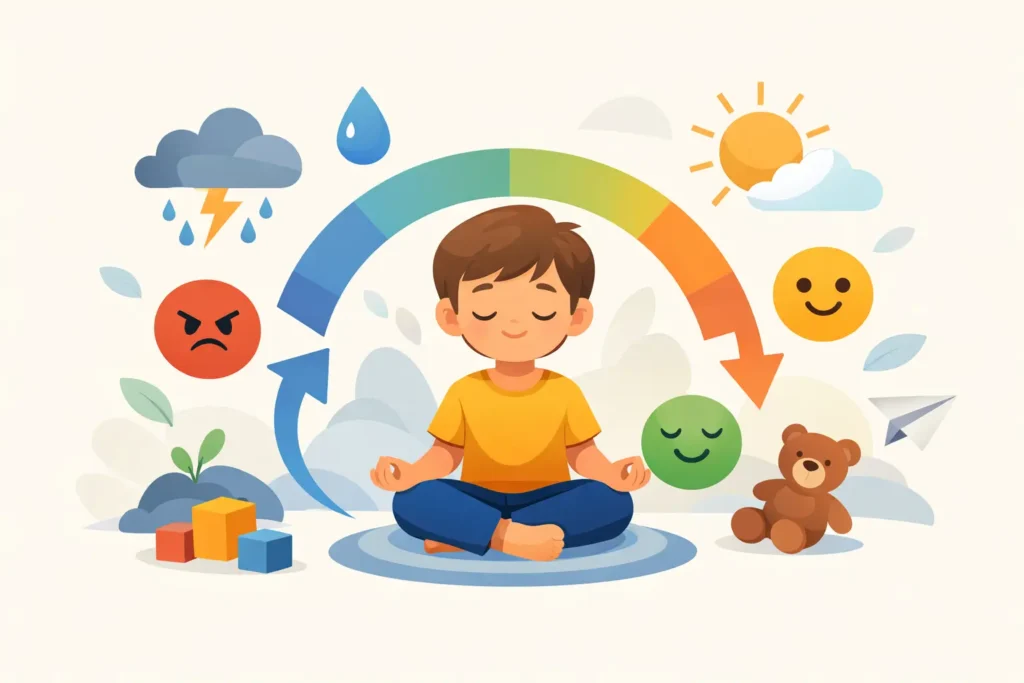
Emotional regulation for kids is the ability to notice feelings, handle them in a safe way, and return to a calmer state. For young children, this is a developing skill, not a finished one. A four-year-old and an eight-year-old may both struggle with regulation, but the support they need can look different.
Regulation is also not the same as obedience. A quiet child is not always a regulated child, and a loud child is not automatically out of control. Some children shut down when overwhelmed. Others cry, yell, cling, or run. The goal is not to eliminate emotion. The goal is to help children express it safely and recover more easily.
That distinction matters at home and in the classroom. When adults focus only on stopping the behavior, children may learn to hide feelings rather than manage them. When adults teach the skill underneath the moment, children build confidence and resilience.
Why some kids struggle more than others
Every child has a different temperament. Some are naturally more sensitive, more intense, or slower to adapt to change. Others can handle transitions easily but become overwhelmed by noise, hunger, or fatigue. Development also plays a role. Young children are still building the brain-based skills that support impulse control, flexible thinking, and frustration tolerance.
Environment matters too. Busy schedules, poor sleep, too much screen time, inconsistent routines, or stressful changes can make regulation harder. Even positive events, like birthdays, holidays, or a fun field trip, can lead to dysregulation because excitement is still a big feeling.
This is why two children can react very differently to the same situation. It is not always about the event itself. It is often about the child’s current capacity to handle it.
Signs a child needs more regulation support
Some signs are obvious, like tantrums, yelling, hitting, or refusing directions. Others are easier to miss. A child who suddenly becomes clingy, unusually silly, perfectionistic, tearful, or withdrawn may also be struggling with emotional overload.
You might notice patterns around transitions, homework, sibling conflict, bedtime, or noisy group settings. Some children lose control after school because they have spent all day trying to hold it together. Others struggle most when they are asked to stop a preferred activity.
Looking for patterns is more helpful than labeling a child as dramatic, defiant, or overly sensitive. Patterns show you where support is needed.
Start with connection before correction
When a child is deeply upset, logic rarely works first. In that moment, connection helps more than a lecture. A calm voice, a short sentence, and physical closeness, if the child wants it, can reduce stress faster than repeated instructions.
That might sound like, “You’re having a hard time. I’m here,” or “Your body looks really upset. Let’s get calm together.” These simple phrases help children feel safe enough to regain control.
This does not mean there are no limits. Safe boundaries still matter. If a child is hitting, throwing, or hurting others, the adult should step in right away. But even then, the tone can stay calm and firm instead of harsh. Children learn regulation best from regulated adults.
Teach feelings when the child is calm
The best teaching happens outside the meltdown. During calm moments, help children build a basic feelings vocabulary. Start simple with words like happy, sad, mad, scared, frustrated, worried, and excited. For older children, you can add disappointed, embarrassed, jealous, or overwhelmed.
Picture books, feeling charts, pretend play, and everyday conversations all help. If a child can identify what they feel, they have a better chance of asking for help before behavior escalates.
It also helps to connect feelings with body signals. You might say, “When you get frustrated, do your hands get tight?” or “When you feel worried, does your tummy feel funny?” This teaches children that emotions often show up in the body before they spill out in behavior.
Build simple calm-down routines
Children do better with strategies they have practiced before they need them. A calm-down routine should be easy to remember and realistic for the child’s age.
For preschoolers, that may be as simple as stop, breathe, squeeze a pillow, and ask for help. For early elementary children, it might include deep breathing, counting slowly, getting a drink of water, drawing, or taking a quiet break.
The key is to keep the routine short and repeatable. If there are too many steps, children will not use it when upset. Practice during neutral times, just like any other skill. You can even role-play common moments such as losing a game, cleaning up toys, or making a mistake on schoolwork.
Create an environment that supports regulation
Many emotional struggles improve when the day feels more predictable. Regular meals, sleep, transitions, and movement breaks can make a big difference. Young children often need structure to feel secure.
Visual schedules are especially helpful for children who struggle with transitions. A simple chart showing what comes next can reduce anxiety and power struggles. Giving advance warnings also helps. “Five more minutes, then clean-up,” is easier to handle than a sudden demand.
A calm-down space can be useful too, as long as it is not framed as punishment. This can be a quiet corner with soft seating, books, sensory tools, paper for drawing, or a feelings chart. The goal is not isolation. It is giving the child a place to reset.
Activities that strengthen emotional regulation
Play is one of the best ways to build regulation skills. Turn-taking games teach patience and flexibility. Simple board games help children practice losing, waiting, and following rules. Movement games such as freeze dance or red light, green light build impulse control in a fun way.
Creative activities help too. Drawing feelings faces, making emotion puppets, or coloring while listening to calming music can help children process emotions indirectly. Breathing exercises often work better for young kids when paired with play, such as pretending to blow up a balloon or slowly cool a cup of cocoa.
At Kids Learning Journey, this kind of skill-building works best when it feels both structured and playful. Children are more likely to practice emotional tools when the activity feels manageable and engaging.
What to do during a meltdown
First, lower your own intensity. If adults raise their voice, rush, or argue, children usually escalate further. Keep your words short. Focus on safety. Reduce extra stimulation if possible.
Once the child is calmer, resist the urge to immediately launch into a long talk. Some children need a few more minutes before they can reflect. When they are ready, keep the conversation simple. Name what happened, validate the feeling, and talk about what to try next time.
For example, “You were really frustrated when the tower fell. You started throwing blocks. Next time, we can stomp feet on the floor, ask for help, or take a breathing break.” This teaches accountability without shame.
Progress is rarely a straight line
Children may use a strategy beautifully one day and fall apart the next. That is normal. Emotional growth is uneven, especially during stressful seasons, developmental leaps, or changes in routine.
It also depends on the child. Some respond quickly to visual tools. Others need movement, sensory support, or a lot of adult co-regulation before they can do more independently. If a strategy is not working, it does not always mean the child is resisting. It may simply be the wrong fit.
If emotional outbursts are extreme, happen very frequently, or interfere with daily life in a major way, extra support from a pediatrician, school counselor, or child development professional can help. Asking for support is not overreacting. It is part of helping a child succeed.
The most encouraging truth is this: every calm response, every practiced routine, and every repaired hard moment is teaching something valuable. Children do not need perfect adults to learn emotional regulation. They need steady ones who keep showing them what calm, safety, and support look like.