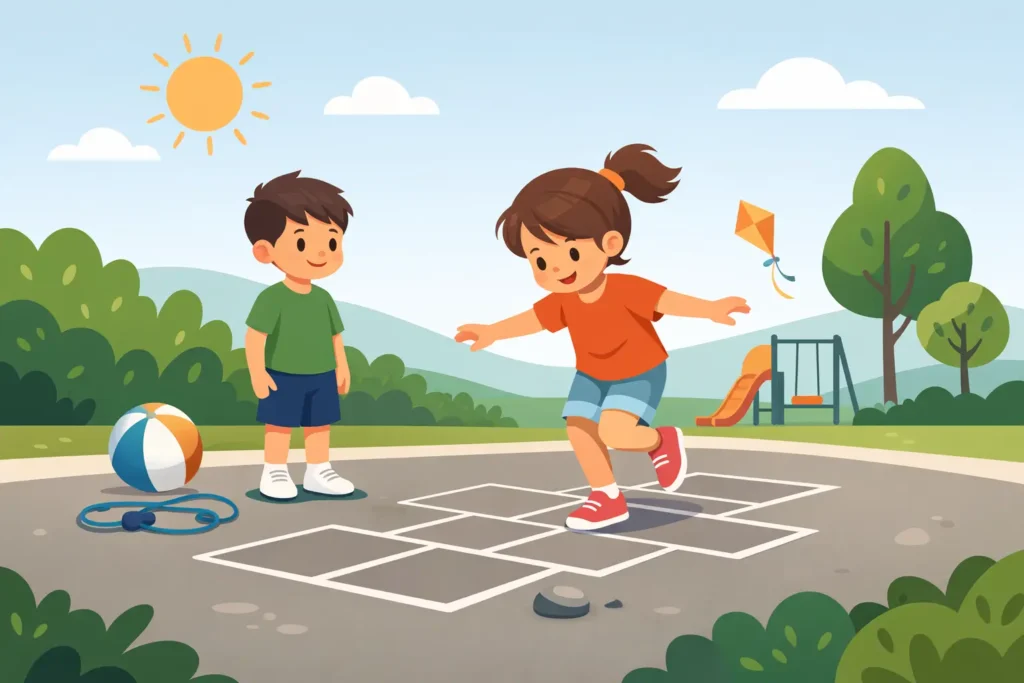
If you need a simple activity that gets children moving without feeling like “exercise,” Outdoor games Hopscotch for kids are hard to beat. With just a little space and a few lines on the ground, children can practice balance, counting, coordination, and turn-taking while having genuine fun.
Hopscotch has stayed popular for a reason. It is easy to teach, affordable, and flexible enough for preschoolers, kindergarteners, and early elementary students. For parents and teachers trying to reduce screen time or add more purposeful outdoor play, this classic game offers both movement and learning in one activity.
Why hopscotch works so well for young children
Hopscotch supports several early childhood skills at the same time. Physically, children strengthen balance, body control, and coordination as they hop on one foot, jump with two feet, and shift their weight from square to square. These movements may look simple, but they ask children to plan where their body will go next.
It also supports school readiness. Children count spaces, follow rules, wait for turns, and remember sequences. For younger kids, that means early math and listening practice. For older kids, it can become a playful way to reinforce number order, skip counting, sight words, or even simple spelling.
Another reason parents and educators love hopscotch is that it scales easily. A child who is just learning can step through the pattern slowly. A more confident child can hop faster, toss more accurately, or try more challenging versions.
How to set up hopscotch outdoors
You do not need much to get started. Sidewalk chalk is usually enough for a driveway, patio, or playground surface. If you are on grass, you can use flat markers, foam squares, or even paper plates secured for a short activity.
A traditional board uses numbered boxes in a simple pattern, usually from 1 to 8 or 10. Leave enough space for little feet and a safe landing. For preschoolers, bigger squares make the game less frustrating. For early elementary kids, standard-sized boxes are usually fine.
Children will also need a marker to toss. A small beanbag works well because it is soft and less likely to bounce away. If you use a stone, choose one that is smooth and light enough for a child to handle safely.
Basic hopscotch rules for beginners
Start by showing children how to toss the marker onto the first square. Then they move through the course, hopping on one foot when there is one square and landing with two feet when there are side-by-side squares. They skip the square holding the marker, turn around at the end, and pick it up on the way back without stepping on lines.
That sounds straightforward, but beginners often need practice with the sequence. If a child steps on a line, loses balance, or tosses the marker outside the correct square, simply let them try again. For young learners, keeping the game encouraging matters more than strict competition.
If you are working with a group, short turns help keep everyone engaged. You can also let children cheer each other on or count aloud together.
Outdoor games hopscotch for kids with learning twists
This is where hopscotch becomes especially useful for home learning and classroom play. A few small changes can turn it into an academic review activity without taking away the fun.
Instead of writing only numbers, try letters in each square and ask children to say the letter name or sound as they land. This works well for preschool and kindergarten phonics practice. You can also use uppercase and lowercase letter matches on separate boards.
For early math, write numbers and ask children to count forward, count backward, or skip count by 2s. Another easy option is to call out a simple problem like “2 plus 3” and have the child hop to the answer.
Sight word hopscotch is another strong choice for early readers. Write one word per square and invite children to read each word aloud before moving on. If a child is still learning, an adult can model the word first.
You can even use hopscotch for colors, shapes, or feelings words. That makes it a helpful activity across a wider early-learning routine, which fits naturally with the playful learning approach many families use through Kids Learning Journey.
Safety and success tips
A few small adjustments make hopscotch more enjoyable for everyone. Choose a flat surface and check for cracks, slippery spots, or loose gravel. Children should wear shoes that stay on securely, especially if they are still developing balance.
It also helps to match the board to the child’s age. If the layout is too small or complicated, children may give up quickly. If it is too easy, they may lose interest. When in doubt, start simple and build from there.
Some children do not like hopping on one foot right away, and that is okay. Let them step through first. Confidence often comes before precision.
When hopscotch is most useful
Hopscotch is a great fit for transition times, outdoor centers, backyard play, or a quick movement break between lessons. It works especially well when children need to reset their energy and attention. Even ten minutes outside can help them come back calmer and more ready to learn.
For families, it is one of the easiest activities to repeat often without much prep. For teachers, it is an easy way to blend gross motor play with early academic review. The best part is that children usually see it as a game first, which is often exactly why the learning sticks.
Sometimes the simplest activities do the most work, and hopscotch is a great example of that.