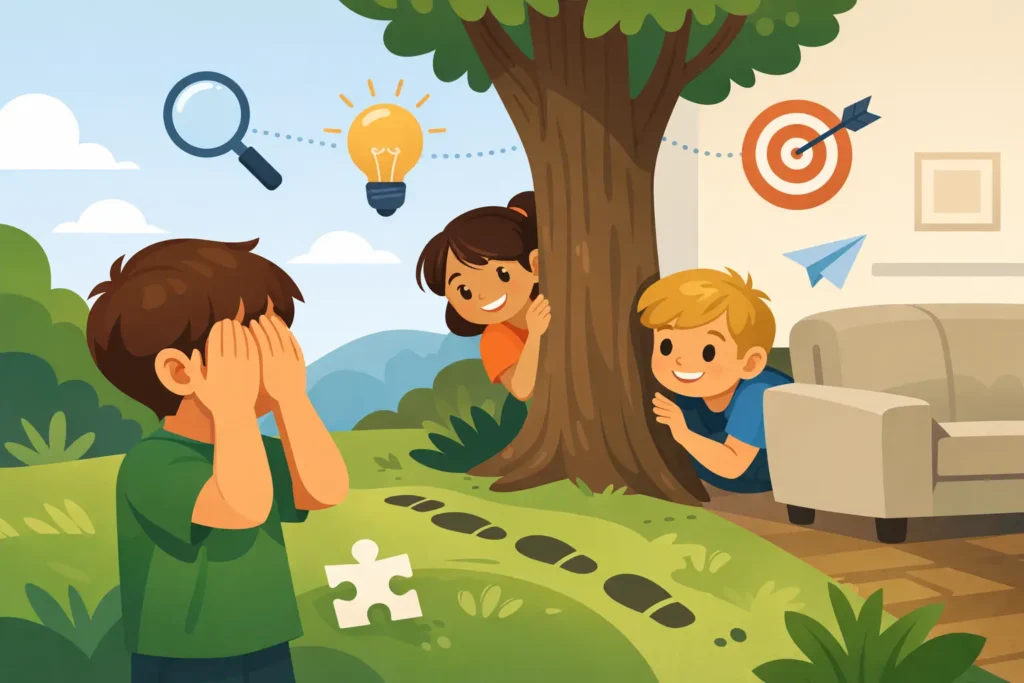
If you need a low-prep activity that gets children moving, thinking, and laughing, hide and seek for kids is hard to beat. It feels like simple play, but it also supports listening, self-control, spatial awareness, and early problem-solving – all skills young children use at home, in preschool, and in the classroom.
For parents and teachers, that is good news. Hide and seek does not require expensive supplies, complicated setup, or a long attention span. You can play it indoors on a rainy afternoon, outside at recess, or as part of a themed learning day. With a few small adjustments, it can work for preschoolers, kindergarteners, and early elementary children.
Why hide and seek helps young children learn
Children learn best when their bodies and brains are both involved. During hide and seek, kids practice following directions, waiting for a turn, and remembering rules. They also build body awareness as they squeeze behind furniture, move quietly, or decide whether a hiding spot is visible.
There is also a social-emotional side to the game. Many young children are still learning how to handle excitement, disappointment, and uncertainty. Hide and seek gives them a playful way to practice patience and confidence. A child who is nervous about being found may need reassurance, while a child who always wants to be the seeker may need support with turn-taking.
For younger children, hide and seek can also strengthen language. You can naturally use words like behind, under, next to, near, far, first, and last. Those position and sequencing words matter for early literacy and classroom directions.
How to play hide and seek for kids successfully
The best version of the game depends on the age of the children and the space you have. Preschoolers usually do best with short counting, obvious boundaries, and easy hiding places. Older children can handle more complex rules and larger play areas.
Start by setting clear limits. Show children exactly where they may hide and where they may not go. If you are indoors, that might mean no closets, no bathrooms, and no climbing. If you are outdoors, point out the physical boundaries before the game starts.
Then keep the counting simple. For very young children, count to 10 slowly. If a child is still learning numbers, count together as a group. That small change makes the game feel more supportive and less stressful.
It also helps to teach what a safe hiding place looks like. Children should be able to breathe comfortably, get out on their own, and stay where an adult can supervise nearby. A safe game is always more fun than a game that turns into panic or tears.
Easy variations of hide and seek for kids
If the classic version starts to feel repetitive, small changes can keep children engaged while adding learning value.
Color hide and seek works especially well for preschoolers. Ask children to hide near something blue, red, or green. This adds color recognition and helps younger players who are not ready for complex hiding.
Alphabet hide and seek can support early literacy. Call out a letter and ask children to hide near an object that starts with that sound, such as B for book or C for chair. You can simplify this by offering two choices if needed.
Sound hide and seek is another fun option. The person hiding makes a soft clap, hum, or bell sound every few seconds while the seeker listens carefully. This strengthens auditory attention and makes the game easier for children who get frustrated searching.
For group settings, try partner hide and seek. Pairing children can build cooperation and reduce anxiety for shy players. One child can help the other choose a spot, whisper reminders about rules, and celebrate together when they are found.
Indoor and outdoor tips
Indoor hide and seek is often the easiest choice, but it works best when the area is calm and uncluttered. Rooms with too many breakable items or unsafe corners can quickly become frustrating. Keep the hiding area small at first so children can feel successful.
Outdoor play gives children more room to move, but supervision matters even more. Yards, playgrounds, and fenced spaces are ideal. Open public spaces can be harder because children may wander beyond the game without realizing it.
In a classroom, you may want to use a gentler version like hide the object instead of hide the child. For example, hide a stuffed animal, alphabet card, or counting bear somewhere in the room and let children search for it together. This keeps the playful spirit while making management easier.
When the game needs adjusting
Not every child enjoys hide and seek in the same way. Some children feel worried in dark or enclosed spaces. Others may struggle with waiting quietly or become upset when they are found too quickly. That does not mean the game is a bad fit. It usually just needs a few simple changes.
You can shorten the game, make hiding spots easier, or let a hesitant child be the helper instead of the hider. You can also switch to hiding toys, letters, or picture cards if a child prefers object play over social play. At Kids Learning Journey, this kind of playful flexibility is often what helps a simple activity become a meaningful learning moment.
Hide and seek works best when children feel safe, included, and successful. With a little structure, it becomes more than a way to pass time – it becomes a playful tool for movement, listening, language, and connection.