If your child can count to 10 but suddenly freezes when you ask, “What’s 5 take away 2?” you’re not alone. Many parents wonder when do kids learn subtraction, especially when early math skills seem to click one day and disappear the next. The short answer is that most children begin learning the idea of subtraction in preschool or kindergarten and build more formal subtraction skills in kindergarten and first grade.
That said, subtraction is not a single milestone. It develops in layers. A child may understand that taking one cracker away leaves fewer crackers long before they can solve 7 – 3 on paper. Knowing what subtraction looks like at each stage can make it much easier to support your child without rushing the process.
When do kids learn subtraction in early childhood?
Most children start noticing subtraction concepts between ages 3 and 5. This usually happens through play and everyday experiences rather than worksheets. If a child has three toy cars and one rolls under the couch, they quickly see that now there are two. That is early subtraction thinking.
In preschool, children often learn the language of subtraction before the symbols. They begin to understand words and phrases like take away, fewer, less, and how many are left. At this stage, hands-on experiences matter much more than memorizing facts.
By kindergarten, many children can solve very simple subtraction problems using objects, fingers, or pictures. They might work with numbers up to 5 or 10. In first grade, subtraction often becomes more structured. Children start solving equations, using number sentences, and understanding the relationship between addition and subtraction.
Some children are ready a little earlier, while others need more time. That range is normal. Math development is affected by language skills, attention span, number sense, and how often a child gets to practice in meaningful ways.
Signs your child is ready to learn subtraction
Before children can subtract, they need a few foundational math skills in place. They do not need to be perfect at them, but these early skills make subtraction much easier to understand.
A child is often ready to begin subtraction when they can count objects accurately, recognize small groups without recounting every item, and understand that numbers represent quantities. It also helps if they can compare groups and notice which has more or less.
Another strong readiness sign is when a child can act out simple stories with objects. If you say, “You have four blocks and give one to me,” and they can show what happens, they are beginning to think mathematically.
Language matters too. Children who understand words like left, fewer, away, and minus often have an easier time with subtraction stories. If the vocabulary is confusing, the math can feel confusing too.
What subtraction usually looks like by age
Ages 3 to 4
At this age, subtraction is very concrete. Children may not use the word subtraction, but they understand taking away in real life. If one apple is removed from a small group, they notice the difference. They learn best through songs, toys, snacks, and movement.
Ages 4 to 5
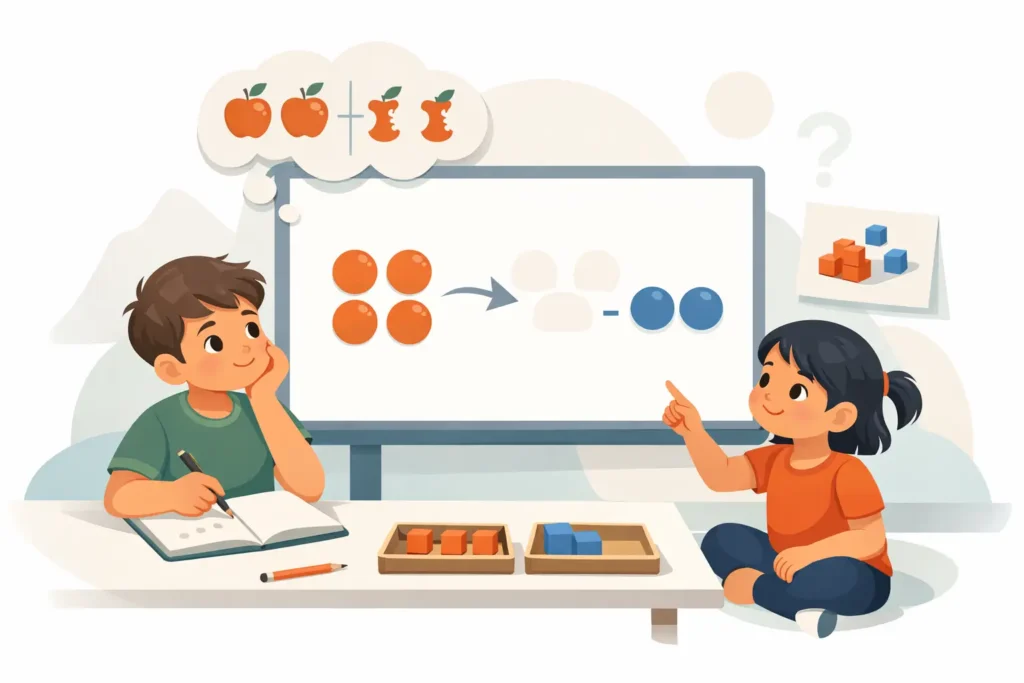
Many pre-K children can solve simple take-away problems with objects. For example, they may start with five counters, remove two, and count what remains. They are still relying heavily on hands-on support, which is exactly what they should be doing.
Ages 5 to 6
In kindergarten, children often begin connecting stories and objects to number sentences. They may solve problems such as 6 – 2 using fingers, drawings, or manipulatives. Some children also begin learning that subtraction can mean finding how many are left or figuring out the difference between two amounts.
Ages 6 to 7
By first grade, many children become more comfortable with subtraction facts within 10 and then within 20. They may use strategies such as counting back, using a number line, or thinking about related addition facts. This is also when written subtraction starts becoming more common.
Why some kids struggle with subtraction
Subtraction can feel harder than addition for many children, even when they seem confident with counting. One reason is that subtraction is less visible. Adding is exciting because more appears. Subtracting asks a child to imagine something disappearing or being removed.
Working memory can also play a role. A child may understand the idea of taking away but forget the starting number, the amount removed, or the question being asked. This is especially common in young learners.
Some children also rush into abstract problems before they are ready. If a child is asked to solve equations on paper without first using blocks, buttons, or drawings, subtraction may seem random instead of logical.
There is also a difference between understanding subtraction and recalling subtraction facts quickly. A child may fully understand 8 – 3 but still need time to count it out. That is not failure. It simply means fluency is still developing.
How to teach subtraction in a way that makes sense
The best way to teach subtraction is to move from real objects to pictures to numbers. This helps children connect the idea to the symbol instead of memorizing a rule they do not yet understand.
Start with everyday moments. At snack time, put five crackers on a plate and eat one. Ask, “How many are left?” During cleanup, line up four stuffed animals and put one away. Then ask what changed. These small math conversations build real understanding.
Once your child is comfortable with objects, try drawing simple subtraction stories. Draw six balloons, cross out two, and count what remains. Pictures help children see the action of subtraction without needing physical materials every time.
After that, connect the picture to the number sentence. Show that six balloons take away two balloons can also be written as 6 – 2 = 4. This progression helps the symbols feel meaningful.
If your child enjoys movement, subtraction can become active play. Hop backward on a number line made of sidewalk chalk. Start with 7 jumps and take away 3. Physical learning often helps young children hold onto new ideas.
Simple subtraction activities for home or the classroom
You do not need fancy materials to practice subtraction well. In fact, the simplest activities are often the most effective.
Use small toys, blocks, pom-poms, or snack pieces for take-away games. Read simple math story problems aloud and let children act them out. Play board games that involve moving backward. Sing songs such as “Five Little Ducks” or “Five Green and Speckled Frogs,” since these naturally build subtraction language.
You can also make subtraction part of routines. Ask questions like, “You had three markers and gave one to your brother. How many do you have now?” or “There were five kids at the table and two went to wash hands. How many are still sitting?”
If your child likes printables, simple kindergarten math worksheets can be helpful after hands-on practice, not before it. The goal is to reinforce understanding, not replace it.
When to be patient and when to look closer
It is completely normal for subtraction to take time. Young children often understand a concept one day and seem to forget it the next. That back-and-forth pattern is part of learning, especially in early math.
Patience is usually the right response if your child can solve problems with objects but struggles with mental math, or if they need repeated practice with the same types of problems. Consistency matters more than speed.
You may want to look more closely if your child has ongoing difficulty counting objects accurately, cannot tell which group has more or less, or seems unable to connect numbers with actual quantities. In those cases, stepping back to foundational number sense is often more helpful than pushing forward with harder subtraction.
For children who become frustrated easily, keep practice short and playful. Five minutes of confident success is better than twenty minutes of tears. Learning sticks best when children feel capable.
A helpful way to think about when kids learn subtraction
Instead of asking whether your child has learned subtraction yet, it can help to ask which part of subtraction they are learning right now. Are they noticing fewer? Acting out take-away stories? Solving with objects? Using pictures? Writing equations? Each step counts.
That perspective takes pressure off both you and your child. It also makes it easier to choose the right next activity instead of expecting mastery all at once. At Kids Learning Journey, that is the heart of early learning support – meeting children where they are and helping them grow with simple, engaging practice.
Subtraction usually begins earlier than parents expect, but it also takes longer to fully develop than many realize. If your child is exploring numbers through play, asking questions, and slowly making sense of what happens when things are taken away, they are already on the right path.