A child proudly writes, “I lik cat,” on a piece of paper, and suddenly you are wondering: when do children write sentences, and what should that look like at different ages? The short answer is that many children begin writing simple sentence-like ideas in kindergarten or first grade, but the path starts much earlier with drawing, scribbling, letter practice, and invented spelling.
Writing development is rarely a straight line. One child may dictate rich stories before writing a single readable sentence. Another may neatly copy a sentence but struggle to come up with one independently. That is why it helps to look at sentence writing as a gradual process instead of one big milestone.
When do children write sentences in typical development?
Most children begin to write simple sentences between ages 5 and 7. For many kids, this starts in kindergarten with short, highly supported sentences such as “I see a dog” or “I like mom.” By first grade, children often begin writing their own simple thoughts with a capital letter, spaces, and an ending mark, even if spelling is still developing.
Before that stage, preschoolers are usually building the foundation. They may draw a picture and explain it out loud, scribble in lines that look like writing, recognize some letters, and write their name or a few familiar words. Those early behaviors matter because sentence writing depends on many smaller skills working together.
A child has to think of an idea, hold the words in mind, hear sounds in words, connect sounds to letters, form those letters, and understand that print carries meaning. That is a lot for a young learner. So if your child is not yet writing full sentences at age 4, that is usually not a sign of a problem. It often just means the foundation is still being built.
The early skills that come before sentence writing
Sentence writing begins long before a child writes an actual sentence on paper. Oral language is one of the biggest pieces. Children need to speak in sentences before they can usually write them. When kids tell you about their day, describe a picture, or retell a story, they are practicing the language structure that later shows up in writing.
Fine motor development also plays a role. If holding a pencil feels tiring or awkward, a child may have great ideas but avoid writing them down. That is why coloring, tracing, playdough, cutting, and simple hand-strength activities can support writing more than many parents realize.
Phonemic awareness is another major building block. Children need to hear that cat has sounds they can stretch out and write. They also need alphabet knowledge so they can match those sounds to letters. This is why early reading and early writing grow together. The more children notice letters and sounds in books, songs, and games, the more prepared they are to write words and then sentences.
What sentence writing looks like by age and stage
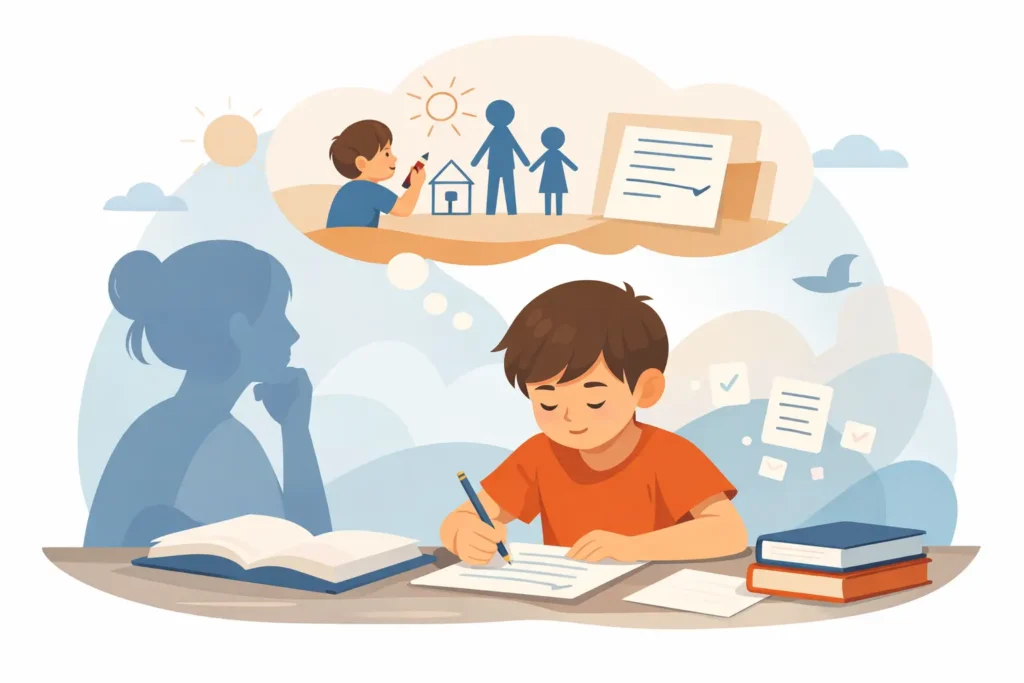
In preschool, sentence writing is often more about pretend writing and dictation than correct written sentences. A child may draw a family picture and say, “We went to the park,” while making wavy lines underneath. That still counts as meaningful early writing behavior.
By pre-K or transitional kindergarten, some children begin writing letter strings, familiar words, or labels for pictures. You might see “MOM” or “DOG” or a row of letters that shows they understand print goes from left to right. Some children may copy a very short sentence with adult help.
In kindergarten, many children begin writing simple sentences using a predictable pattern. They may write “I like cake” or “I can run.” Spelling is often phonetic, so “cake” might become “cak.” That is developmentally normal. What matters most at this stage is that the child is connecting sounds to print and expressing a complete thought.
In first grade, sentence writing usually becomes more independent. Children often write multiple simple sentences on one topic. They start using capitals, spaces, and periods more consistently, though not perfectly. Some begin adding details and using words like and, because, or but.
By second grade, many children can write clearer, longer sentences and short paragraphs. Their spelling, punctuation, and sentence variety usually improve, but they still benefit from support and modeling.
Why some children start earlier or later
There is a normal range for writing development, and it can be wider than many adults expect. Some children are eager writers early on because they love letters, stories, or drawing. Others need more time because handwriting feels hard, language development is still growing, or they are more comfortable speaking than writing.
Exposure matters too. Children who are read to often, invited to draw and label pictures, and given playful opportunities to use letters may be more ready to write sentences earlier. That does not mean a later writer is behind in every case. It may simply mean they need more guided practice.
Temperament can also affect progress. A perfectionist child may avoid writing because they do not want to make mistakes. Another child may happily write a page of inventive spelling without worrying whether adults can read it. Both children are learning, just in different ways.
Signs your child is getting ready to write sentences
You may notice readiness before you see a full sentence on paper. A child who can tell you a complete idea, hear beginning sounds in words, write some letters, and leave spaces between words is moving in the right direction.
Another encouraging sign is when children want to write for a purpose. They might make a pretend grocery list, label a drawing, write a card, or copy a sentence from a book. Motivation matters. Kids are more willing to stretch into sentence writing when it feels meaningful.
If your child writes something like “I lv mi dg,” that is also progress. It shows they understand that spoken language can be broken into words and written down. The spelling may not be standard yet, but the thinking is exactly what early writers need.
How to help children write sentences without pushing too hard
The best support is a mix of structure, encouragement, and realistic expectations. Start by helping children say a sentence out loud before writing it. If they can speak the sentence clearly, writing it becomes more manageable.
Next, keep the sentence short. A child who has a lot to say may need help shrinking “Yesterday I went to Grandma’s house and we baked cookies and my cousin came too” into “I baked cookies.” Success builds confidence.
Modeling helps a lot. You can say, “Let’s think of a sentence about your picture. How about, ‘I see a red truck’?” Then count the words together and help your child write one word at a time. This kind of guided practice works well at home and in the classroom.
It also helps to accept invented spelling in the early stages. If a child writes “I lik mi cat,” they are doing important sound work. You can gently model the correct spelling later without making every writing moment feel like a correction session.
Simple activities that encourage sentence writing
Children do not need long writing lessons to build this skill. A few focused, playful routines can make a big difference.
Picture prompts work especially well. Show a child a simple image and ask, “What is happening here?” Then help them turn that idea into one sentence. Journals are another strong option because they give children a regular reason to draw and write.
Sentence starters can reduce frustration. Phrases like “I see,” “I like,” “My favorite,” and “Today I” give children a clear place to begin. Over time, they rely less on the starter and generate more of the sentence on their own.
Hands-on learning supports writing too. After a nature walk, a child might write “I found a leaf.” After building with blocks, they might write “I made a tower.” Real experiences make sentence writing feel easier because the child has something concrete to say.
For families using printable learning tools, simple phonics practice, handwriting pages, and beginner writing prompts can all support sentence development. At Kids Learning Journey, that kind of structured practice fits best when it stays short, encouraging, and tied to what children can already do.
When to look more closely at writing struggles
Some variation is normal, but a few signs may suggest a child needs extra support. If a child is well into first grade and cannot write any recognizable words, strongly resists all writing tasks, or seems unable to connect sounds and letters even with practice, it may be worth talking with their teacher.
You may also want to ask questions if handwriting is extremely difficult, letter formation is unusually hard to learn, or your child can say strong sentences out loud but cannot get even a few words onto paper. Sometimes the challenge is literacy-related. Other times it involves fine motor skills, attention, or confidence.
Early support can make writing feel less frustrating. It does not always mean there is a serious problem. Often, children simply need targeted practice in one part of the process.
If you are wondering whether your child is on track, try this simple lens: look for growth, not perfection. A child who moves from scribbles to letters, from letters to words, and from words to short sentences is making meaningful progress. Keep the writing experiences positive, give plenty of chances to talk, read, and draw, and trust that sentence writing usually grows best when children feel capable enough to try.