A child hands you a paper covered in loops, zigzags, and a few scattered letters and proudly says, “I wrote a story.” That moment is bigger than it looks. If you are wondering how to start emergent writing, the good news is that it does not begin with perfect handwriting or correct spelling. It begins when children realize that marks on a page can carry meaning.
Emergent writing is the early stage of writing development, usually seen in preschool, pre-K, and kindergarten. At this stage, children may draw pictures, make scribbles, write letter-like shapes, copy familiar letters, or use a few real letters to stand for words. All of these are valid starting points. They show that a child is learning that writing is a way to communicate.
For parents and teachers, this stage can feel a little confusing because it does not always look like “real writing” yet. But it matters deeply. Emergent writing builds the foundation for reading, spelling, fine motor control, and confidence. When children are encouraged early, they begin to see themselves as writers long before they can write a full sentence on their own.
What emergent writing really looks like
Emergent writing is often messy, playful, and full of experimentation. A child might draw a family picture and add a row of random letters underneath. Another child may write the first letter of their name over and over. Some children mix drawing and writing together because, developmentally, those skills are closely connected.
This is normal. Young children are not trying to produce polished work. They are testing ideas. They are learning that spoken words can be represented in print, that letters have shapes, and that writing moves in patterns. In English, that usually means left to right and top to bottom, though children learn this gradually.
It also helps to know that emergent writing does not move in a straight line. A child may write recognizable letters one day and return to scribbles the next. That does not mean progress has stopped. It usually means they are still practicing several skills at once.
How to start emergent writing without pressure
The best way to begin is to make writing part of everyday life. Young children respond well when writing feels useful, playful, and low-stress. If writing only appears during formal lessons, some children will resist it. If it shows up during pretend play, storytelling, and daily routines, they are more likely to join in naturally.
Start by giving your child easy access to writing tools. Keep crayons, markers, short pencils, chalk, and paper where they can be reached without a big setup. Clipboards, sticky notes, small notebooks, and blank cards can make writing feel special. Some children prefer vertical surfaces like an easel or a paper taped to the wall because it is easier for their hand muscles.
Then, let your child see writing in action. Write a grocery list, label a drawing, leave a simple note, or make a sign for a pretend store. When children watch adults use writing for real reasons, they begin to understand its purpose.
Simple ways to encourage emergent writing
If you are looking for practical ways to start, focus on short, repeatable activities that fit into the day.
Invite your child to “sign in” by writing their name when they start an activity. Ask them to make a birthday card for a family member. During pretend play, offer paper for menus, tickets, recipes, or doctor notes. After reading a story, ask if they want to draw their favorite part and “write” about it.
These small invitations work because they connect writing to meaning. A worksheet can help with letter practice, but meaningful writing builds motivation. Ideally, children need both. Structured activities support skill development, while open-ended writing helps them understand why writing matters.
You can also make writing part of play-based learning. A child building a zoo with blocks can create animal signs. A child playing school can make an attendance sheet. A child pretending to be a chef can write an order pad full of scribbles and favorite food letters. None of this has to be corrected to be valuable.
How to support emergent writing skills step by step
When adults hear “writing,” they often think first about pencil grip or letter formation. Those skills matter, but emergent writing includes much more.
Children need strong oral language so they have ideas to express. They need fine motor practice so their hands can control tools. They need alphabet knowledge so letters begin to feel familiar. They also need phonological awareness so they can start hearing sounds in words.
That means a strong emergent writing routine may include storytelling, songs, rhyming games, name practice, tracing, drawing, and free writing time. A child who is not ready to write many letters may still be building writing readiness through play dough, tweezers, painting, and finger tracing in الرمل or shaving cream.
One helpful approach is to respond to the message before the mechanics. If your child shows you a page and says, “This says I went to the park,” begin with interest. You might say, “You wrote about the park. Tell me more.” This shows that their ideas matter. Later, you can gently support skill growth by pointing out a letter they used or helping them hear the first sound in a word.
How much help is too much?
This is where many caring adults get stuck. They want to help, but they do not want to take over.
A good rule is to support without controlling. If a child asks how to write “mom,” you can slowly say the word and emphasize the first sound. If they write just M, that is a meaningful success. If you insist that they copy the whole word perfectly, the task can quickly become about pleasing the adult instead of learning.
The same goes for spelling. Early invented spelling is a healthy part of development. When children write “KT” for cat or “MI DG” for my dog, they are showing that they hear sounds and are trying to map them to letters. That is a strong early literacy sign, not a mistake to shut down.
Of course, there is a balance. Children also benefit from seeing correct print. You can model proper spelling in a natural way by writing their dictated sentence underneath their work or by making labels during shared writing time. This gives them a reference without sending the message that their attempt was wrong.
A simple routine for emergent writing at home or in class
If you want a starting point, keep it predictable and brief. Ten to fifteen minutes is enough for many young children.
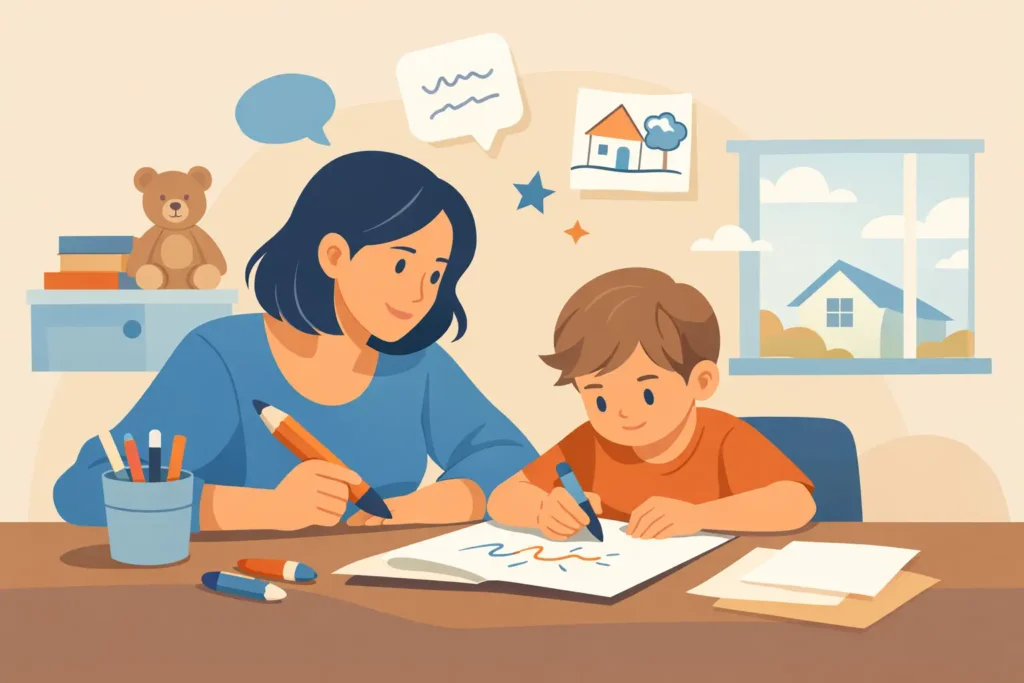
Begin with conversation. Ask a simple prompt such as, “What did you build today?” or “What was your favorite part of our walk?” Then let the child draw first if needed. Drawing often helps children organize their thoughts before writing.
Next, invite them to add writing. Depending on their stage, that may be scribbles, a name, a few letters, or a sound-based attempt at words. Stay encouraging and curious. If they are unsure how to begin, suggest writing the first sound they hear.
Finish by having them read their writing back to you. This step is powerful. It reinforces that writing carries meaning, even when the marks are not conventional yet.
At Kids Learning Journey, this kind of simple structure fits well with the bigger goal of making early literacy feel manageable and meaningful for families.
Signs your child is making progress
Progress in emergent writing does not always show up as neat handwriting. More often, it appears in small shifts. A child may start using symbols in a more organized way. They may recognize letters in their name, write left to right more often, or begin connecting sounds to letters. They may also stay with writing activities longer and show more pride in their work.
Confidence is part of progress too. A child who once avoided writing may begin choosing to make signs, cards, or pretend notes during play. That growing willingness matters because motivation drives practice.
If progress feels slow, try not to compare one child to another. Age, temperament, fine motor development, and exposure all play a role. Some children eagerly write early but need more time with reading skills. Others become strong readers first and warm up to writing later.
When to be concerned
There is a wide range of normal in early writing. Still, if a child consistently avoids all mark-making, struggles greatly with hand control, or shows frustration far beyond what seems typical, it may help to look more closely. Vision issues, fine motor delays, and language challenges can affect writing development.
That does not mean something is wrong, only that extra support may be useful. A pediatrician, teacher, or occupational therapist can help if concerns continue over time.
What matters most at the start is not perfect letters. It is helping a child believe, “My ideas can go on paper.” Once that belief takes hold, skills have something strong to grow on. Keep paper nearby, make room for messy attempts, and treat those early scribbles like the beginning they are.