
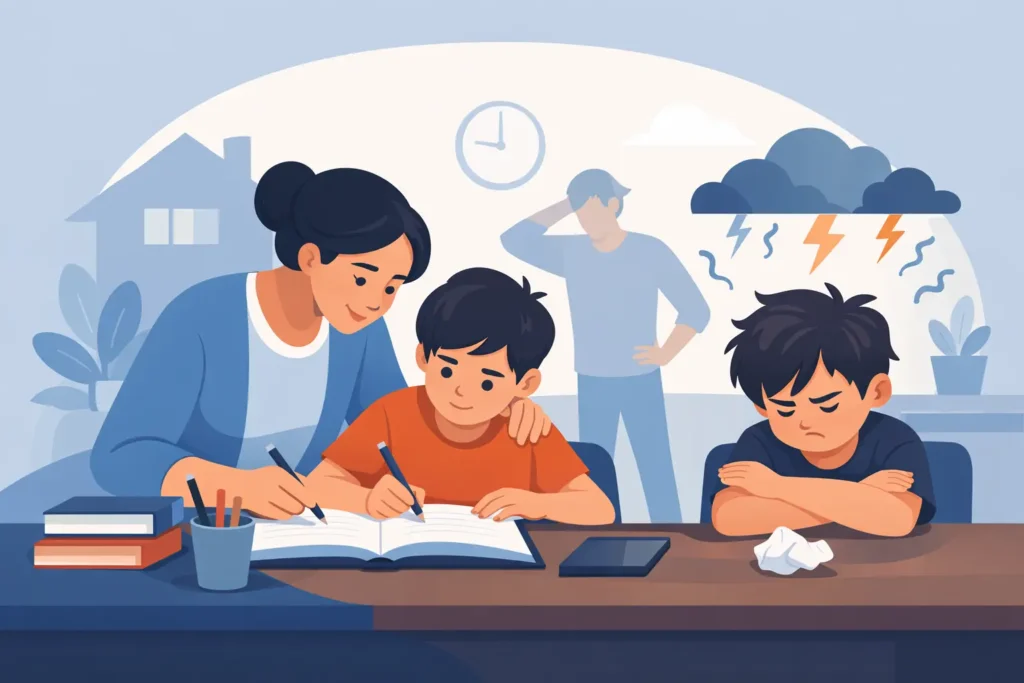
Some afternoons seem to fall apart the minute the homework folder hits the table. A child is tired, a parent is stretched thin, and a simple worksheet suddenly turns into tears, stalling, or an argument. If you are wondering how to reduce homework battles, the good news is that the problem usually is not laziness or defiance. More often, it is a mismatch between what the child needs and how homework time is set up.
For young children especially, homework can feel big at the end of a long day. They may need movement, food, reassurance, or clearer expectations before they can focus. When parents shift from trying to control the moment to creating a calm, predictable structure, homework often becomes much more manageable.
Why homework battles happen in the first place
Homework struggles rarely start with the assignment itself. In many homes, the real issue is timing, energy, or frustration tolerance. A preschooler or early elementary child may have already spent hours following directions, waiting their turn, and working hard at school. By late afternoon, their ability to handle one more task is often lower than adults expect.
Sometimes the work is also not a great developmental fit. A child who is still building handwriting stamina may resist writing tasks. A child who is learning to read may panic when directions feel confusing. Others simply do not know how to begin, so they avoid the whole task instead.
This is why it helps to look beyond behavior. A child who complains, wiggles, or shuts down may actually be communicating, “This feels too hard,” “I am tired,” or “I do not know what to do first.” That shift in perspective can change everything.
How to reduce homework battles with a better routine
A steady routine is one of the most effective ways to lower stress. Children do better when they know what happens first, what comes next, and when the task will end. Homework should not feel like a surprise attack every evening.
Start by choosing a regular homework window. For some children, that is right after a snack and short break. For others, especially younger kids, a little outdoor play first works better. It depends on the child. If your child melts down the moment they get home, do not assume they are avoiding work. They may simply need to reset.
Keep the routine simple and repeatable. A child might come home, wash hands, eat a snack, play for 20 minutes, then sit down for homework. The order matters less than the consistency. Predictability helps reduce pushback because children are not constantly negotiating what happens next.
A visual routine can also help younger learners. When children can see the steps, they are less likely to argue about them. It turns homework time into a known part of the day rather than a power struggle.
Choose a homework spot that supports focus
The best homework space is not always a perfectly decorated study corner. It is the place where your child can concentrate with the fewest distractions. For some children, that is the kitchen table near a parent. For others, it is a quiet desk with minimal noise.
Try to keep supplies nearby so homework does not get interrupted by constant searching for pencils, erasers, scissors, or crayons. Small interruptions can stretch a ten-minute assignment into a thirty-minute conflict.
It also helps to think about sensory needs. Some children focus better sitting upright at a table. Others may benefit from a footrest, a wiggle cushion, or a short standing break between tasks. If a child constantly leaves their seat, it may be a sign they need movement, not stricter correction.
Use connection before correction
When a child resists homework, many adults understandably jump straight into instructions. Sit down. Start now. Stop complaining. But young children often respond better when connection comes first.
Before homework begins, take a minute to check in. You might say, “You look tired today,” or “Let us look at this together.” That kind of calm opening lowers defensiveness. It tells your child that homework is something you will handle with them, not something being done to them.
This does not mean making homework optional whenever a child protests. It means leading with empathy while still holding a clear boundary. A warm tone can carry a firm expectation much more effectively than repeated warnings.
Watch your language during hard moments
The goal is to keep communication clear and steady. Long lectures usually do not help a frustrated six-year-old. Short, supportive prompts work better. Try language like, “Let us do the first one together,” “Show me the part that feels tricky,” or “You only need to finish these two lines before your break.”
Praise effort in a specific way. Instead of saying only, “Good job,” try, “You kept going even when that word was hard,” or, “You started faster today.” That helps children notice the habits that matter.
Break homework into smaller pieces
One major reason battles grow is that the work feels endless. Even if the assignment is objectively short, a young child may not experience it that way. Breaking homework into smaller parts can make it feel more possible.
Cover part of the page if there are too many problems visible at once. Ask your child to complete three math questions, then pause. Read one sentence at a time rather than the whole passage. Small chunks reduce overwhelm and create more opportunities for success.
This is especially important for children who are still developing attention, reading confidence, or fine motor skills. A worksheet that looks easy to an adult may still require a lot of mental effort from a child.
Build in short breaks on purpose
Breaks are not a reward for bad behavior. They are a tool that helps many children stay regulated and complete their work. A two-minute movement break, drink of water, or stretch between tasks can prevent a bigger meltdown later.
The key is to make breaks brief and predictable. If a child leaves for an open-ended play session, it may be hard to return. But if they know they get a quick break after one section, they are often more willing to begin.
Make sure the support matches the child
Some homework battles happen because adults give too much help, and some happen because they give too little. Young children need support, but they also need room to build independence.
If you sit beside your child and correct every mistake immediately, homework may start to feel tense or high-pressure. If you send them off alone when they cannot yet read directions independently, they may feel lost. The right balance depends on age, skill level, and confidence.
Start by asking what kind of help is actually needed. Does your child need you to read directions out loud? Help them get started? Stay nearby but not hover? This kind of adjustment can reduce friction quickly.
When homework regularly seems too difficult, it is worth paying attention. Ongoing tears, extreme frustration, or complete shutdown may signal that a child needs more support at school or a conversation with the teacher. Not every struggle should be solved at the kitchen table.
Keep homework from taking over family life
For early learners, homework should support learning, not consume the evening. If assignments are consistently dragging on because of battles, perfectionism, or repeated redoing, the family may need a reset.
Set a calm tone around doing your best rather than doing everything flawlessly. Messy handwriting, slow reading, and simple mistakes are part of learning. When children feel that every assignment must be perfect, resistance often grows.
It can also help to protect time for play, rest, and connection. Children learn well when their lives include balance. A child who knows homework has a clear beginning and end is less likely to treat it like an endless punishment.
For some families, adding a playful element makes a difference. A simple timer challenge, sticker chart for smooth starts, or a fun pencil choice can help. The goal is not to bribe children through every assignment. It is to make the routine lighter and more encouraging.
When homework battles keep happening
If you have tried routines, breaks, and calmer communication and homework is still a daily fight, look for patterns. Does the struggle happen only with reading? Only on certain days? Only when your child is hungry or overtired? Patterns point to solutions.
It is also okay to adjust expectations. A kindergartener or first grader may not be able to sit and work for long stretches after school. Shorter sessions, more parent support, or a conversation with the teacher may be the most helpful next step.
At Kids Learning Journey, we believe learning works best when it feels structured, supportive, and approachable. Homework time should help a child practice skills, not make them feel defeated.
Reducing homework battles usually does not come from one perfect trick. It comes from noticing what your child is struggling with, then building a routine that feels calmer, clearer, and easier to stick with. A peaceful homework habit can start with something very small tonight – a snack first, a gentler opening, or just doing the first problem together.