A lot can hinge on one small question: should your child learn at the kitchen table or in a kindergarten classroom? When parents compare homeschool vs classroom kindergarten, they are usually not looking for a perfect answer. They are trying to find the setting where their child will feel safe, ready to learn, and supported day by day.
That is why this choice can feel emotional. One child may thrive with a predictable class routine, group activities, and a teacher-led day. Another may do better with slower mornings, one-on-one support, and lessons tailored to their pace. The best choice is not the one that sounds ideal on paper. It is the one that fits your child and your family in real life.
Homeschool vs classroom kindergarten: what really changes?
At this age, kindergarten is about much more than academics. Children are building early reading and math skills, but they are also learning how to follow directions, manage emotions, wait their turn, solve simple problems, and keep trying when something feels hard.
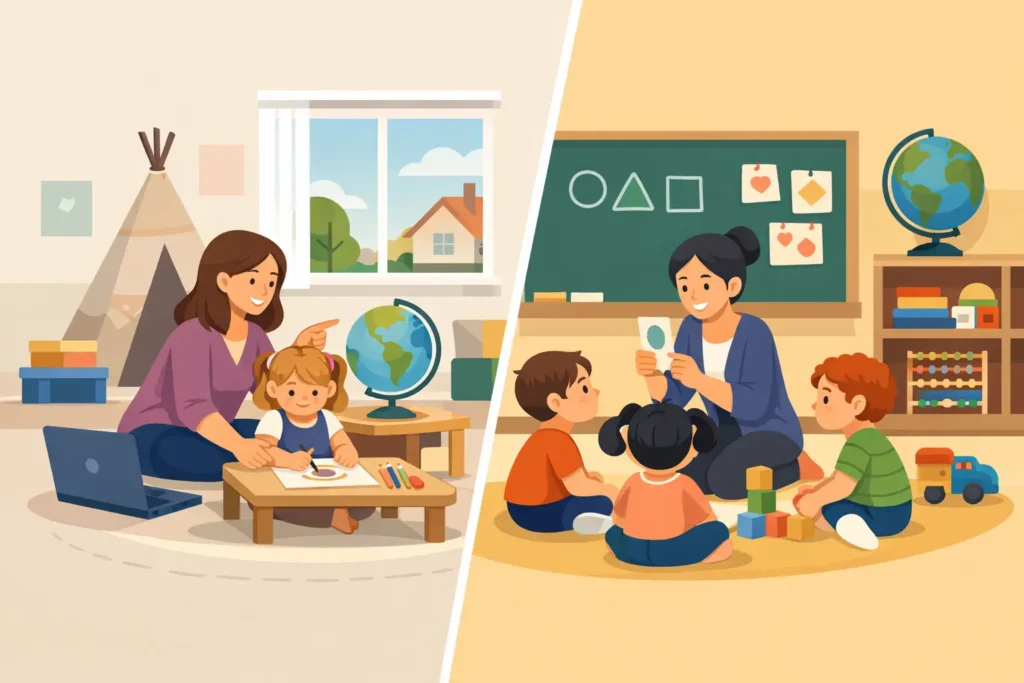
In a classroom kindergarten, those skills are often practiced in a group setting. Children learn to line up, share materials, listen during circle time, and move through a structured school day. There is a built-in rhythm, and that can be helpful for kids who do well with routine and clear expectations.
In homeschool kindergarten, the setting is usually more flexible and personal. A parent can spend extra time on letter sounds, handwriting, counting, or social-emotional learning without the pressure of keeping up with a full class. Lessons can be shorter, breaks can happen when needed, and learning can be woven into everyday life.
Neither option automatically leads to better results. The difference often comes down to how the environment matches a child’s needs and how consistently the adults can support learning.
Academic learning looks different in each setting
Parents sometimes worry that homeschooling means taking on the role of a full-time teacher with a complete school setup at home. In kindergarten, that is usually not necessary. Young children learn best through short, focused lessons, play, repetition, read-alouds, hands-on practice, and conversation.
Homeschooling can make it easier to slow down and build strong foundations. If your child needs extra work on phonics, number recognition, pencil grip, or listening skills, you can adjust right away. If they master a concept quickly, you can move forward without waiting. That personalized pace is one of the biggest strengths of homeschool kindergarten.
Classroom kindergarten has different advantages. A trained teacher often has experience spotting learning patterns, supporting early skill development, and managing a wide range of abilities. Schools may also provide access to literacy programs, classroom materials, specialist support, and enrichment activities that would be harder to recreate at home.
The trade-off is pace. In a classroom, the teacher has to balance the needs of many children at once. Some children are ready for more challenge, while others need more repetition than the schedule allows. In homeschool, that pace can be individualized, but the parent has to plan, teach, and keep things moving.
Social development is not one-size-fits-all
Socialization is often the first concern people raise in the homeschool vs classroom kindergarten conversation. It matters, but not in the oversimplified way it is sometimes presented.
Classroom kindergarten offers daily peer interaction built into the school day. Children practice sharing space, making friends, handling disappointment, and participating in group routines. For many kids, that steady exposure helps them develop confidence and classroom readiness.
Homeschool kindergarten can support social growth too, but it usually requires more intentional planning. Playdates, library programs, co-ops, sports, church groups, neighborhood time, and community classes can all provide social practice. The difference is that these experiences are chosen and scheduled rather than automatically built into each weekday.
It also helps to remember that not all social experiences are equally helpful. A child who is shy, easily overwhelmed, or still learning emotional regulation may not immediately benefit from a large, busy classroom. Some children become more socially confident after spending time in a calmer home-learning environment first.
On the other hand, a child who craves group play and learns by watching peers may feel energized in a classroom. The question is not just, Will my child be around other children? It is, In what setting will my child practice social skills most successfully?
Your family’s daily life matters more than people admit
This decision is not only about educational philosophy. It is also about logistics, energy, finances, and time.
Homeschool kindergarten usually asks more from the parent during the day. Even if formal lessons only take a small portion of the morning, planning, organizing materials, supervising activities, and staying consistent require real effort. For some families, that is a joyful fit. For others, especially those balancing work schedules, multiple children, or limited support, it can become stressful.
Classroom kindergarten may provide more daily structure for the whole family. There is a set schedule, and the responsibility for instruction is shared with the school. That can bring relief, especially if parents need dependable childcare during school hours or feel stretched thin already.
Cost can also look different than expected. Public kindergarten may seem like the less expensive option, but families may still spend money on transportation, supplies, lunch, clothing, fundraisers, and after-school care. Homeschooling can be very affordable, especially in kindergarten, but curriculum, printables, books, manipulatives, field trips, and outside activities can add up if you are not careful.
There is no shame in letting practical reality shape your choice. A learning plan only works if your family can actually sustain it.
How to tell which option fits your child
Start by looking at your child as they are right now, not who you hope they will become by fall. Some children need movement, extra time, and close guidance. Some are eager for independence and group routines. Some are academically ready for structured learning but emotionally not quite ready for a full classroom day.
It can help to think through a few areas. How does your child handle transitions? Do they warm up easily in new environments? Can they follow multi-step directions? Do they enjoy learning with other children, or do they shut down in busy settings? Are they energized by routine or calmer with flexibility?
You should also consider your own strengths. Are you comfortable leading early learning at home? Can you create a simple routine and stick with it most days? Do you enjoy teaching foundational skills like letter sounds, counting, handwriting, and read-aloud comprehension? If not, would a classroom setting bring more peace to your family?
Sometimes the answer is clear. Sometimes it is not. In that case, think about whether your choice has to be permanent. For some families, homeschool kindergarten works beautifully for one year before transitioning into school. For others, classroom kindergarten is the right start, with plenty of home support in the afternoons.
A strong kindergarten experience matters more than the label
Whether learning happens at home or in school, most children benefit from the same core ingredients: read-aloud time, early phonics instruction, playful math practice, fine motor work, emotional coaching, conversation, and a predictable rhythm.
A strong homeschool kindergarten day might include story time on the couch, alphabet tracing, counting with manipulatives, outdoor play, and simple crafts that build hand strength. A strong classroom experience might include morning meeting, center time, shared reading, small-group instruction, and structured social practice. The setting is different, but the developmental goals are often very similar.
That is good news for parents because it means the choice is not between a good path and a bad one. It is between two workable paths with different strengths.
If you homeschool, structure and consistency will matter. If your child attends classroom kindergarten, home support still matters just as much. Skills like phonics, handwriting, number sense, and emotional regulation grow best when children see learning reinforced in everyday life. That is where simple routines and beginner-friendly resources can make a big difference, and it is why brands like Kids Learning Journey focus on making foundational practice easier for families.
When your child may do better in one setting
Some children tend to do especially well in homeschool kindergarten. This often includes children who are highly sensitive, not quite ready for a full school day, advanced in some skills but behind in others, or easily distracted in large groups. The ability to personalize instruction can help them build confidence without unnecessary pressure.
Some children tend to do especially well in classroom kindergarten. This often includes children who enjoy group interaction, adapt well to routines, and are motivated by classroom energy and teacher guidance. For them, the social and academic structure can create momentum.
Still, these are patterns, not rules. Children surprise us. A cautious child may blossom in school with a skilled teacher. An outgoing child may still need the slower pace of home.
The most helpful question is simple: where is my child most likely to grow steadily, not perfectly? That mindset leaves room for adjustment, support, and grace.
If you are feeling torn, trust that thoughtful parents often are. Kindergarten is a beginning, not a final verdict on your child’s future. Choose the setting that lets your child feel secure, curious, and ready to learn, then build from there with patience and consistency.