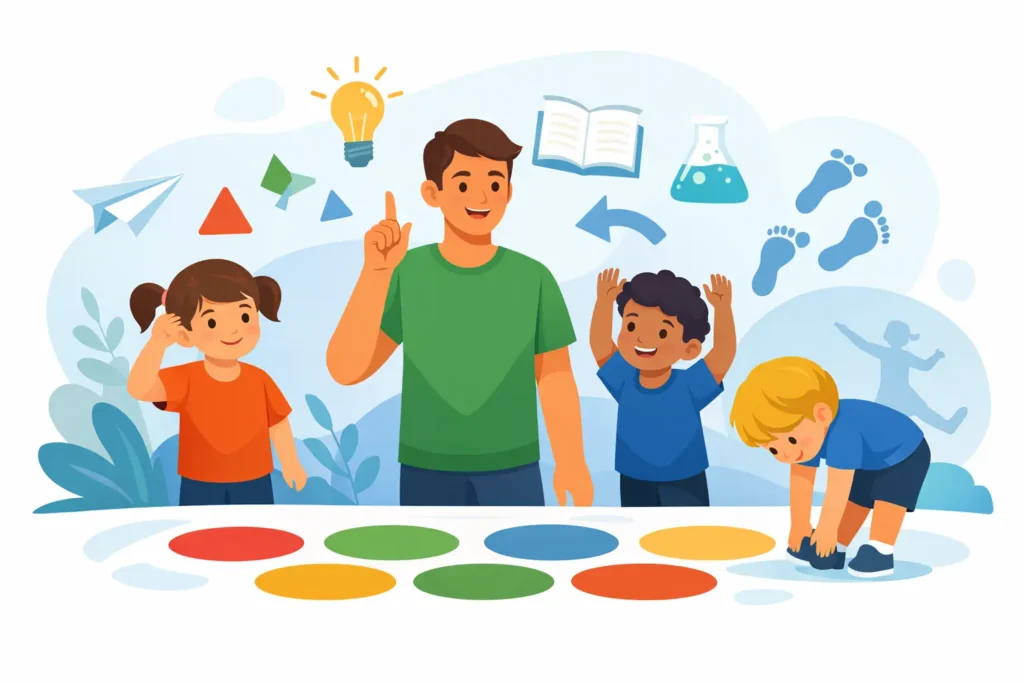
Need a no-prep activity that gets kids moving and listening at the same time? Games for kids Simon’s says are a favorite for a reason. This simple classic helps young children practice self-control, follow directions, build body awareness, and even reinforce early academic skills – all while feeling like pure fun.
For parents and teachers, that combination matters. Many children need movement to stay engaged, but they also need practice with listening carefully and slowing down before they act. Simon Says does both. It works well at home on a rainy afternoon, during circle time, as a brain break, or as a quick transition activity when energy starts to climb.
Why Simon Says works so well for young children
Simon Says is more than a party game. It supports several school-readiness skills in a very natural way. Children have to listen for key words, remember the rule, and control the impulse to move too quickly. That kind of pause-and-think practice strengthens executive functioning, which is a big part of early learning.
It also gives children a chance to connect language with action. When you say, “Simon says touch your shoulders,” kids hear the body part, process the direction, and respond physically. That helps build vocabulary and comprehension in a way that feels active instead of formal.
Another reason this game works is that it is easy to adjust. Preschoolers can follow simple one-step directions, while kindergarten and early elementary children can handle more detailed commands. You can make it silly, calm, educational, or energetic depending on what your child or class needs.
How to play Simon Says with kids
The basic rule is simple. One person is Simon and gives directions. Kids should only follow the direction if it begins with “Simon says.” If Simon gives a direction without saying that phrase first, players should stay still.
For younger children, keep the pace slow at first. Use clear actions like clap your hands, touch your nose, or stomp your feet. Once they understand the pattern, you can speed it up a little or add more variety.
If a child moves by mistake, you do not have to make them sit out. In many home and classroom settings, it works better to keep everyone in the game. A gentle reminder and a fresh round keeps the activity positive and avoids frustration, especially for younger learners.
Games for kids Simon Says with learning built in
One of the best things about this game is how easily it supports academic practice. You are not adding worksheets or turning play into pressure. You are simply weaving learning into movement.
Try body-part directions for vocabulary development. Use positional words like “put your hands over your head” or “stand behind your chair” to strengthen listening and direction-following. For early math, say things like “Simon says jump three times” or “Simon says make a triangle with your arms.” For literacy, you can ask children to make a letter shape with their body, tap out syllables, or move when they hear a word that rhymes.
In a classroom, this can be especially helpful during transitions. A quick round with colors, numbers, shapes, or beginning sounds reinforces concepts without feeling repetitive. At home, it is a great way to review skills your child is already practicing in preschool or kindergarten.
Fun Simon Says variations to keep it fresh
If kids start losing interest in the basic version, a small twist can make it feel brand new. Theme-based rounds usually work especially well.
Animal Simon Says is an easy favorite. Ask children to hop like a frog, waddle like a duck, or stretch like a cat. This supports pretend play and gross motor development. Emotion Simon Says can also be useful. Children can show a happy face, cross their arms like they are frustrated, or take a deep calming breath. That adds a gentle social-emotional learning piece.
You can also try classroom-friendly versions with quieter movements, such as blinking, tapping knees, shrugging shoulders, or whispering a color word. If you need an outdoor version, use bigger actions like running in place, tiptoeing to a spot, or reaching up high.
Tips for success with preschool and kindergarten ages
A few simple adjustments make Simon Says smoother for young children. Start with success. That means choosing easy, familiar directions before adding trickier ones. Children are more likely to stay engaged when they feel confident.
It also helps to model the game. Show a few examples before expecting kids to catch every rule on their own. Some children, especially younger preschoolers, need to see and hear the pattern several times.
Keep rounds short. Two to five minutes is often enough, especially for children with shorter attention spans. You can always come back to it later. If the group is getting overly excited, shift to calmer directions like sitting, stretching, breathing, or touching something blue in the room.
Most importantly, keep the tone light. The goal is learning through play, not catching mistakes. When adults stay encouraging, children are more willing to keep trying, even when impulse control is hard.
When Simon Says is especially useful
This game fits into everyday routines more easily than many parents expect. It can help fill the gap between activities, reset attention after screen time, or turn a restless moment into something productive. Teachers can use it before lessons, after recess, or during indoor movement breaks.
Because it needs no supplies, it is also one of those reliable activities worth keeping in your back pocket. At Kids Learning Journey, we love games like this because they support real developmental skills while still feeling simple enough to use any day of the week.
Sometimes the best learning activities are the ones children do not even realize are building important skills. Simon Says is a perfect example – playful, flexible, and full of meaningful practice.