If your child can sing the alphabet song but still guesses when you ask what sound ball starts with, that is completely normal. Letter names and letter sounds develop on different timelines, and printable beginning sounds activities can help bridge that gap in a way that feels clear, playful, and manageable for both kids and adults.
Beginning sounds are one of the first big building blocks in early reading. Before children can blend sounds into simple words, they need to hear that sun starts with /s/, pig starts with /p/, and moon starts with /m/. This is part of phonemic awareness and early phonics, and it matters because it helps children connect spoken language to printed letters.
For parents, homeschoolers, and teachers, the appeal of printables is simple. They take away some of the prep work while giving children repeated practice with a focused skill. That said, not every worksheet leads to strong learning. The best activities are short, visual, and interactive enough that children are listening for sounds instead of just circling random pictures.
Why beginning sounds can be tricky for young learners
Adults often hear sounds in words automatically, so it can be surprising when a child says that dog starts with d because they are naming the letter rather than hearing the sound, or when they confuse similar sounds like /b/ and /p/. Young children are doing several things at once. They are looking at a picture, retrieving the word, isolating the first sound, and then matching it to a letter.
That is a lot of mental work for preschoolers and kindergarteners.
This is why short practice sessions usually work better than longer ones. A child may understand beginning sounds well for five minutes and then lose accuracy once they get tired. It also helps to remember that some children struggle more with articulation, attention, or auditory discrimination. If a child says a sound differently in speech, that can affect how easily they identify it in print-based activities.
What makes printable beginning sounds activities effective
The strongest printables do more than ask children to mark an answer. They help children slow down and listen.
Picture support is a big part of this. Children need images that are easy to recognize right away. A clear picture of a cat, fish, or hat works better than a detailed drawing that leaves them guessing what the object is supposed to be. If the vocabulary is unfamiliar, the activity becomes more about naming than sound recognition.
It also helps when the page focuses on a small set of choices. Asking a child to choose between m, s, and t is often more productive than scanning the whole alphabet. Too many options can lead to guessing, especially for children who are still learning letter formation and visual recognition.
Finally, good printables invite participation. Coloring, matching, cutting, sorting, and saying the sound out loud all add value. The worksheet is not the lesson by itself. The conversation around it is what turns it into a learning experience.
Types of printable beginning sounds activities to use
Some printable beginning sounds activities are better for introducing the skill, while others are better for review. It helps to rotate formats so children stay engaged without feeling like they are doing the same page over and over.
Picture-to-letter matching
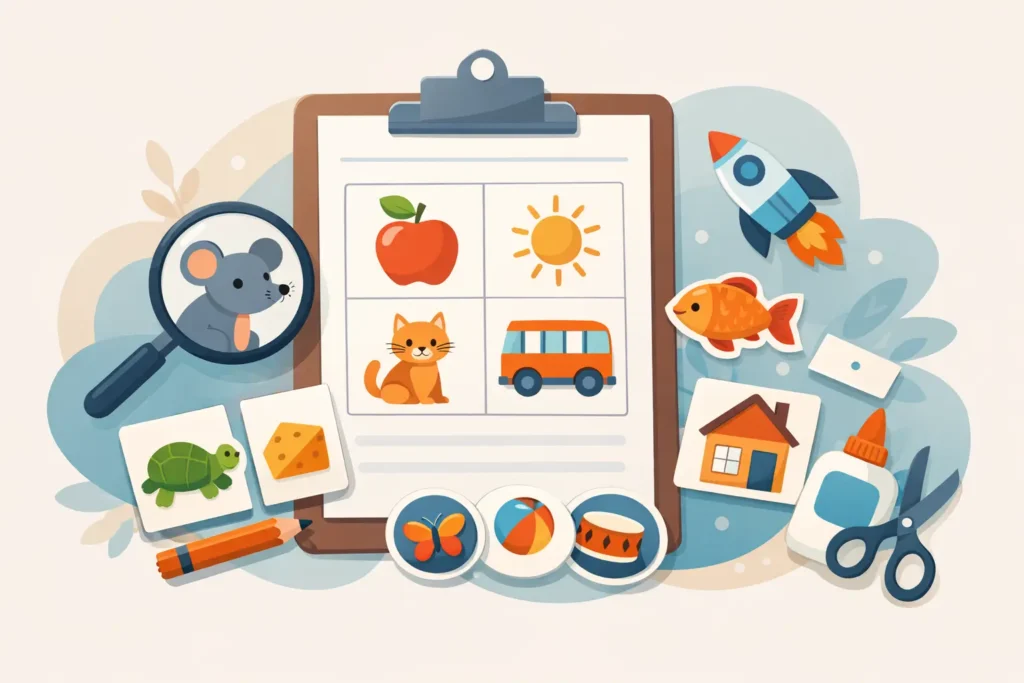
This is one of the easiest places to start. Children look at a picture and match it to the letter that makes the first sound. For example, they may draw a line from apple to A or from bus to B. This format works well for children who are still building confidence because it keeps the task simple and direct.
Cut-and-paste sorting
Sorting pictures by their beginning sound adds a hands-on element that many young learners enjoy. A child might cut out several pictures and glue them under the correct letter heading. This format slows children down in a good way. They have to say the word, hear the first sound, and make a decision before placing it.
Sound hunts and coloring pages
These are useful when you want practice to feel lighter. A child might color all the pictures that begin with s or circle the objects that start with m. Activities like this are especially helpful for review days, centers, or independent work, though they still work best with adult guidance nearby.
Beginning sound clip cards or mini cards
If your printable set includes cards instead of full worksheets, that can be a great option for repetition. Children can use clothespins, counters, or small manipulatives to mark the correct answer. This makes the activity feel more like a game, which is often helpful for children who resist pencil-and-paper work.
How to use beginning sounds printables without making them feel like busywork
A printable should support instruction, not replace it. Before handing your child a worksheet, say each picture name together. This quick step prevents confusion later. If the page has a picture of a mug and your child calls it a cup, you want to clear that up before asking for the beginning sound.
Next, model the task out loud. You might say, Mouse. /m/ /m/ mouse. Which letter says /m/? This kind of language teaches children how to think through the activity. Over time, many children begin to copy that process on their own.
Keep sessions short. One or two pages is usually enough for preschool or kindergarten practice. If your child is engaged and wants more, that is great. But stopping while they are still successful often leads to better progress than pushing through five pages just because they are printed.
It also helps to mix printable work with movement. After finishing a page with the letter S, go on a quick sound hunt around the room for sock, spoon, or sticker. When children connect the worksheet to real objects, the learning becomes more meaningful.
Printable beginning sounds activities at home vs. in the classroom
The same printable can work differently depending on the setting.
At home, you have more flexibility to pause, repeat, or turn one page into a conversation. That can be especially helpful if your child needs extra support or gets frustrated easily. You can also tailor the activity to current interests. If your child loves animals or trucks, sound pages built around those themes may hold attention longer.
In a classroom, the challenge is often managing different ability levels at the same time. Some children may be ready to identify beginning sounds independently, while others still need oral practice first. In that case, printables work best as one part of a larger literacy routine, not the whole lesson. A teacher-led warm-up, a small-group check-in, or a center activity can all make the worksheet more effective.
Common mistakes to avoid
One common mistake is moving to ending sounds or full CVC words too quickly. If a child is not yet consistent with beginning sounds, adding more complex phonics tasks can create confusion. It is usually better to build a strong foundation first.
Another issue is focusing only on uppercase letters. Children should become familiar with both uppercase and lowercase forms, since early readers will see lowercase letters most often in books.
It is also easy to overcorrect. If a child makes a mistake, a calm prompt usually works better than a quick no. Try saying, Let’s say the word together. Sun. What sound do you hear first? That keeps the tone supportive and encourages real listening.
Finally, watch for picture vocabulary that is too advanced. A worksheet may look cute, but if the images include words your child does not know, it will not give you an accurate picture of their phonics skill.
Signs a child is ready for more challenge
Once a child can identify beginning sounds with familiar pictures and letters most of the time, you can start increasing the challenge. You might use worksheets with more letter choices, introduce lowercase-only practice, or ask children to come up with another word that starts with the same sound.
Some children are also ready to connect beginning sounds to simple spelling. After finishing a page about the letter T, they may enjoy trying to write the first letter for words like tub, ten, or top. That next step should feel like a natural extension, not a test.
For families and teachers who want learning to stay simple and structured, this is where ready-to-use resources can really help. A thoughtful set of phonics printables from a brand like Kids Learning Journey can save time while keeping practice focused on what young learners actually need.
Making early phonics practice feel encouraging
Children build reading confidence one small success at a time. If they can hear that fish starts with /f/ and find the matching letter, they are doing meaningful early literacy work. That may seem like a tiny step, but it is the kind of step that supports everything that comes next.
So if you are using printable beginning sounds activities, keep the goal simple. Talk through the pictures, say the sounds together, and treat each page as a chance to practice rather than perform. A few focused minutes of playful phonics can go a long way, and for many young learners, that steady rhythm is exactly what helps the pieces click.