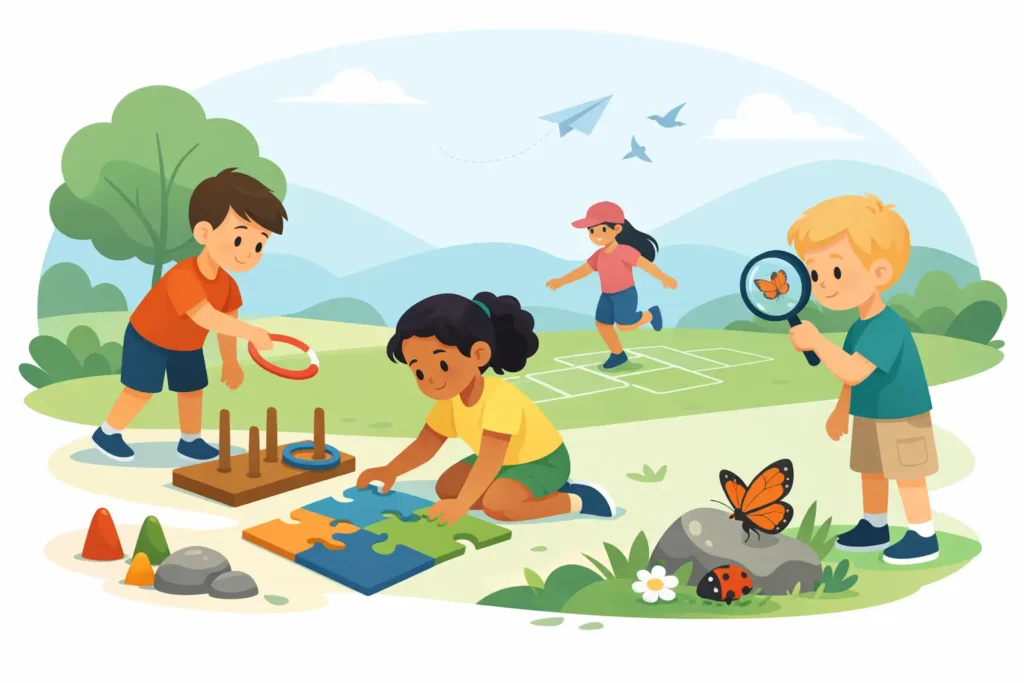
Fresh air can reset the whole day. If your child is bouncing off the walls, resisting worksheets, or asking for more screen time, outdoor games for kids can be one of the simplest ways to shift the mood while still supporting real learning.
For preschoolers and early elementary kids, outdoor play is not just a break from learning. It is part of learning. Running, balancing, listening, taking turns, noticing patterns, and following directions all build the same foundational skills children use for reading, writing, math, and classroom success. The best part is that you do not need fancy equipment or a huge backyard to make it work.
Why outdoor play matters for early learning
Young children learn best when their bodies are involved. A child who hops to a number, tosses a beanbag to a letter, or follows a movement pattern is practicing much more than coordination. They are strengthening attention, memory, language, and self-control in a way that feels playful instead of pressured.
This matters especially for families trying to reduce screen time without hearing, “I’m bored” every ten minutes. Outdoor games give children a clear job to do. They also help parents and teachers bring structure to free play, which is often the missing piece. A little intention can turn recess, backyard time, or a park visit into a meaningful part of the day.
There is also a practical benefit. Many learning struggles look bigger indoors. Children who seem restless at the table may focus better after movement. Kids who resist academic tasks may join in quickly when the activity starts with chalk, cones, balls, or a scavenger hunt. That does not mean every lesson belongs outside, but it does mean outdoor time can support the work you are already doing at home or in the classroom.
How to choose outdoor games for kids
The most helpful games match your child’s age, attention span, and current learning goals. A three-year-old usually needs very simple directions and lots of repetition. A six- or seven-year-old may enjoy more challenge, simple rules, and a clear “win” or finish point.
It also helps to think in categories. Some outdoor games build gross motor strength. Others strengthen early literacy, number sense, listening skills, or social-emotional development. When you choose with a purpose, play becomes easier to repeat because you can use it to support something your child already needs.
If you want more ideas in the same spirit, our guide to 21 Screen Free Activities for Kids can help you build a wider routine around hands-on play.
15 outdoor games for kids that build real skills
1. Alphabet sidewalk hop
Write letters on the driveway or patio with sidewalk chalk. Call out a letter and have your child jump to it. For a bigger challenge, ask for the letter that makes a certain sound, or name a simple word and have them jump to its first sound.
This game supports letter recognition, phonemic awareness, and listening. If letter sounds are a current focus, it pairs naturally with How to Teach Letter Sounds That Stick.
2. Number treasure hunt
Hide numbered cards, sticky notes, or paper circles around the yard or playground area. Children search for the numbers in order, or collect them and put them in sequence once they find them.
You can keep it basic with numbers 1 through 10, or extend it by asking children to find “one more” or “one less” than a number you call out. It is active, simple, and especially useful for kids who learn better while moving.
3. Color and shape scavenger hunt
Ask children to find something round, something green, something tiny, or something with stripes. You can say the clues aloud or make a picture checklist for younger children.
This builds vocabulary, observation, and categorizing skills. It also works well for mixed ages because older kids can handle more descriptive clues while younger children focus on basic colors and shapes.
4. Animal movement race
Call out an animal and have children move like that animal from one point to another. They can hop like a frog, stomp like an elephant, slither like a snake, or waddle like a duck.
This is excellent for gross motor development and body awareness. It also helps children practice following directions and switching quickly between tasks, which are useful school-readiness skills.
5. Rhyming toss
Set out buckets, hoops, or chalk circles. Say a word like “cat” and ask your child to toss a beanbag only when they can think of a rhyming word such as “hat” or “bat.”
The movement keeps the game light, while the language practice supports early reading development. If your child enjoys this, 8 Rhyming Words Games for Preschoolers offers more easy ways to build the same skill.
6. Red light, green light
This classic game still earns its place. One child or adult calls “green light” to move and “red light” to stop. You can add yellow light for slow movement or blue light for hopping.
What looks like a simple running game actually builds listening, self-control, and attention. Those are big skills for preschool and kindergarten, especially for children who struggle with impulse control.
7. Sight word spray game
Write sight words on a fence with chalk, or tape laminated word cards outside. Call out a word and let your child spray it with a water bottle.
This works because it combines movement, novelty, and quick repetition. For emerging readers, that is often much more effective than asking them to sit and drill words indoors.
8. Obstacle course with directions
Create a basic obstacle course using cones, cushions, hoops, jump ropes, or outdoor toys. Then give your child two-step or three-step directions such as, “Jump over the rope, crawl under the chair, then toss the ball in the bucket.”
Obstacle courses support coordination, sequencing, and listening. You can also adapt them for positional words like over, under, around, and through, which strengthens language development in a very natural way.
9. Nature counting walk
Take a short walk and count what you find: three flowers, five rocks, two birds, four sticks. You can also sort objects by size, color, or texture once you return.
This is a gentle option for children who do not love competitive games. It builds counting, noticing, and descriptive language without feeling like a lesson.
10. Freeze dance outside
Play music from a phone or speaker and let children dance freely. When the music stops, they freeze. You can add directions like freeze in a tall shape, a tiny shape, or on one foot.
This game supports balance, body control, and listening. It is also helpful for releasing energy before transitioning back inside.
11. Ball roll name game
Sit or stand in a circle and roll a ball to a child while saying their name. Older children can say the first letter of their name, clap the syllables, or name a word that starts with the same sound.
This game encourages turn-taking and social connection, which makes it a strong choice for classrooms, playgroups, or siblings learning together.
12. Follow-the-path chalk trail
Draw a long path with chalk that includes prompts along the way. Children might stomp on stars, tiptoe along a line, jump over zigzags, or stop on a square and count to ten.
The beauty of this game is how flexible it is. You can make it about movement, numbers, letters, or simple direction-following based on what your child needs most that week.
13. Emotion charades in the yard
Call out feelings like happy, frustrated, sleepy, excited, or nervous and have children act them out with their faces and bodies. Then talk briefly about when someone might feel that way.
This game adds social-emotional learning to active play. For children who need help naming feelings, this can be much easier than asking them questions at a table.
14. Shadow tag
Instead of tagging bodies, children try to step on one another’s shadows. It is safer for younger kids who are still working on body control, and it naturally sparks curiosity about light, position, and time of day.
This is a nice example of how outdoor play can also introduce early science thinking without turning the moment into a formal lesson.
15. Simple relay races with learning prompts
Relay races can be as basic as carrying a beanbag from one basket to another. To add learning, place letters, numbers, or picture cards at the turnaround point and ask children to identify one before racing back.
Relays work well for groups, but they can also be adapted for one child. The main thing is to keep the challenge manageable so it stays fun rather than frustrating.
Making outdoor play feel structured, not chaotic
A common reason parents avoid outdoor activities is that they sound harder than they really are. In practice, most successful outdoor games need only three things: a clear start, one simple goal, and a short time limit. Young children do better when they know what to do first, what counts as success, and when the game will end.
It also helps to rotate rather than reinvent. Choose three to five favorites and repeat them often. Children usually enjoy games more when they already understand the rules. Repetition also deepens the learning because kids can focus on the skill instead of figuring out the activity every time.
If you are working toward school readiness, outdoor play can support that larger goal beautifully. Our Kindergarten Readiness Skills Checklist is a helpful next step if you want to connect playful activities with the skills children need before starting school.
A few realistic tips for parents and teachers
Keep expectations age-appropriate. Some children will happily play a game for twenty minutes, while others will need a reset after five. That is normal. Short, successful play is better than dragging out an activity after your child has checked out.
Use what you already have. Chalk, balls, buckets, painter’s tape, beanbags, and index cards can cover most of the games in this article. If you are outdoors with a class, simple stations often work better than one big group game, especially for younger children.
Most of all, remember that learning outside does not need to look polished. If your child is moving, noticing, talking, listening, and trying again, the activity is doing valuable work. Sometimes the best outdoor games for kids are the ones that feel almost too simple to count, right up until you notice the skills growing with every round.