If your child can sing the alphabet but freezes when you point to a letter and ask for its sound, you are not doing anything wrong. That gap is incredibly common. Learning how to teach letter sounds takes more than repeating the ABCs – it takes simple, consistent practice that helps children connect what they see with what they hear.
For many preschoolers and kindergarteners, letter names come first because songs, books, and toys reinforce them constantly. Letter sounds are a different skill. Children need to hear the sound clearly, notice how their mouth makes it, and connect that sound to the printed letter over and over in meaningful ways. The good news is that this can feel playful, not pressured.
How to teach letter sounds in a way kids remember
The most effective approach is usually slow, direct, and hands-on. Instead of trying to teach the whole alphabet at once, focus on a few letters at a time. Children tend to learn more when they can revisit the same sounds in different ways rather than racing through all 26 letters.
Start with common, continuous sounds when possible. Sounds like m, s, f, and n are often easier for young children because they can be stretched out and heard clearly. Short vowel sounds and stop sounds like t or b can take a little more repetition because they are quicker and less obvious to the ear.
When you introduce a letter, say the sound cleanly. For example, /m/ should sound like mmm, not muh. Adding an extra vowel sound is very common, but it can make blending words harder later. If a child learns that m says muh and a says ah and t says tuh, sounding out mat becomes much more confusing than it needs to be.
That said, perfection is not the goal. If your child is making progress, stay encouraged. Clear modeling matters, but children do not need a speech lesson every time they practice phonics.
Start with sounds before too many names
Parents often ask whether they should teach letter names or letter sounds first. In most real-life settings, children learn both at the same time, but when your goal is early reading, sounds deserve extra attention.
A child who knows that the symbol is called B has useful alphabet knowledge. A child who knows that b says /b/ is beginning to build a reading skill. That is why phonics activities should consistently bring the focus back to sound.
One simple routine works well: show the letter, say its name once, then repeat the sound several times. You might say, “This is M. M says mmm. Can you say mmm?” That keeps the name available without letting it take over the lesson.
Use lowercase letters often
Most beginning readers encounter lowercase letters more frequently in books and simple texts, so it helps to teach them early and often. Capital letters are still worth learning, especially for names, but if a child only recognizes uppercase letters, reading practice will feel harder than it should.
Teach a few letters at a time
Three to five letters is plenty for one short learning cycle. Once a child can recognize and produce those sounds with some confidence, add a few more. This smaller focus gives children a chance to feel successful, which matters more than parents sometimes realize.
Make letter sounds visible and physical
Young children learn best when they can see, hear, touch, and move. If letter-sound practice only happens on flashcards, some kids will get it quickly, but many will lose interest or struggle to retain it.
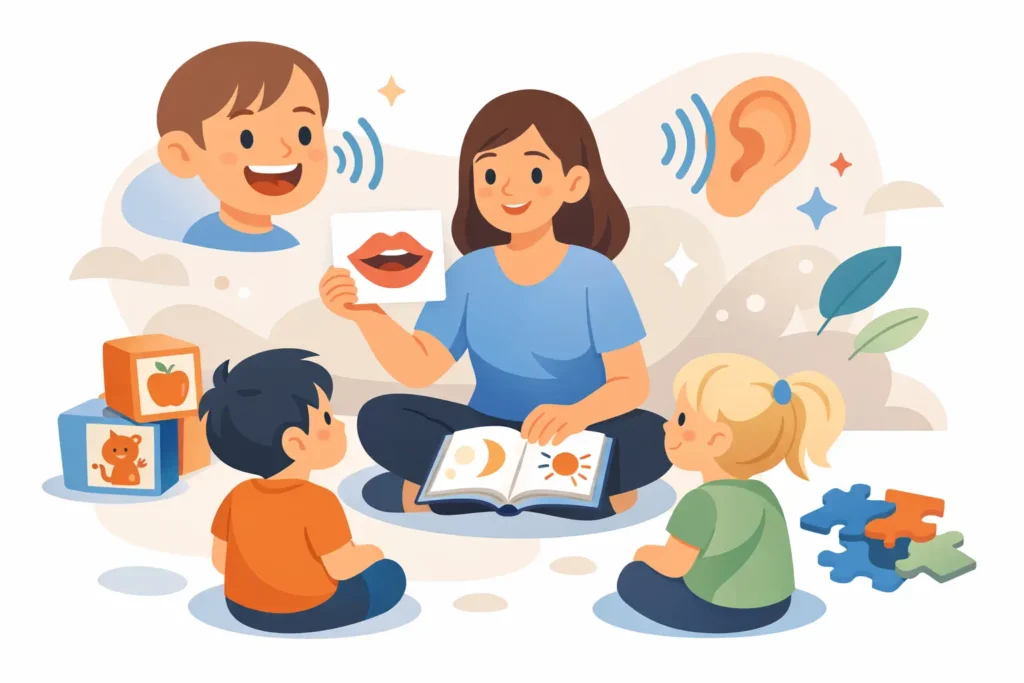
Try connecting each sound to a mouth movement. Exaggerate how your lips come together for /b/, or how your teeth touch your lip for /f/. Let your child watch your face and then copy it. This small step can make abstract sounds feel much more concrete.
Movement also helps. You can trace a letter in the air while saying its sound, build it with play dough, or hop onto a letter card on the floor and call out the matching sound. These playful moments are not extras – for many children, they are the lesson.
If your child enjoys worksheets, use them as reinforcement rather than the whole method. A tracing page works better after a child has already heard the sound, said it aloud, and noticed the letter in books or play. That sequence usually leads to stronger retention.
Use beginning sounds in everyday life
One of the easiest ways to practice how to teach letter sounds is to stop treating it like a separate school subject. Once a child knows a few sounds, you can point them out naturally throughout the day.
At breakfast, you might say, “Milk starts with mmm.” In the car, “Sun starts with sss.” During cleanup, “Toy starts with t.” This kind of practice is brief, but it helps children understand that sounds live inside real words, not just on lesson pages.
Picture sorting is another strong activity. Gather a few objects or images and ask your child to group the ones that start with the same sound. Keep it simple at first. If you are working on s, choose obvious examples like sun, sock, and sandwich rather than trickier words with blends or less familiar vocabulary.
There is one trade-off to keep in mind here: some children become very good at matching the first sound in spoken words but still struggle to recognize the printed letter. If that happens, bring the letter card back into the activity so the sound and symbol stay connected.
Keep lessons short and repeat often
Short lessons almost always work better than long ones. Five to ten focused minutes can be enough, especially for preschoolers. If your child is wiggly, distracted, or resistant, that usually does not mean they are not ready. It often means the lesson has gone on too long.
Repetition matters more than intensity. A child who practices four minutes a day for two weeks will often retain more than a child who does one long lesson on a Saturday. Familiar routines build confidence, and confidence keeps children engaged.
This is especially helpful for families trying to reduce screen time without turning every moment into formal instruction. A quick sound game while folding laundry or waiting at pickup can be more effective than a lengthy sit-down lesson that ends in frustration.
Watch for confusion between similar letters
Some letter sounds are easier to mix up, especially b and d, or short vowel sounds. That is normal. When confusion shows up, slow down and separate those letters for a bit rather than drilling them side by side.
Children also need time to hear the difference between sounds that feel close together. If e and i are both sounding the same to your child, more auditory practice may help before expecting instant accuracy on paper.
Read aloud with a phonics lens
Story time can support phonics without feeling like a formal lesson. When you read aloud, occasionally pause to notice a familiar letter sound in the text. You might point to a big S in the title and say, “There is sss, like snake.”
The key word is occasionally. If you stop on every page to teach, the story loses its rhythm. A few well-timed moments are enough to help children connect letter sounds to real reading.
Alphabet books and simple decodable readers can be useful here, but they serve different purposes. Alphabet books are great for introducing letters and sounds. Decodable readers are better once a child knows several sounds and is ready to start blending them into words. If a book feels too hard, step back. Frustration is not a sign that more pressure is needed.
Know what progress really looks like
Progress in phonics is rarely perfectly neat. One week your child may confidently say five sounds in a row. The next week they may forget two of them. That does not mean the learning disappeared. Young children often need many exposures before a skill becomes automatic.
Look for steady signs of growth instead of instant mastery. Is your child noticing letters in the environment? Attempting sounds during read-alouds? Matching a few beginning sounds correctly? Those are meaningful steps.
If you want extra support, structured printables and playful phonics practice can help bring consistency to your routine. Families and teachers often do well with simple resources they can return to throughout the week, like the early learning activities shared at Kids Learning Journey.
If teaching letter sounds has felt harder than you expected, take that as a cue to simplify, not to worry. A few clear sounds, a little playful repetition, and a calm routine can go a long way. Children build reading foundations one small connection at a time, and those small connections matter more than they seem in the moment.