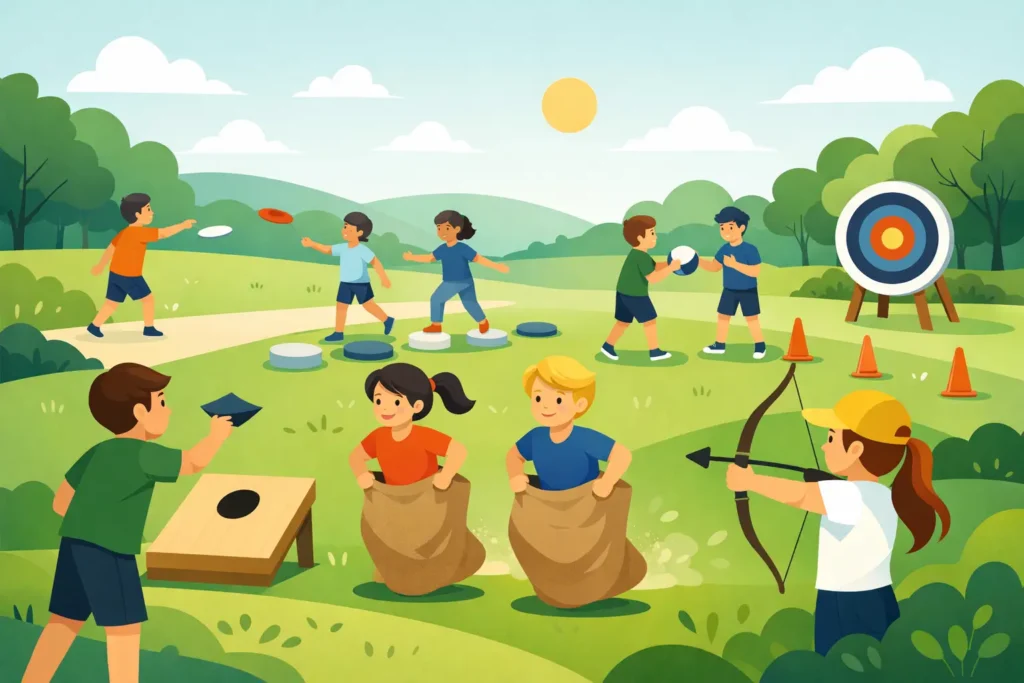
If your child has energy to spare but you still want the day to feel productive, outdoor games for kids can do both jobs at once. The right game gets children moving, of course, but it can also build early math, listening, language, and social skills without feeling like extra schoolwork.
For preschoolers and early elementary kids, the best outdoor play is simple, flexible, and easy to start with what you already have. You do not need expensive equipment or a big backyard. A sidewalk, patch of grass, driveway, playground, or open classroom area can be enough.
Why outdoor games matter for young children
Outdoor play gives children space to practice big body movements like running, jumping, balancing, and throwing. Those skills support coordination and confidence, which matter for everyday tasks and school readiness.
Just as important, many games naturally build learning habits. Children follow directions, take turns, count objects, listen for cues, remember rules, and solve small problems. If you are trying to cut back on screen time, this kind of play can make the afternoon feel calmer and more purposeful.
Outdoor games for kids that support learning
Simon Says is a classic for a reason. It strengthens listening skills, self-control, and body awareness. For younger children, keep directions short, such as “touch your nose” or “hop two times.” For older kids, you can add academic twists like “clap the number after three” or “point to something that starts with B.”
A scavenger hunt works especially well for children who like to explore. You can ask them to find a smooth rock, something yellow, three sticks, or a leaf bigger than their hand. This adds observation, vocabulary, and counting practice to active play. If your child is also working on letter recognition, pair the hunt with early literacy activities from Best Alphabet Tracing Worksheets Printable.
Hopscotch is another strong choice because it blends movement with number learning. Children practice balance while recognizing numbers and following a sequence. You can make it easier by using fewer squares, or more challenging by asking kids to jump to odd numbers, even numbers, or numbers that add up to a target. Families working on number skills at home may also like this Kindergarten Math Worksheets Printable Guide.
Red Light, Green Light helps children practice stopping and starting on cue. That sounds simple, but it builds attention and impulse control. For very young children, shorten the playing distance. For groups, let different children take turns being the caller so they also practice speaking clearly and leading others.
Obstacle courses are one of the easiest ways to keep kids engaged. You can use cones, chalk lines, pool noodles, buckets, or pillows if you are setting one up on a safe surface. Ask children to crawl under, jump over, zigzag around, and balance along a line. This kind of game is great for mixed ages because you can make each station easier or harder.
Easy games when you need almost no prep
Sometimes you need an activity that starts in two minutes, not twenty. Freeze dance outdoors is perfect for that. Play music from your phone or simply call out “freeze” while children move. It supports listening and self-regulation, and it works well for playdates, classrooms, or a quick movement break.
Follow the leader is another low-prep favorite. Walk, tiptoe, march, skip, or stretch while children copy you. This works especially well with toddlers and preschoolers because imitation is a natural way they learn.
Ball roll counting is simple but useful. Sit or stand facing your child and roll a ball back and forth while counting each pass. You can count to ten, count backward, or name letters or rhyming words instead of numbers. If reading readiness is on your mind, How to Teach Phonics at Home offers more playful ways to build those early sound skills.
How to choose the right game for your child
A good game matches your child’s age, energy level, and attention span. A highly active child may love relay races or obstacle courses, while a child who gets overwhelmed by noise may prefer a scavenger hunt or chalk games. Some children enjoy competition, but many do better when the goal is simply to finish, explore, or work together.
It also helps to think about the skill you want to encourage. If your child needs more practice with listening, choose games with clear directions. If they are working on number recognition, use movement games with counting. If social skills are the focus, choose partner or small-group activities that involve turn-taking.
A few quick tips for success
Keep rules short and model the game first. Young children usually understand best when they can see what to do rather than hear a long explanation.
Rotate games instead of repeating the same one every day. Familiar structure is helpful, but too much repetition can make kids lose interest. Even a small change, like using colors, numbers, or animal movements, can make an old game feel new.
Finally, do not worry about perfect organization. The real goal is active, meaningful play. When children are moving, laughing, and practicing important early skills at the same time, that is a win for everyone.