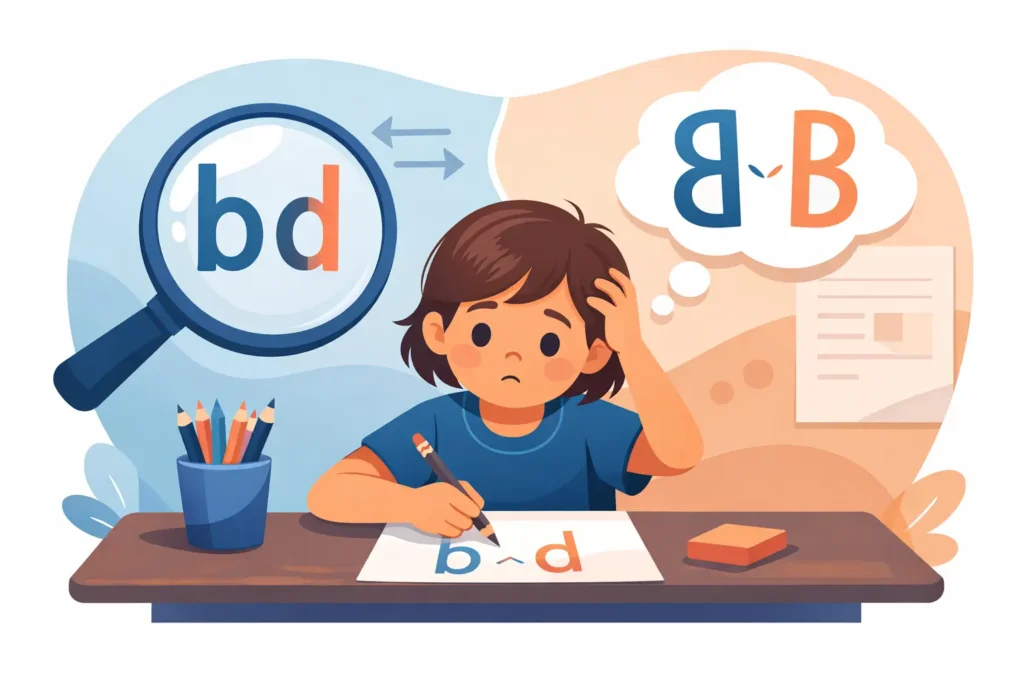
You sit down to look at your child’s writing and notice a backward b, a flipped d, or their name written with a few letters facing the wrong way. If you’ve been asking, “why is my child reversing letters,” you are not alone. This is one of the most common concerns parents and early educators have during the preschool and early elementary years, and in many cases, it is a normal part of learning to read and write.
Letter reversals can look surprising to adults because we already know what letters are supposed to look like. Young children, though, are still building that knowledge from the ground up. They are learning letter shapes, matching those shapes to sounds, figuring out left to right direction, and coordinating the small hand movements needed for writing. That is a lot happening at once.
Why is my child reversing letters in the first place?
For many young learners, reversing letters is a developmental stage rather than a warning sign. Children often learn that shapes can stay the same even when they are turned or flipped. A chair is still a chair from a different angle. A toy is still the same toy upside down. Letters are trickier because direction matters. A b and a d are not interchangeable, even though they look closely related.
This is one reason reversals are especially common with letters like b and d, p and q, or sometimes numbers like 2, 3, 5, 6, and 9. These symbols require children to notice small visual differences and remember exact orientation. That kind of visual discrimination takes time.
Writing direction also plays a role. English print moves from left to right, but that pattern is not automatic for every child right away. Some children start writing from the side that feels easiest. Others know the letter name and sound but still have trouble recalling how to form it in the correct direction when a pencil is in hand.
It also helps to remember that reading and writing develop on slightly different timelines. A child may recognize letters accurately during a game or while reading with you, but still reverse them when writing independently. That gap is very common in early learning.
What age are letter reversals considered normal?
In preschool, kindergarten, and even first grade, letter reversals are often part of typical development. Many children continue to mix up letter orientation as they practice handwriting and early reading skills. Occasional reversals can still show up around age 7, especially with letters that are visually similar.
What matters most is the overall pattern. If your child is gradually improving, learning new letter forms, and becoming more consistent over time, that is usually a good sign. Growth is rarely perfectly neat. One week your child may write every b correctly, and the next week a few backward letters show up again. That does not automatically mean something is wrong.
A younger child who is still learning alphabet recognition may need more repetition and hands-on practice. An older child who is still reversing many letters often, and who also struggles with reading, spelling, or remembering letter sounds, may need closer attention.
When should parents pay closer attention?
There is a difference between normal early reversals and a pattern that keeps getting in the way of learning. It may be worth talking with your child’s teacher or pediatrician if reversals continue well beyond the early primary years, happen very frequently, or appear alongside other challenges.
For example, you may want to look more closely if your child avoids writing tasks, has a hard time remembering letters and sounds despite repeated practice, struggles to hear the difference between sounds in words, or seems unusually frustrated during reading and handwriting activities. Reversing letters by itself does not mean a child has dyslexia or another learning difficulty. Still, if it is one piece of a bigger picture, it is worth following up.
That distinction matters. Letter reversals are common in many children, including children without any learning disorder. Dyslexia is more closely related to difficulty with phonological processing, such as hearing and working with sounds in words, than to reversals alone. So if reversals are your only concern, try not to jump to conclusions.
How to help a child who reverses letters
The most effective support is simple, consistent, and low pressure. Children usually make better progress when handwriting practice feels manageable and encouraging instead of stressful.
Start with just a few commonly reversed letters rather than the whole alphabet at once. If your child keeps mixing up b and d, focus on those in short practice sessions. Too many corrections at once can make writing feel overwhelming.
Use multisensory practice whenever possible. Children often remember letter direction better when they see it, say it, hear it, and form it with their hands. You might trace letters in sand, build them with play dough, write them in shaving cream, or use finger tracing before pencil work. These activities strengthen memory in a playful way.
Verbal cues can help too. Some children benefit from a short phrase attached to a letter. For example, when teaching b and d, consistency matters more than using a perfect trick. Pick one cue and use it the same way each time so your child is not trying to remember multiple rules.
It also helps to teach letters through formation patterns. Instead of only showing the final letter shape, show how to make it. Where does the pencil start? Which direction does it go? Children often need repeated instruction on the motor plan for writing each letter.
Why is my child reversing letters when reading seems okay?
This can feel confusing, but it is actually common. Reading a letter and writing a letter are related skills, not identical ones. A child may visually recognize a printed letter on a page but struggle to reproduce it from memory with correct formation. Writing asks for recall, motor control, and directionality all at once.
Think of it this way: recognizing a song when you hear it is easier than playing it from memory on an instrument. In the same way, recognizing a letter during reading is often easier than forming it independently.
That is why short handwriting practice still matters, even for children who seem to know their letters well in books or flashcards. The goal is to connect recognition with production.
Activities that make letter direction easier to learn
Short, focused activities usually work better than long writing drills. Young children learn best when practice feels active and clear.
Try using a visual model during writing time so your child can copy from an accurate example. Keep the target letter visible at the top of the page and encourage your child to check it often. Over time, this reduces guessing.
You can also practice sorting letters by shape. Put letters with tall sticks in one group, curved letters in another, and commonly confused pairs side by side for comparison. This builds visual attention to the features that make each letter unique.
Movement-based learning is especially helpful for children who get frustrated by pencil tasks. Have your child skywrite large letters with their arm, walk along a taped letter on the floor, or make letters with craft sticks. Bigger movement can make direction easier to remember.
When your child is ready for paper practice, keep it short. Five minutes of focused, calm work is more useful than twenty minutes of resistance. A simple routine using tracing, copying, and then writing from memory can be very effective.
If you use printables, choose pages that are uncluttered and beginner-friendly. Clear models, plenty of space, and repeated practice on a few target letters often work better than worksheets that try to cover too much at once.
What not to do
It is easy to start correcting every backward letter the moment you see it, but too much correction can backfire. If a child starts feeling watched or criticized, they may avoid writing altogether. Try to correct gently and selectively, especially during independent writing when the bigger goal may be getting ideas onto paper.
It is also not helpful to assume laziness or carelessness. Most children who reverse letters are not rushing on purpose. They are still learning a skill that is more complex than it looks.
And while it is smart to stay aware, try not to panic. Reversals can be part of normal development, especially in the early years. Paying attention is helpful. Catastrophizing is not.
A steady approach builds confidence
Children make the most progress when they feel safe practicing. Warm encouragement, clear modeling, and regular repetition go a long way. If your child is reversing letters, the goal is not perfection overnight. The goal is steady growth, stronger letter knowledge, and more confidence each time they write.
If you ever feel unsure, partnering with your child’s teacher can give you a clearer picture of what is typical for their age and what support may help most. And if your child simply needs more practice, that is okay too. With time, playful repetition, and patient guidance, those backward letters usually begin to turn around.