Need an easy activity that gets kids moving, laughing, and learning at the same time? Charades: Act and react game for kids is one of those rare screen-free wins that works at home, in small groups, or in the classroom. It looks simple on the surface, but it supports language growth, listening, self-control, social skills, and creative thinking in a way that feels like pure fun.
For parents and teachers, that matters. Young children often learn best when their bodies and minds are working together. A game like charades gives them a reason to pay attention, interpret clues, take turns, and express ideas without relying only on words. It is playful, but it is not pointless.
Why charades works so well for young children
Charades is a natural fit for preschoolers and early elementary students because it turns abstract thinking into something visible. Instead of just hearing a word like hop, elephant, sleepy, or firefighter, children act it out and watch someone else do the same. That physical connection helps many kids understand and remember new vocabulary more easily.
It also gives children practice in several school-readiness skills at once. They have to listen carefully to the rules, wait for their turn, observe body language, and make a guess based on context. Those are foundational skills for classroom learning, group activities, and early literacy development.
Another benefit is confidence. Some children are hesitant to speak in a group, but they may feel more comfortable showing an idea with movement first. Others love dramatic play and need an outlet that feels structured. Charades meets both needs. Quiet children can participate without pressure, and energetic children get a clear, purposeful way to move.
How to play Charades: Act and react game for kids
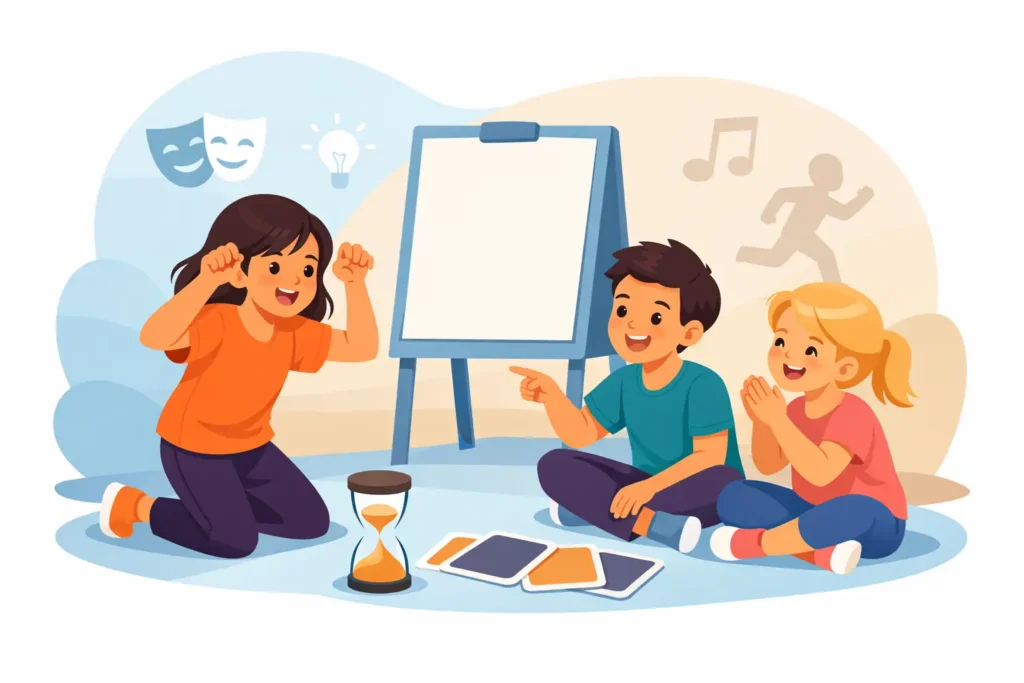
The basic version is wonderfully simple. One child chooses a word or picture card and acts it out without speaking. The other players watch and guess. Once the word is guessed, the next child takes a turn.
For younger children, keep the pace gentle and the rules light. They do not need a timer, teams, or complicated scoring to enjoy the game. In fact, many preschoolers do better when the goal is cooperative guessing rather than competition. If a child gets stuck, an adult can model an action or offer a small hint.
For kindergarten and early elementary students, you can add a little more structure. Children can take turns drawing cards from a bowl, acting for a set amount of time, or playing in small teams. Just be careful not to make the game so fast or competitive that the learning part gets lost. The sweet spot is a playful challenge that still feels supportive.
If you are working with a mixed-age group, use pictures for younger players and simple written words for older ones. That one small adjustment makes the activity more accessible and keeps everyone included.
Best charades ideas for preschool and early elementary ages
The easiest charades prompts are familiar, concrete, and easy to show with the body. Animals are a great starting point because children already know how to slither like a snake, stomp like an elephant, or flap like a bird. Everyday actions also work well, such as brushing teeth, eating, sleeping, reading, or tying shoes.
Feelings are another strong category, especially if you want to build social-emotional learning into play. Children can act out happy, sad, surprised, frustrated, sleepy, or excited. This helps them connect facial expressions and body language to emotion words, which is an important early skill.
Community helpers give the game an educational twist. Kids can pretend to be a doctor, teacher, firefighter, mail carrier, chef, or farmer. Seasonal prompts are useful too, especially in classrooms. Think of shoveling snow, carving a pumpkin, planting flowers, or building a sandcastle.
If children are ready for a bigger challenge, try storybook characters, action verbs, or simple school-related vocabulary. The key is choosing words that can be physically represented. If a word is too abstract, young children may get frustrated rather than engaged.
Learning benefits beyond entertainment
One reason parents and educators keep coming back to charades is that it supports more than one area of development. Language growth is the most obvious. Children hear new words, connect them to actions, and practice expressing ideas in a memorable way. That kind of playful repetition can strengthen vocabulary without making it feel like a lesson.
The game also supports early literacy. When children use picture cards or simple word cards, they begin connecting images, actions, and print. A child who acts out jump after seeing the written word is practicing an early form of word meaning and comprehension. It is not phonics instruction by itself, but it pairs nicely with literacy learning.
Attention and self-regulation get a workout too. Children have to watch closely, hold ideas in mind, and wait until the right moment to guess. That may sound small, but these are important executive function skills. Many young children need playful ways to practice impulse control, and charades gives them exactly that.
Then there is social learning. Kids learn to read nonverbal cues, cheer for others, and cope with small disappointments if their idea is not guessed right away. In group settings, that can be just as valuable as the vocabulary practice.
How to make charades more educational
If your goal is meaningful play, a few thoughtful changes can turn a simple game into a strong learning activity. The first is to organize prompts by theme. If you are teaching animals, weather, emotions, or community helpers, use charades to reinforce that unit. Children learn more when the game connects to what they are already hearing and seeing during the day.
Another helpful strategy is to talk briefly after each turn. Once a word is guessed, you might ask, “What clues helped you figure it out?” or “Can you use that word in a sentence?” This adds just enough reflection to deepen understanding without slowing the game too much.
You can also pair charades with drawing or writing. After the game, children might draw their favorite action, trace the matching word, or sort cards into categories. Older children can write a sentence using one of the charades words. That creates a nice bridge between movement-based learning and paper-based practice.
For children who are still developing expressive language, use visual supports. Picture cards, gesture modeling, and category examples can help them join in with less frustration. If a child is reluctant to perform alone, let them act with a partner first. Support matters more than perfect independence.
Tips for home and classroom success
A short game usually works better than a long one. Ten to fifteen minutes is often enough for younger kids before attention fades. Ending while children are still excited makes it much easier to bring the activity back another day.
The environment matters too. Give children enough room to move safely, and set clear expectations before you begin. Remind them that charades uses quiet acting, careful watching, and kind guessing. When the rules are predictable, children are more likely to stay focused.
Choice is another helpful tool. If you notice resistance, offer two categories and let children pick. A child who does not want to act out emotions might gladly act like zoo animals. Small choices can turn hesitation into participation.
It is also worth remembering that not every child enjoys being the center of attention. Some will want to guess rather than perform, especially at first. That is okay. Watching closely is still active learning. Over time, many children become more comfortable once they see the game is fun and low-pressure.
Easy variations to keep the game fresh
If traditional charades starts to feel repetitive, simple variations can help. Reverse charades works well in a classroom, where a small group acts out a word together while one child guesses. This reduces pressure on individual performers and adds teamwork.
Emotion charades is a strong choice when you want to focus on social-emotional skills. Action charades is great for movement breaks. Story charades invites children to act out scenes from a familiar book, which supports comprehension and sequencing.
You can even create a literacy-friendly version by matching action cards with beginning sounds or sight words children already know. That kind of variation works especially well for families and teachers who want play to support school goals without feeling too formal.
Charades does not need fancy materials, long prep time, or a big budget to be effective. It simply gives children a playful way to think, move, communicate, and connect. When an activity can build vocabulary, confidence, and cooperation while kids are laughing, it earns a place in the regular rotation. A simple game can do a lot of teaching when it is used with intention.