Few games grab a child’s attention as quickly as a wobbly tower. That is part of what makes the Block Stacking Game: Jenga such a helpful tool for parents and teachers. It feels like pure fun, but it also gives young children a chance to practice patience, hand control, problem-solving, and even early academic skills without sitting through a formal lesson.
If you are trying to cut back on screen time or looking for a simple activity that works for mixed ages, Jenga is a strong option. It is easy to set up, quick to explain, and flexible enough to use for playtime, homeschool lessons, small groups, or rainy afternoons at home.
Why the block stacking game Jenga works so well for young learners
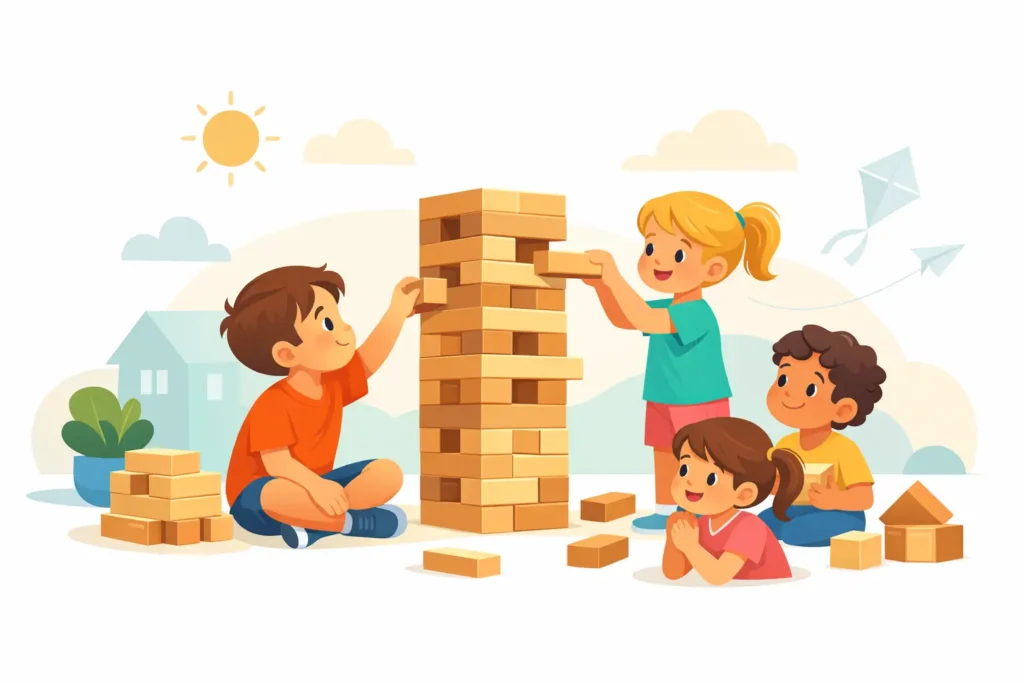
Jenga looks simple on the surface. Children pull out one block at a time and place it on top without knocking the tower down. But under that simple structure, a lot of learning is happening.
First, there is fine motor development. Picking a single block from the middle of a tower takes finger strength, hand stability, and controlled movement. Young children are still building these skills, and games like this give them practice in a way that feels exciting instead of repetitive.
Second, Jenga supports focus and self-control. Many children want to move quickly, especially when they are excited. This game gently teaches them to slow down, watch carefully, and think before they act. That kind of pause matters in early learning. It supports everything from handwriting to following directions.
There is also a social-emotional side. Children learn to take turns, handle suspense, and cope when the tower falls. For some kids, losing or making a mistake can feel big. Jenga gives them low-pressure practice with disappointment and helps them build resilience in a playful setting.
Skills kids can build while playing Jenga
The biggest strength of Jenga is that it can support more than one area of development at once. That makes it especially useful for busy parents and educators who want learning activities to do more than one job.
Fine motor skills are an obvious benefit, but not the only one. Children also use visual discrimination when deciding which block looks safest to pull. They use early engineering thinking as they notice weight, balance, and structure. They build concentration because one rushed move can change the whole game.
Language skills can grow too, especially when adults talk through the process. You might ask, “Which block looks loose?” or “Why do you think the tower fell?” That kind of conversation builds vocabulary and reasoning. With younger children, even simple words like top, bottom, middle, careful, steady, and balance add value.
Math learning can fit in naturally as well. Children can count blocks, compare heights, notice patterns in the rows, or estimate how many turns are left before the tower tumbles. The game does not replace a full math lesson, but it gives children a playful reason to use math language in a real situation.
Is Jenga a good fit for preschoolers?
It can be, with a few adjustments. Standard Jenga is often more manageable for kindergarten and early elementary ages because the blocks are small and the game requires controlled movement. Some preschoolers may do well with support, while others may get frustrated if the tower falls too often.
The key is to match the activity to the child. A younger preschooler may enjoy stacking the blocks freely rather than following official rules. An older preschooler might be ready for a simplified version where the goal is just to remove one block and restack it, without worrying too much about competition.
If you are introducing Jenga to younger children, stay nearby and model calm reactions. The tower falling is part of the fun, but it can also feel upsetting to a child who is still learning flexibility. A warm response such as, “That was a tricky move. Let’s build it again,” keeps the experience positive.
Easy ways to turn Jenga into a learning activity
One reason families and teachers keep coming back to Jenga is that it adapts easily. With a marker, sticker dots, or small labels, you can turn the blocks into a hands-on learning game that still feels playful.
For early literacy, write one letter on each block. When a child pulls a block, they can name the letter, say its sound, or think of a word that begins with it. If your child is working on phonics, you can focus on only a few target letters at a time instead of labeling the whole set.
For sight words, write simple high-frequency words on the blocks. Each turn becomes a quick reading check. This works especially well for kindergarten and first grade students who need short, repeated practice but do not want another worksheet.
For math, add numbers to the blocks. Children can identify the number, count out objects to match, or solve a quick addition fact before placing the block on top. In a classroom, this can become a fun center activity that blends movement with review.
You can also use Jenga for conversation and social-emotional learning. Write prompts such as “Name one feeling,” “Share something kind,” or “What helps you calm down?” on the blocks. This approach is especially helpful for morning meetings, family time, or small-group work.
Classroom and homeschool uses for Jenga
In a homeschool setting, Jenga works well as a short brain break that still supports learning. After a reading lesson or math worksheet, one quick round can reset energy without shifting into passive entertainment. That makes it a practical tool for families trying to balance structure with fun.
In classrooms, Jenga can be used during center time, indoor recess, partner work, or small-group instruction. Teachers often need activities that are simple to explain and easy to repeat. Jenga fits that need, especially when blocks are adapted for skills students already know how to practice.
It also works across ages better than many games. A younger child may focus on taking turns and balancing blocks, while an older child reads words or solves problems on each turn. That flexibility is valuable for families with siblings and educators teaching mixed readiness levels.
Tips for making Jenga less frustrating for young children
Even a great game can flop if the challenge level feels too high. Some children love suspense right away, while others need a gentler start.
Begin by teaching the physical skill before expecting children to play by the full rules. Let them touch the blocks, build towers, and experiment with pulling from the top rows first. This lowers pressure and helps them understand how the game works.
Keep rounds short. A long game can be exciting for older kids, but younger children may lose interest or become overly silly. Short, successful rounds tend to work better.
It also helps to focus on the process rather than winning. You can say, “You used such careful fingers,” or “You really looked closely before choosing that block.” That kind of praise supports persistence and confidence.
If competition causes tension, turn it into a cooperative game. Everyone works together to see how tall the tower can get before it falls. This small change keeps the fun while removing the stress some children feel about losing.
What Jenga teaches that worksheets cannot
Worksheets have their place, especially for practicing early handwriting, letters, and math. But games like Jenga offer something different. They create immediate feedback. A child sees what happens when they rush, when they use too much force, or when they pause and plan.
That type of learning is active and memorable. Children are not just answering a question on paper. They are testing ideas with their hands, noticing patterns, and adjusting in real time. For many kids, especially those who learn best through movement and play, that can make a lasting difference.
It also gives adults a chance to observe skills that are easy to miss in formal lessons. You may notice that your child struggles with turn-taking, avoids challenge, or has trouble controlling small hand movements. Those observations can help you choose other activities that support growth in the right areas.
A simple game with lasting value
The best learning tools are often the ones that children ask to use again. The Block Stacking Game: Jenga stands out because it is simple, engaging, and full of educational potential. Whether you use it for family game night, a quiet center, or a quick phonics review, it can support meaningful skill building through play.
When learning feels hands-on and enjoyable, children are more likely to stay engaged and keep trying. Sometimes a small stack of wooden blocks can do more than we expect.