If you have ever watched a preschooler line up blocks by color, give careful directions during pretend play, or insist that every bedtime routine happen in the exact same order, you have already seen the building blocks of coding. Beginner coding activities preschool children enjoy do not need laptops, apps, or complicated lessons. At this age, coding is really about patterns, sequencing, problem-solving, and learning that actions happen in an order.
That is good news for parents and teachers who want meaningful STEM learning without adding more screen time. Preschool coding can be playful, hands-on, and surprisingly simple to set up with materials you already have. The goal is not to teach a 4-year-old to write computer code. The goal is to help young children think logically, follow steps, notice mistakes, and try again.
What coding looks like in preschool
For preschoolers, coding starts with concepts rather than technology. Children learn that first something happens, then something else happens. They learn that a direction needs to be clear if you want a result. They begin to understand patterns, repetition, and cause and effect.
This matters because those same thinking skills support much more than STEM. Sequencing helps with retelling stories. Following directions supports classroom routines. Pattern recognition shows up in early math. Problem-solving and persistence help across every subject.
That said, preschool coding should stay developmentally appropriate. If an activity feels too abstract, too long, or too focused on getting the right answer, many young children will lose interest. Short, active experiences usually work best.
How to teach beginner coding activities in preschool
The easiest way to introduce coding is to connect it to play. Preschoolers learn best when they can move, touch, sort, build, and talk through what they are doing. A coding activity does not need to look high-tech to be effective.
Use simple language such as first, next, last, repeat, if, and fix. Those words build coding vocabulary naturally. You can also model thinking out loud. Try saying, “First we move forward two spaces, then we turn,” or “That plan did not work, so let’s fix the step that got mixed up.”
It also helps to keep expectations realistic. Some children will love the puzzle of giving directions. Others will be more engaged by movement games or storytelling. It depends on age, attention span, and personality. The best preschool coding activities leave room for flexibility.
7 beginner coding activities preschool kids can do through play
1. Make a human robot game
This is often the easiest starting point because it turns coding into a silly movement game. Ask your child to be the coder while you are the robot. They must give you one-step directions such as “walk forward,” “turn left,” or “pick up the teddy bear.”
The fun comes when you follow directions very literally. If they say “go there,” you can pause and explain that robots need clearer instructions. That helps children see why sequence and detail matter. After a few rounds, switch roles and let the child be the robot.
For younger preschoolers, use just a few actions. For older preschoolers, create a mini obstacle course with chairs, pillows, or tape lines on the floor.
2. Build a picture path with arrows
Draw simple arrows on index cards or paper squares. Then place them in a line to show a path across the room. Your child can “read” the code by following the arrows one step at a time.
You can make this more meaningful by adding a goal, such as reaching a toy, a book, or a stuffed animal. If the path does not work, invite your child to look back and figure out which arrow needs to be changed. That gentle troubleshooting is a big part of early coding.
This activity also supports visual tracking and direction words, which makes it a nice fit for school-readiness skills.
3. Use story sequencing cards
Coding and storytelling have more in common than many adults expect. Both rely on order. Give your child three to five pictures that show a familiar routine, such as planting a seed, brushing teeth, or getting dressed. Ask them to put the cards in order and explain what happens first, next, and last.
Once they understand the sequence, you can add a simple challenge. Mix up one card on purpose and ask, “What went wrong?” That question introduces debugging in a preschool-friendly way. They are learning to spot an error and fix it.
This is a great option for children who enjoy books more than movement games.
4. Clap and move in repeating patterns
Patterns are one of the clearest early coding concepts for preschoolers. Start a pattern like clap, stomp, clap, stomp and ask your child to continue it. You can also use toys, colored blocks, or snack items to make visual patterns.
After that, try adding the word repeat. For example, “Clap, stomp, repeat.” Children begin to understand that some instructions happen again and again. That idea connects to loops in coding, but you do not need to use technical language unless it feels helpful.
The key is keeping it playful. If your child wants to invent a silly dance pattern, that still counts.
5. Create a grid game with toys
Tape a simple grid on the floor or draw one on paper. Place a toy at one point and a target at another. Then ask your child to plan the steps needed to move the toy to the finish.
You might say, “How many spaces forward? Do we need to turn?” Young children can use arrow cards, verbal directions, or even small movement counters. This activity strengthens planning because children have to think ahead instead of moving randomly.
Some preschoolers may need a lot of support at first, and that is fine. You can model one route and then let them try the next one. As confidence grows, add a small obstacle or ask for a shorter path.
6. Try coding with building blocks
Blocks are excellent for preschool STEM because they naturally invite planning and problem-solving. To turn them into a coding activity, create simple build cards with step-by-step pictures. For example, first place two blue blocks, next add one red block on top, then place a yellow block beside it.
Your child follows the sequence to build the structure. If the finished design does not match the card, they can go back and figure out where the sequence changed. That process helps children slow down, compare, and revise.
This works especially well for children who enjoy constructive play but are not as interested in paper-based activities.
7. Play “if this, then that” with everyday routines
Conditional thinking can sound advanced, but preschoolers use it all the time. You can build this skill with simple everyday statements such as, “If you are wearing socks, then hop to the door,” or “If the card is red, put it in the basket.”
Children listen for the condition and decide what action matches it. You can turn this into a game during cleanup, transitions, or circle time. It feels light and active, but it teaches an important coding habit: paying attention to the rule before responding.
For some children, this is easier than sequencing because it feels more like a quick challenge than a multi-step task.
Tips for keeping preschool coding fun and manageable
Keep activities short enough that your child can be successful. Ten to fifteen minutes is often plenty for preschoolers, especially if the activity is new. You can always stop while they are still interested and come back another day.
It helps to use familiar materials. Tape, paper, blocks, toy animals, and picture cards can do a lot. Expensive tools are not necessary when children are just learning core concepts.
Try to focus on thinking, not perfection. If your child mixes up left and right or forgets a step, that does not mean the activity failed. In many ways, the mistake is the lesson. Coding is full of trial and error, and preschoolers benefit from hearing that it is okay to adjust a plan.
You can also connect coding to other preschool learning goals. A story sequence supports literacy. Pattern play supports math. Direction games build listening and self-control. That overlap is one reason these activities fit so well into home learning and classroom routines.
When to use screens and when to skip them
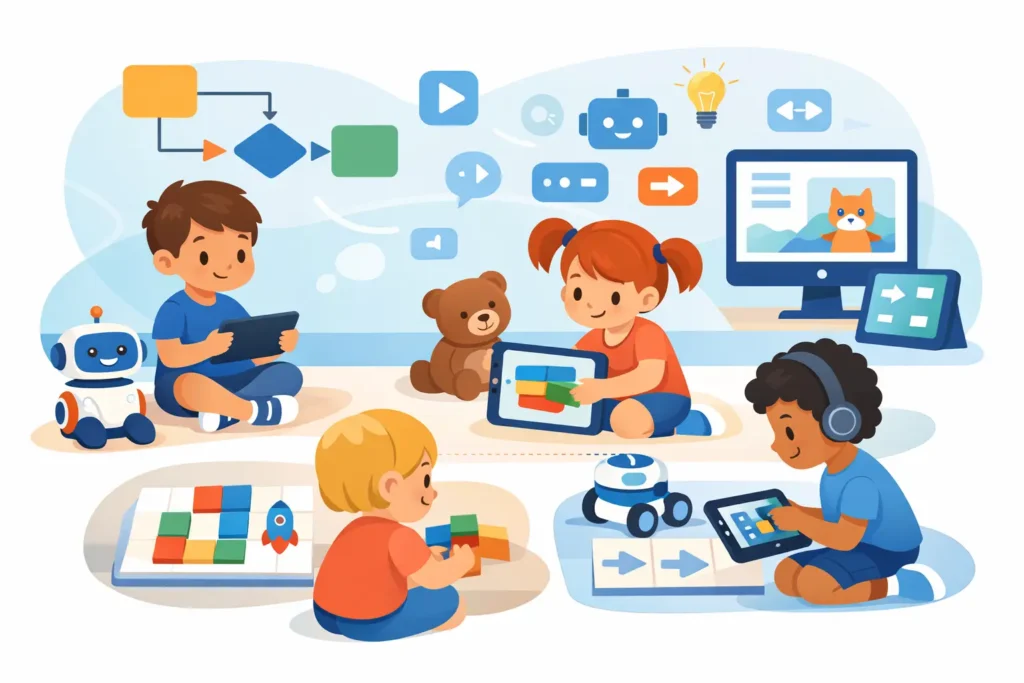
There are some beginner coding apps and toys designed for young children, and some families enjoy them. Used occasionally and with adult support, they can reinforce sequencing and logic. But they are not required for preschool coding.
For many families, unplugged activities are the better place to start. They are easier to set up, easier to understand, and more active. If screen time is already a concern in your home or classroom, hands-on coding gives you a way to support STEM without adding another device.
Kids Learning Journey readers often want learning activities that feel structured without becoming overwhelming. That is exactly where preschool coding fits best – simple directions, playful practice, and just enough challenge to build confidence.
When young children learn to put steps in order, follow a pattern, or fix a mistake, they are doing more than playing a game. They are building the kind of flexible thinking that will help them in kindergarten and well beyond, one small step at a time.