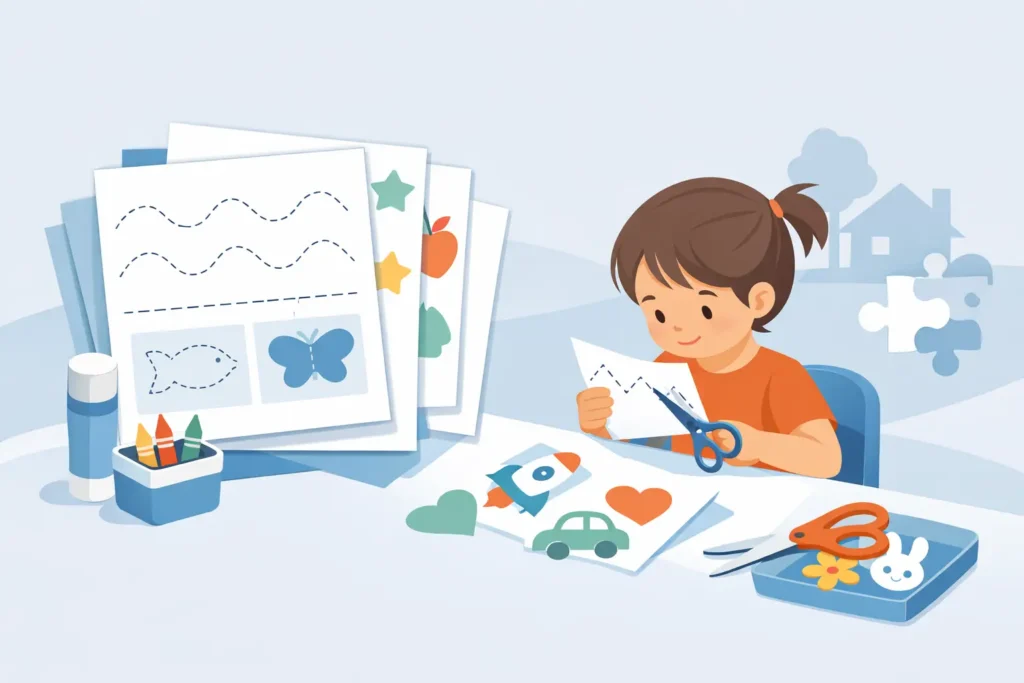
Few preschool tasks make adults as nervous as handing over a pair of scissors. You want your child to build independence, but you also want to protect little fingers, your table, and every paper item in the room. That is exactly why preschool cutting practice printables are so helpful. They give children a clear, structured way to practice an essential school-readiness skill without turning it into a free-for-all.
Cutting is more than a craft activity. It supports hand strength, bilateral coordination, visual-motor skills, focus, and confidence. For many preschoolers, learning to cut also feels exciting because it gives them a real tool and a visible result. A simple line on a page becomes a task they can complete on their own.
Why preschool cutting practice printables matter
When children use scissors, they are doing several jobs at once. One hand opens and closes the scissors while the other hand turns and steadies the paper. Their eyes track the line. Their fingers work with control and timing. That combination makes cutting practice a strong pre-writing activity, even if it does not look like handwriting practice at first.
Printables help because they remove guesswork. Instead of deciding what to cut, how much paper to use, or where to begin, a child can focus on one skill at a time. Straight lines are easier than curves. Short snips come before zigzags. Simple shapes usually feel more manageable than detailed pictures.
That progression matters. If a child starts with pages that are too hard, frustration builds fast. Some children then avoid scissors altogether, even when their hands are capable of learning with the right support. A well-designed printable keeps practice doable and helps success come early.
What skills cutting practice builds
Parents often notice the obvious goal first – learning how to hold scissors and cut on a line. But the benefits reach further than that.
Cutting strengthens the small muscles in the hands, especially when a child repeats opening and closing motions. It also encourages hand separation, which means the thumb, index, and middle fingers do one job while the ring and pinky fingers help stabilize the hand. That same kind of control supports pencil grip later on.
There is also an attention component. Preschoolers need to slow down, look carefully, and adjust as they go. For children who tend to rush through activities, cutting can gently teach patience. For children who are hesitant, it can build confidence through short, clear wins.
In classroom settings, cutting practice also supports following directions and task completion. At home, it gives parents a meaningful screen-free option that feels purposeful rather than just busy.
What to look for in preschool cutting practice printables
Not every printable is equally useful. The best preschool cutting practice printables are simple, progressive, and visually uncluttered. A page packed with tiny shapes or distracting decorations may look cute, but it can be harder for a beginner to use.
Start by looking for printables that move from basic to more complex. Early pages should focus on straight cuts across short strips of paper. After that, children can try longer lines, angled cuts, gentle curves, and eventually simple shapes. This order helps them practice control without feeling overwhelmed.
You will also want clear cutting paths. Thick, dark lines are usually easier for preschoolers to follow than thin or decorative ones. Plenty of white space around the cutting line can also help, especially for children who are just learning where to place the scissors.
If your child is easily discouraged, themed pages can help with motivation. Animals, seasonal pictures, transportation, or simple puzzles can make practice more appealing. Still, fun themes work best when the skill level is right. A child who loves dinosaurs may still get frustrated by a dinosaur page with tight corners and tiny details.
How to introduce cutting practice at home or in class
The setup matters almost as much as the printable itself. A calm, simple start usually works better than making cutting feel like a big test.
Begin with child-safe scissors that fit the child’s hand comfortably. Then show how to hold the paper with the helping hand while the cutting hand does the opening and closing. Many children need to see this modeled several times before it clicks.
Keep the first session short. Five to ten minutes is often enough for a new learner. If a child is enjoying it, you can always continue, but stopping before frustration sets in makes the next session easier.
It also helps to teach one small goal at a time. One day, the goal might simply be making snips along the edge of paper. Another day, it might be cutting across one straight line. Once that feels comfortable, you can move on.
Praise should be specific. Instead of saying only, “Good job,” try pointing out what worked: “You kept your scissors on the line,” or “You remembered to turn the paper.” That kind of feedback helps children understand their own progress.
A simple skill progression that works
If you are not sure where to start, think of cutting as a staircase rather than one skill. Children do best when they move up one step at a time.
First come snipping activities, where the child makes small cuts into paper strips. Next come short straight lines. After that, longer straight lines and simple angled lines tend to work well. Curved lines usually come later because they require more paper control. Shapes such as squares and triangles may be manageable before circles, since circles require continuous turning.
Some children move through these stages quickly. Others need extra time with one step. That does not mean they are behind. It usually means they are still building hand strength, coordination, or confidence. Preschool learning is rarely perfectly even, and cutting is no exception.
When a child struggles with cutting
It is common for preschoolers to find cutting tricky at first. If a child keeps tearing the paper, opening the scissors too wide, or avoiding the activity, the answer is not always more practice in the same format.
Sometimes the printable is too advanced. Going back to shorter lines or wider cutting strips can help right away. In other cases, the child may need more hand-strength activities first. Playing with playdough, using tongs, squeezing spray bottles, or peeling stickers can all support the same muscles used for cutting.
Scissor choice matters too. Some children do better with spring-assist scissors, while others prefer standard preschool scissors. Left-handed children often need true left-handed scissors rather than trying to adapt to right-handed ones.
There is also a temperament piece. A child who loves perfection may become upset if the line is not exact. A child with lots of energy may want to rush. In both cases, keeping the tone light helps. The goal is progress, not perfect edges.
Making cutting practice more engaging
Printables are most effective when they feel like part of a fun routine rather than an isolated worksheet. You can turn a cutting page into a craft, a sorting activity, or a matching game once the cutting is done. That extra purpose often motivates children to finish the task.
For example, a child might cut out shapes and then glue them into a picture. They might cut along lines to create puzzle strips and put the pieces back in order. Seasonal printables can also add variety throughout the year and keep practice from feeling repetitive.
This is one reason many families and teachers appreciate structured resources from brands like Kids Learning Journey. When a printable fits naturally into a broader learning routine, it becomes easier to use consistently.
Consistency matters more than marathon sessions. A few minutes of cutting practice two or three times a week is often more effective than one long session that leaves everyone tired.
Preschool cutting practice printables and kindergarten readiness
Parents often ask whether cutting is really necessary before kindergarten. The answer depends somewhat on the school, but in general, yes, basic cutting skills are helpful. Kindergarten classrooms often include crafts, fine motor centers, and simple projects that require children to use scissors with some independence.
A child does not need to cut perfect shapes before kindergarten begins. That is not the goal. What helps most is being familiar with scissors, knowing basic safety rules, and having enough hand control to make simple cuts without becoming overwhelmed.
That is where printables shine. They create low-pressure practice before those classroom expectations appear. Instead of facing scissors for the first time in a busy room full of peers, a child can develop comfort at home or in a small group setting.
If your preschooler is just beginning, keep it simple. Offer one page, one small goal, and plenty of encouragement. If your child already enjoys scissors, choose printables with a bit more challenge and a fun purpose after the cutting is done. Either way, these early practice moments build more than a classroom skill. They help children feel capable, focused, and ready to try something new.