If your child can memorize favorite books but struggles to sound out a new word, you are already seeing the heart of the phonics vs whole language debate. For parents and early educators, this topic matters because the way reading is taught shapes how children handle unfamiliar words, build confidence, and grow into independent readers.
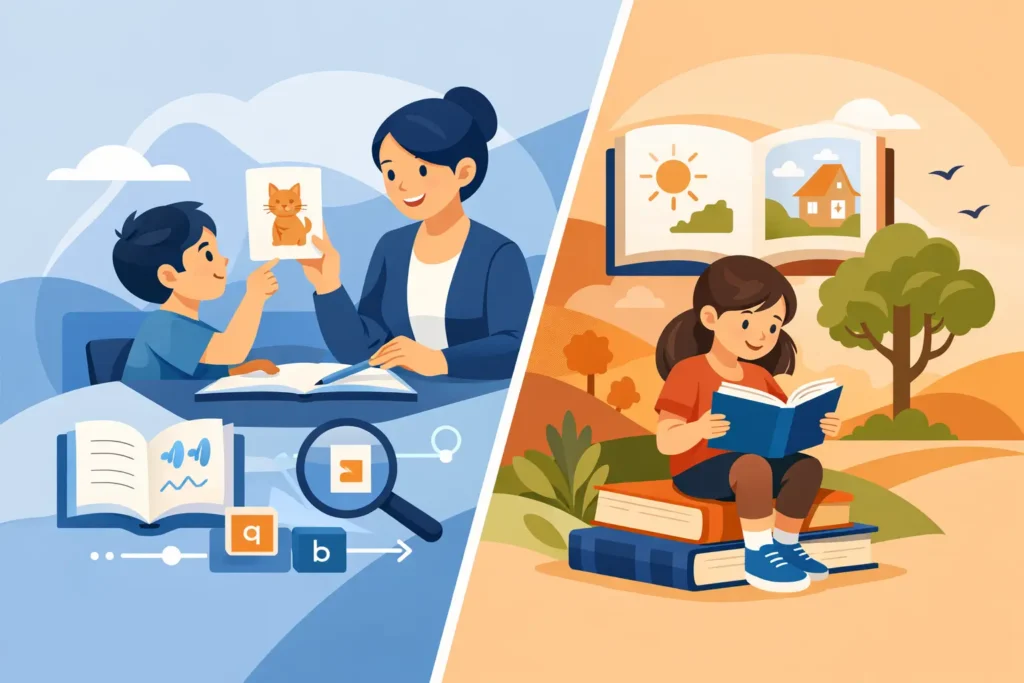
At a simple level, phonics teaches children that letters and letter combinations represent sounds. Whole language focuses more on meaning, exposure to real books, and the idea that reading develops naturally when children are surrounded by print. Both approaches care about helping children read, but they get there in very different ways.
For most families and classrooms, the real question is not which side sounds better on paper. It is which approach gives young readers the tools they need when reading gets hard.
What is phonics?
Phonics is an approach to reading instruction that teaches the relationship between letters and sounds. Children learn that the letter m stands for the /m/ sound, that sh makes a blended sound, and that words can be broken into smaller sound parts and then blended together.
This matters because English is not a language children can reliably guess their way through. Even though some words are irregular, many can be decoded if a child knows basic sound patterns. When a child sees cat and can say /c/ /a/ /t/ and blend those sounds, that is phonics in action.
Good phonics instruction is usually explicit and sequential. Children start with simple letter-sound relationships, then move into blending, segmenting, digraphs, long vowels, and more complex spelling patterns. It is structured, and that structure is often especially helpful for beginning readers, struggling readers, and children who need extra repetition.
What is whole language?
Whole language is based on the idea that reading is learned much like spoken language – through meaningful exposure, rich literature, and authentic use. Instead of focusing heavily on decoding skills in isolation, this approach encourages children to use context clues, pictures, sentence patterns, and prior knowledge to make sense of text.
In a whole language setting, a teacher may read aloud often, surround children with books, encourage writing from an early age, and emphasize comprehension and enjoyment. These are valuable goals. Children absolutely benefit from hearing strong language, talking about stories, and connecting reading to real meaning.
The challenge comes when children face words they do not know and do not have enough decoding skill to work them out. Pictures and context can help sometimes, but they are not reliable for every text. As books become more complex, guessing stops being enough.
Phonics vs whole language: the biggest difference
The biggest difference in phonics vs whole language is how children are taught to figure out words. Phonics teaches children to decode words by looking at the letters and matching them to sounds. Whole language encourages children to focus more on meaning and use multiple cues, such as pictures or sentence context.
That difference may seem small at first, especially in preschool or kindergarten when books are simple and repetitive. But it becomes much more important as children move into first grade, second grade, and beyond. At that point, readers need a dependable strategy for new words, not just familiar patterns.
A child using phonics might see the word sun and sound it out. A child relying mostly on whole language might look at the picture, think about what would make sense in the sentence, and make a guess. One approach builds a transferable skill. The other can work temporarily but often breaks down with harder text.
Why phonics gets more support today
Over time, reading research has pointed strongly toward the importance of explicit phonics instruction, especially in the early years. That does not mean children should only do drills or worksheets all day. It means they need direct teaching in how written words work.
Phonics tends to help children become more accurate readers because it gives them a clear path to solving unknown words. It is also more supportive for children who do not pick up reading naturally through exposure alone. Many children need reading instruction to be taught, not just absorbed.
This is one reason many schools, literacy specialists, and family learning programs now put phonics at the center of early reading. Parents often notice the difference too. A child who once guessed wildly at words may start to slow down, look closely, and actually decode.
Where whole language still offers value
Even though whole language has major limits as a primary reading method, some of its strengths still matter. Children need to know that reading is about meaning, not just sounding out letters. They need rich read-alouds, conversations about stories, chances to write their own ideas, and books that feel enjoyable.
A child who can decode every word but does not understand what they read is not yet a strong reader. Reading instruction should include comprehension, vocabulary, fluency, and motivation alongside phonics.
So this is not a case where one side has nothing to offer. The trade-off is in what should come first and what should carry the most weight. Meaning-rich literacy experiences are important, but they do not replace decoding instruction.
What works best for most children
For most young learners, the strongest approach is structured phonics taught within a language-rich environment. In plain terms, children need direct instruction in letter sounds and word patterns, and they also need stories, discussion, writing, and playful reading experiences.
That balance often works well at home too. You can spend a few focused minutes practicing letter sounds, blending, or simple word families, then read a picture book together and talk about the characters. Those two experiences support each other.
This is often called a balanced literacy approach when done well, but the quality depends on what balance actually means. If phonics is just a tiny add-on and guessing is still the main strategy, that is not likely to help struggling readers. If phonics is taught clearly and consistently while children also enjoy real books, that is a much stronger mix.
How parents can tell what their child needs
One clue is how your child handles unfamiliar words. If they look at the first letter and then guess based on the picture, they may need more phonics support. If they can sound out simple words but read slowly and choppily, they may need more practice building fluency. If they decode well but cannot answer basic questions about the story, comprehension needs attention too.
It also helps to listen to the kinds of mistakes your child makes. Reading horse for house is often a guessing habit based on shape or context. Reading slip as sip may point to difficulty tracking each sound. Those errors tell you a lot.
You do not need to turn your home into a formal classroom. A short, steady routine is often enough. Practice letter-sound connections, read decodable books when appropriate, and keep enjoyable read-aloud time part of the day. Many families find that simple printable activities, sound games, and repeated practice with beginner words make a real difference.
Phonics vs whole language in the classroom and at home
Teachers and parents often feel pressure to make reading fun, and that is understandable. Young children learn best when they are engaged. But fun and structure are not opposites. A child can build words with letter tiles, clap syllables, play sound matching games, and read beginner texts while still enjoying the process.
What matters most is whether the activity teaches children how print works. If a reading lesson mostly asks children to memorize, predict, or guess, it may feel successful in the moment but leave gaps later. If it helps them connect sounds to symbols and apply those skills in real reading, it is setting them up for growth.
That is the kind of support many families are looking for now – practical, clear, and easy to use in everyday routines. At Kids Learning Journey, that means helping parents and educators turn early literacy into something structured enough to build skills and playful enough to keep children involved.
The bottom line on phonics vs whole language
When families ask which method is better, the answer is usually this: phonics is the stronger foundation for learning to read, while whole language practices can still support comprehension and enjoyment when they are not used as a substitute for decoding. Children need more than exposure. They need tools.
If your child is just starting out, struggling with reading, or showing signs of guessing, start with strong phonics support and build from there. A child who knows how to work through a new word gains something bigger than a reading skill. They gain the confidence to keep going.