A bored child can turn a quiet afternoon upside down in about five minutes. That is exactly why Color Hunt Games For kids work so well – they are quick to set up, easy to adapt, and packed with real learning. When children search, sort, match, and describe colors, they are doing much more than staying busy. They are building observation skills, vocabulary, focus, and early academic confidence through play.
For preschoolers and early elementary learners, color games feel naturally inviting. Young children notice bright objects first, and that makes color-based activities a smart entry point for everything from speaking and listening to early science and math. If you want a low-prep activity that gets kids moving, talking, and thinking, a color hunt is one of the easiest tools to keep in your back pocket.
Why color hunt games are more than just fun
At first glance, a color hunt looks simple. You ask a child to find something red, blue, or yellow, and off they go. But under that simple task, a lot of learning is happening.
Children practice visual discrimination when they look for specific colors in a room, classroom, or outdoor space. They strengthen expressive language when they name what they found and describe it using full sentences. They also build categorization skills by grouping objects by color, shade, size, or use. For younger learners, this supports school readiness. For kindergarten and first grade students, it can reinforce vocabulary, attention, and following directions.
Color hunts also help with movement breaks. If your child has been sitting too long during worksheets, reading practice, or table work, this kind of game can reset energy without losing the learning focus. That makes it especially helpful for homeschooling families, preschool classrooms, and parents trying to reduce screen time without hearing, “I’m bored” every ten minutes.
How to set up Color Hunt Games for kids
The best part is that you do not need special supplies. In most cases, you only need the space around you and a clear goal.
Start by choosing the colors you want to focus on. For younger children, begin with basic colors like red, blue, yellow, and green. Older kids can handle more specific shades like pink, gray, turquoise, or brown. Then decide whether children will collect items, point to them, draw them, photograph them, or simply call them out.
It helps to set a few simple rules before you begin. For example, children can search only in one room, only find safe objects, or bring back just one item per color. This keeps the activity manageable and prevents the game from turning into a messy treasure pile.
You can also shape the activity around your learning goal. If you want to encourage speech, ask children to describe each item they find. If you want to add math, have them count how many objects they found in each color. If you are working on beginning sounds, ask them to name the object and identify its first letter.
10 easy color hunt game ideas
1. Classic indoor color hunt
This is the easiest place to start. Call out a color and have children find one object in the room that matches. Once they return, ask, “What did you find?” and “Can you use it in a sentence?” That small language step turns a simple game into a meaningful learning activity.
2. Outdoor nature color hunt
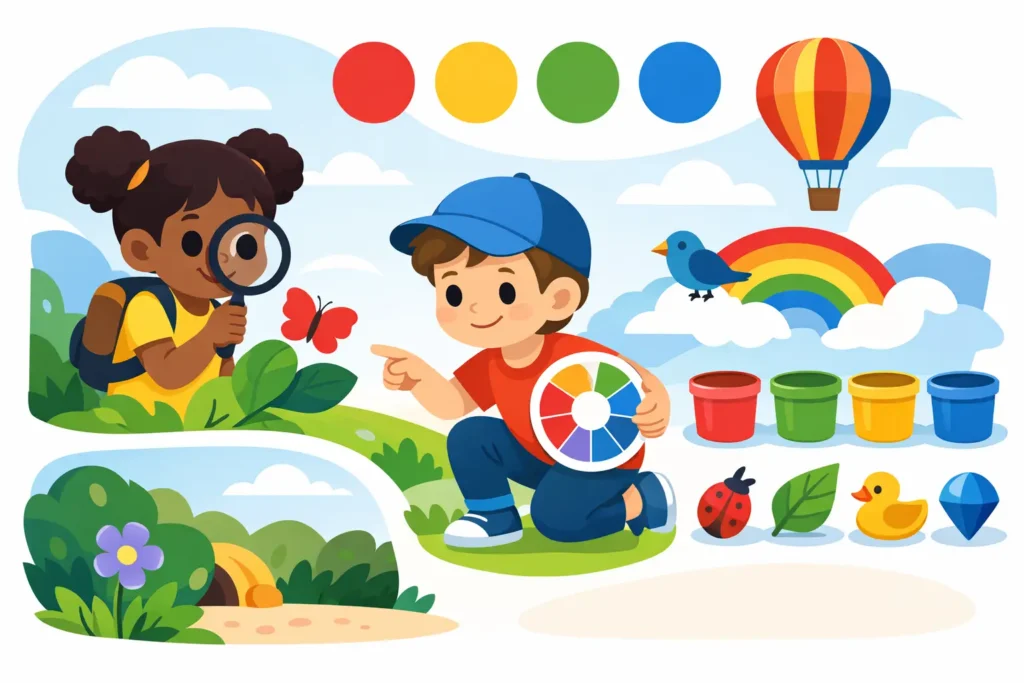
Take the game outside and look for colors in nature. Children might spot green grass, brown bark, yellow flowers, or a gray rock. This version adds science observation and helps children notice details they would usually rush past.
For some children, nature colors can be trickier than toy colors because shades vary. That challenge is a good thing. It teaches flexibility and careful looking.
3. Color hunt with sorting trays
Have children gather small safe items and sort them into bowls, baskets, or paper circles labeled by color. This works especially well for preschool and pre-K because it combines movement with classification. If you want to stretch the lesson, ask which group has more, fewer, or the same number.
4. Rainbow scavenger hunt
Challenge children to find one item for each color of the rainbow. This gives the game a clear structure and encourages persistence. If a child gets stuck on indigo or violet, it is perfectly fine to simplify the task and focus on red, orange, yellow, green, blue, and purple.
5. Color and letter hunt
Ask children to find a blue object that starts with B or a green object that starts with G. This is a great bridge between playful movement and early literacy. It works best with children who already know many letter sounds, but younger learners can still participate with help.
6. Color clue hunt
Instead of naming the object, give clues. You might say, “Find something red that we use when we draw,” or “Find something yellow that you eat at breakfast.” This version supports listening comprehension and problem-solving.
7. Timed color hunt
Set a timer for one or two minutes and ask children to find as many objects as they can in one color. Timed games add excitement, but they are not always the best choice for every child. Some children thrive on the challenge, while others feel rushed. If needed, keep it untimed and focus on careful searching instead.
8. Color hunt and graph
After the hunt, count the items and make a simple graph using blocks, stickers, or drawn boxes. Which color had the most objects? Which had the least? This adds an early math layer without making the activity feel like a lesson.
9. Mystery bag color hunt
Place colored paper squares or crayons in a bag. A child pulls one out and then finds an object that matches. The surprise element keeps children engaged and makes repeated rounds more fun.
10. Partner color hunt
In a classroom or sibling setting, pair children together. One child calls the color, and the other searches. Then they switch roles. This builds turn-taking, listening, and cooperation along with color recognition.
Skills children build during a color hunt
One reason these games are so useful is that they support several areas of development at once. Children practice color recognition first, of course, but they also strengthen memory, attention, and oral language. When they compare shades, sort items, or count objects, they are using early math thinking. When they move around a room or playground, they are getting sensory and physical input that can improve focus.
This is why simple activities often work so well for young learners. They do not divide learning into neat boxes the way adults do. A child on a color hunt may be learning science words, using descriptive language, following directions, and practicing self-control all in one short game.
Tips for preschoolers, kindergarteners, and early elementary kids
For preschoolers, keep directions short and use only a few clear colors. It is best to choose familiar objects and allow plenty of repetition. Young children often enjoy finding the same color more than once, and that repetition helps the learning stick.
For kindergarteners, you can add structure by asking for one object per color, having them sort what they find, or using sentence frames like “I found a red ball.” This supports both academic language and confidence.
For first and second grade students, increase the challenge by adding clues, graphing, writing, or categories. Ask them to find something blue that is larger than their hand, or three green things from nature. At this age, the game can grow with their thinking skills.
Making color hunts feel fresh
If a child loses interest, the answer is usually not more materials. It is a small twist in the activity. Change the location from the living room to the backyard. Ask children to sketch what they find instead of carrying it back. Turn the game into a clean-up challenge by saying, “Can you put away all the red toys first?” Even routine chores can become playful when color is the focus.
You can also tie the hunt to seasons and themes. In fall, look for red, orange, and yellow leaves. In spring, search for flower colors. During a transportation unit, find toy vehicles by color. During literacy time, match colored objects to alphabet cards. That flexibility is one reason educational brands like Kids Learning Journey often focus on play-based learning that can connect across subjects.
A few common mistakes to avoid
The biggest mistake is making the activity too complicated too soon. If you give too many directions, children may forget the goal and become frustrated. Start simple, then add one extra layer only when they are ready.
Another common issue is choosing colors that are hard to distinguish, especially for very young children. Similar shades can be confusing. That is not a problem in itself, but it can make an easy game feel harder than it needs to be.
It also helps to remember that some children are less interested in racing around to find objects. They may prefer pointing, matching picture cards, or using crayons to record what they see. A color hunt still counts even if it looks calmer than you expected.
Color hunts are one of those rare activities that ask very little from adults while giving children a lot in return. With just a few prompts and the space around you, you can turn everyday moments into playful practice that supports learning in a way children actually enjoy.