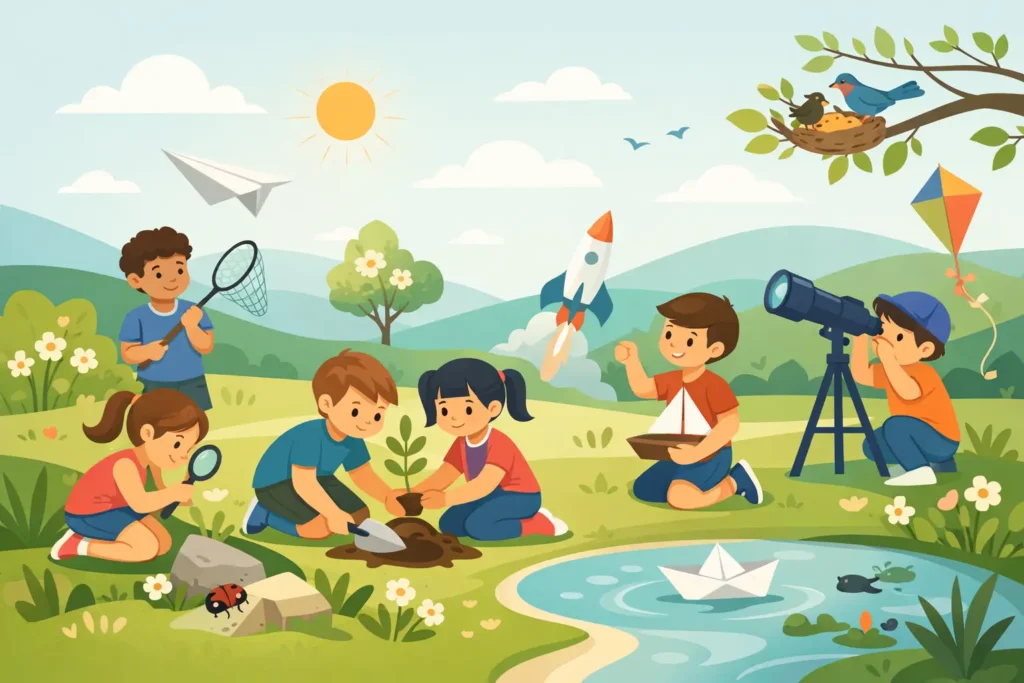
When the weather starts warming up, many parents and teachers feel the same pull – get the kids outside, use up some energy, and make the most of the season. The best spring activities for kids do more than fill an afternoon. They can build early literacy, strengthen math skills, encourage curiosity, and give children a healthy break from screens.
Spring is especially useful for learning because it naturally gives children things to notice like:
Seeds sprout
Rain puddles appear
Bugs return.
Colors change
Young kids learn best when they can touch, observe, sort, compare, and talk about what they see, so this season gives you an easy way to turn everyday moments into meaningful practice.
Why spring activities for kids work so well
For preschoolers and early elementary children, hands-on learning tends to stick better than abstract instruction alone. A worksheet can help reinforce a skill, but a child who counts flower petals, describes cloud shapes, or measures a growing plant is connecting that skill to real life.
That matters for busy families and classrooms. If a child is restless, reluctant to practice letters, or bored with routine, seasonal activities can lower resistance. The learning feels lighter, but the skill-building is still there.
There is one trade-off to keep in mind. Outdoor and seasonal activities are often more flexible than formal lessons, which is great for engagement but can feel messy if you prefer a clear structure. A simple fix is to choose one learning goal before you begin, such as letter sounds, counting, observation, or fine motor practice.
15 spring activities for kids that blend learning and play
1. Nature letter hunt
Write a few target letters on paper or call them out one at a time, then ask children to find natural items that begin with those sounds. B might be bark or bud. R might be rock or robin.
This works well for early phonics because children are hearing a sound, connecting it to a word, and matching it to something real. For younger children, start with just three letters. For older children, ask them to think of multiple words for each sound.
2. Sidewalk chalk story paths
Instead of simply drawing pictures, create a path with simple prompts. Draw a sun, a puddle, a flower, and a bird, then invite your child to tell a story using each image in order.
This is a gentle way to build oral language and sequencing skills. If your child is ready, have them dictate one sentence for each part of the story and write it down for later reading practice.
3. Seed planting journals
Planting seeds is a classic spring activity because it gives children a reason to return, observe, and record. Even a small cup with soil and bean seeds can become a mini science lesson.
Ask children to draw what they see every few days. They can measure height with cubes, compare leaf sizes, or talk about what plants need to grow. The journal does not need to be fancy. A few pages stapled together are enough.
4. Rainy day measurement fun
Spring weather is unpredictable, which makes it useful. On a rainy day, place small containers outside and compare how much water each one collects.
Children can talk about more, less, full, and empty. Older kids can estimate, count spoonfuls, or line containers up from least to most. This kind of math practice feels playful but still builds vocabulary and comparison skills.
5. Bug observation walks
Many children are naturally interested in insects, even if they are a little hesitant at first. A short walk to look for ants, ladybugs, caterpillars, or butterflies can support both science and language.
Encourage your child to describe what they see using simple words like tiny, striped, fast, or crawling. If they are ready for more, ask them to compare two bugs or draw one from memory when they get back inside.
6. Flower petal counting
If you have access to dandelions, daisies, or other common blooms, flower petal counting is an easy spring math activity. Count petals, sort flowers by size or color, and compare which has more or fewer.
For very young learners, stop at counting. For kindergarten-aged children, add simple addition by combining petals from two flowers or subtracting a few petals and counting what remains.
7. Spring scavenger hunts
A scavenger hunt is one of the most flexible spring activities for kids because you can match it to almost any age or subject. Younger children can look for colors, shapes, or simple items like a leaf or a feather. Older children can search for things that are rough, smooth, tall, curved, or living.
This kind of activity supports observation and vocabulary while keeping children moving. If you want more structure, limit the hunt to five items and ask children to draw or label what they found.
8. Mud kitchen pretend play
Messy play is not always convenient, but it is incredibly engaging. A simple mud kitchen with old bowls, spoons, and cups gives children a chance to mix, pour, scoop, and create.
This supports sensory learning, fine motor development, and imaginative language. You can also add light academic practice by asking children to make three mud cupcakes, fill a cup halfway, or follow a two-step direction.
9. Spring rhyme baskets
Gather a few seasonal objects or pictures such as bee, leaf, snail, rock, and flower. Then play a rhyming game by asking which words sound alike or by coming up with silly matches.
Rhyming helps strengthen early phonological awareness, which is an important pre-reading skill. It does not need to be perfect. Young children benefit simply from listening to sounds and noticing patterns.
10. Birdwatching tally charts
Children do not need to know bird species to enjoy birdwatching. Sit by a window or go outside with a simple tally chart and count every bird you see.
This is a great way to practice one-to-one counting and data collection. If children notice color differences or size differences, turn that into a conversation too. Which birds did we see most often? Which did we see least?
11. Puddle jumping with directions
Gross motor play can support listening skills when you add simple directions. Ask children to jump over the puddle, stomp beside it, tiptoe around it, or take two giant steps past it.
This helps with positional words and following directions while giving children the movement they often need. If puddles are not available, use chalk circles instead.
12. Leaf and flower pattern making
Collect natural materials and use them to build patterns such as leaf-flower-leaf-flower or rock-stick-rock-stick. Patterning is a foundational early math skill, and spring gives you plenty of free materials to work with.
If your child catches on quickly, ask them to extend your pattern or invent one of their own. That shift from copying to creating is where deeper understanding starts to show.
13. Outdoor alphabet tracing
Take letter practice outside with a paintbrush and water on a fence, chalk on the driveway, or fingers in dirt or sand. Many children who resist pencil-and-paper work are much more willing to trace letters in a larger, more playful format.
This kind of practice supports letter formation without the pressure of a formal handwriting lesson. It can be especially helpful for children still building hand strength.
14. Spring sorting trays
Fill a tray or basket with safe seasonal items such as pebbles, leaves, petals, seed pods, and twigs. Then invite children to sort by color, size, texture, or type.
Sorting develops classification skills, vocabulary, and visual discrimination. It is also easy to adjust. A preschooler may sort into two groups, while an older child may explain the rule behind each category.
15. Weather chart routines
A simple daily weather chart can become a calm and useful spring routine. Each day, children can describe the sky, temperature, wind, or rain and record it with words, drawings, or symbols.
Over time, this builds observation skills and introduces simple graphing and comparison. It also gives children practice talking about change, which is one of spring’s biggest themes.
How to make spring learning manageable
You do not need to do all 15 activities, and you do not need a perfect setup. In most homes and classrooms, the best approach is to choose two or three activities that match what your child is already working on.
If your goal is literacy, focus on nature letter hunts, rhyme baskets, and outdoor alphabet tracing. If you want more math, try petal counting, pattern making, and bird tally charts. If your child mostly needs movement and attention support, scavenger hunts and puddle direction games may work better than anything that requires sitting still.
It also helps to keep materials simple. Paper, crayons, chalk, cups, and a small notebook can carry a lot of learning. When activities are easy to repeat, children get more practice without it feeling repetitive.
For families who like extra structure, this is where printable supports can help. A simple observation page, tracing sheet, or counting record can turn a fun activity into a more complete lesson. Kids Learning Journey often centers this kind of practical balance – playful enough to keep children engaged, structured enough to support real progress.
Spring does not last long, and that is part of what makes it useful. It gives children a season full of change to observe, talk about, and learn from, one simple activity at a time.