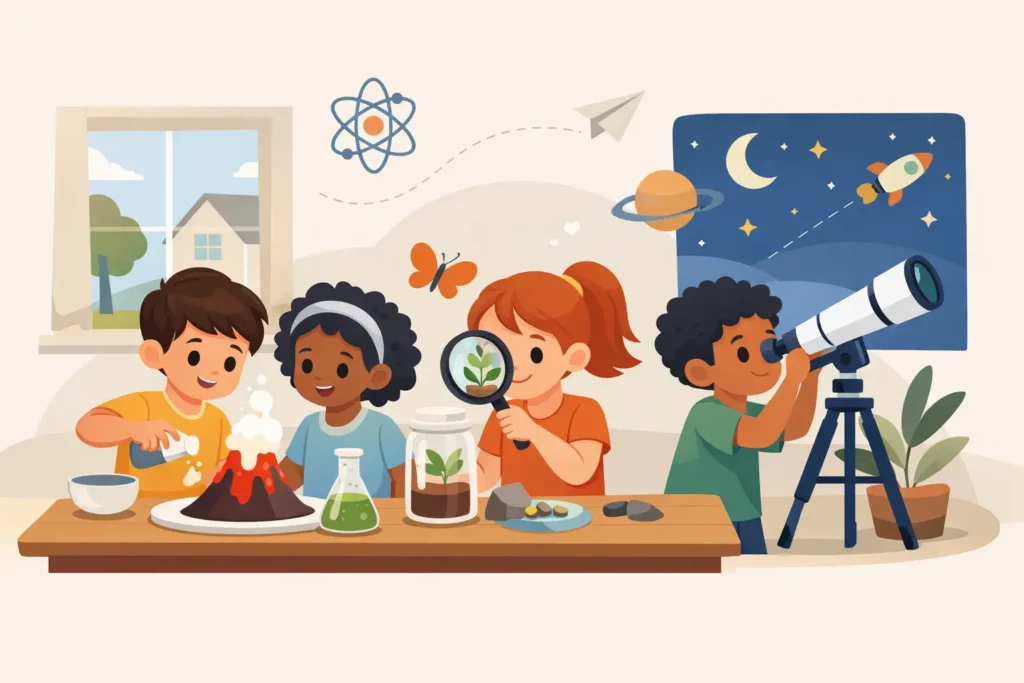
A cup of water, a few ice cubes, and a child asking, “Why did it melt?” – that is often all it takes to turn an ordinary afternoon into real learning. Preschool science activities at home do not need special kits or long prep. What matters most is giving young children a chance to observe, predict, test, and talk about what they notice.
For preschoolers, science is less about memorizing facts and more about building habits of curiosity. They learn by touching, pouring, comparing, and asking the same question five different ways. That can feel messy, and sometimes a little slow, but it is also exactly how early learning grows. When science is playful and simple, it supports language development, early math, fine motor skills, and confidence all at once.
Why preschool science activities at home matter
At this age, children are natural scientists. They notice which objects sink, which colors mix, and what happens when a shadow moves across the floor. Home is a perfect place to build on that curiosity because the materials are familiar and the learning feels safe.
Science also gives preschoolers practice with skills they will need in kindergarten. They learn to make observations, compare results, describe changes, and follow simple steps. Just as important, they learn that it is okay not to know the answer right away. That mindset can be more valuable than getting the “right” result.
There is one helpful trade-off to keep in mind. The more open-ended an activity is, the more room there is for creativity and conversation, but the less predictable it becomes. If your child does better with structure, keep the activity short and guide it with one clear question. If your child loves exploring, you can allow a little more freedom and follow their lead.
How to make science feel manageable
You do not need to set up a full lesson. A strong preschool science activity usually has three simple parts: a question, a test, and a chance to talk about what happened. Even two or three sentences of conversation can make the activity more meaningful.
It also helps to keep expectations realistic. Preschoolers may lose interest halfway through, repeat the same action over and over, or focus on the mess instead of the concept. That does not mean the activity failed. Repetition is part of learning, and sensory play is often what keeps them engaged long enough to notice a scientific idea.
12 preschool science activities at home to try
1. Sink or float
Fill a bin or bowl with water and gather a few safe household objects like a spoon, cork, block, leaf, and toy car. Before placing each item in the water, ask your child to guess whether it will sink or float.
This activity introduces prediction and observation in a very clear way. The best part is that preschoolers can test the same idea with new objects again and again. If your child is ready for more, talk about size versus weight. A big sponge may float while a small coin sinks, which can be surprising and memorable.
2. Color mixing with water
Set out clear cups of water and add red, yellow, and blue food coloring. Give your child an eyedropper or spoon and let them combine colors in empty cups.
This is simple science, but it also builds hand strength and color vocabulary. If food coloring feels too messy for your space, washable paint in small amounts can work too. The trade-off is that paint shows color changes well, while colored water is easier to pour and compare.
3. Melting race
Place ice cubes in different spots, such as a sunny windowsill, a shady table, and a bowl of warm water. Ask your child which one will melt first.
Preschoolers love seeing fast results, and this one gives them a concrete way to notice temperature and change. You can make it even more engaging by freezing small plastic toys in ice and letting your child “rescue” them as the ice melts.
4. Baking soda and vinegar fizz
Put a spoonful of baking soda in a cup or tray, then let your child add vinegar with a dropper. The fizzing reaction is exciting and easy to repeat.
It is tempting to treat this as just a fun reaction, but the learning happens in the conversation. Ask what they hear, what they see, and whether adding more vinegar changes anything. If your child is sensitive to loud sounds or strong smells, start with very small amounts.
5. Growing seeds in a bag
Place a damp paper towel and a few bean seeds inside a clear zip-top bag, then tape it to a window. Over several days, your child can watch roots and sprouts appear.
This activity works well if you want to stretch science over time instead of doing everything in one sitting. It also teaches patience, which is not always easy for preschoolers. Checking the bag each day gives children a reason to observe and describe gradual change.
6. Shadow play outside
Take chalk outside on a sunny day and trace your child’s shadow. Come back later and trace it again.
Children quickly notice that the shadow moved, even if they do not fully understand why yet. That is okay. Preschool science does not need a long explanation. A simple question like, “Why do you think your shadow changed?” is enough to spark thinking.
7. Nature sorting
Go on a short walk and collect leaves, rocks, sticks, or flowers. Back at home, sort them by color, size, texture, or shape.
This blends science with early math beautifully. Your child is learning to observe details and classify objects, which is a basic science skill. If collecting outdoors is not practical, you can use pantry items like dry pasta, beans, and cereal pieces for a similar sorting activity.
8. Magnet hunt
Give your child a magnet and test which objects around the house it attracts. Try paper clips, a spoon, a toy block, a key, and a plastic lid.
This feels almost magical to preschoolers, which makes it memorable. Be sure to supervise closely and keep small items away from children who still mouth objects. Safety matters more than squeezing in every experiment.
9. Rain cloud in a jar
Fill a clear jar with water, add a layer of shaving cream on top, and drop colored water onto the “cloud.” As the color falls through, your child can watch a simple model of rain.
This is a great visual for weather discussions. It is not a perfect scientific model, and that is fine. For preschoolers, the goal is to connect what they see in the jar with what they notice outside.
10. What dissolves in water?
Set out cups of water and test small amounts of sugar, salt, flour, and rice. Stir and watch what happens.
This activity helps children compare materials and notice that not everything behaves the same way. It is also a good reminder that science can be slow. Some changes are immediate, and some need stirring, waiting, and another look.
11. Balloon static experiment
Rub a balloon on hair or clothing, then see if it can pick up tiny paper pieces or stick to a wall. Preschoolers usually find this surprising and funny.
Dry air helps, so results can vary depending on your home and the weather. If it does not work well the first time, that can become part of the lesson. You can say, “Let’s try a different spot,” and show that science sometimes involves adjusting and testing again.
12. Sound shakers
Fill small containers with different materials like rice, beans, coins, or pom-poms. Let your child shake them and compare the sounds.
This builds listening skills along with scientific observation. Ask which shaker sounds loudest, softest, fastest, or slowest. If you want to connect science with literacy, introduce descriptive words and have your child practice using them.
Tips for better preschool science at home
The most helpful science questions are often the simplest ones. Try asking, “What do you notice?” “What do you think will happen next?” and “How are these different?” These open the door to thinking without putting pressure on your child to perform.
It also helps to repeat favorite activities instead of always looking for something new. Repetition builds confidence, and children often notice more the second or third time. If you use printables or structured learning resources from Kids Learning Journey alongside hands-on activities, that combination can make science feel both playful and purposeful.
If mess is a barrier, choose activities with water, ice, or sorting before moving to fizzing or colored liquids. If time is the issue, remember that even ten minutes counts. A short, calm activity usually works better than an elaborate setup that feels stressful to manage.
When to step in and when to let your child lead
Some preschoolers want constant help, while others want to do every step themselves. It depends on age, temperament, and experience. If your child is getting frustrated, step in just enough to keep the activity going. If they are deeply engaged, resist the urge to explain everything too quickly.
That balance matters. Children learn more when they feel ownership, but they also benefit from gentle guidance and vocabulary support. Your role is not to turn home into a classroom. It is to make room for curiosity and help your child put words to what they are already discovering.
Science at this age can be wonderfully ordinary. A puddle, a seed, a magnet, or a melting ice cube can become a real lesson when a caring adult slows down long enough to notice it too.