
What if 15 minutes with a simple piece of paper could spark more joy and build stronger foundational skills than an hour in front of a screen? It’s a question many parents and teachers are asking themselves in 2026. It’s tough to sift through the endless digital apps and low-quality printables online, all while feeling that little pang of screen-time guilt. You just want to find something that works, something that helps your child get ready for school without the tech-battles.
This guide is your answer. We’ll show you how the right kind of preschool activity sheets can transform learning from a chore into a cherished moment of connection and discovery. You’ll discover exactly how to use these powerful tools to build critical pre-writing, literacy, and numeracy skills, all while watching your child’s confidence blossom. Forget the busy work; it’s time for play-based learning that creates visible progress and happy, engaged kids. Let’s explore how to create a joyful learning journey, one page at a time.
Key Takeaways
- Discover how simple printables can reduce screen time and transform learning into a joyful, play-based activity.
- Learn the key criteria for choosing effective preschool activity sheets that spark curiosity without causing cognitive overwhelm.
- Uncover a balanced approach to early learning by focusing on five foundational pillars for well-rounded development.
- Find out how to easily turn any worksheet into an engaging, multi-sensory experience your child can enjoy again and again.
The Magic of Preschool Activity Sheets: More Than Just Paper and Pen
Imagine a quiet afternoon, a cup of tea for you, and a colorful new activity page for your little one. This is the simple magic we’re talking about. Preschool activity sheets are so much more than just a way to pass the time; they are thoughtfully designed tools that turn playtime into a powerful learning experience. In a world full of glowing screens, these printables offer a gentle, hands-on alternative that engages a child’s mind and body in a way digital apps simply can’t.
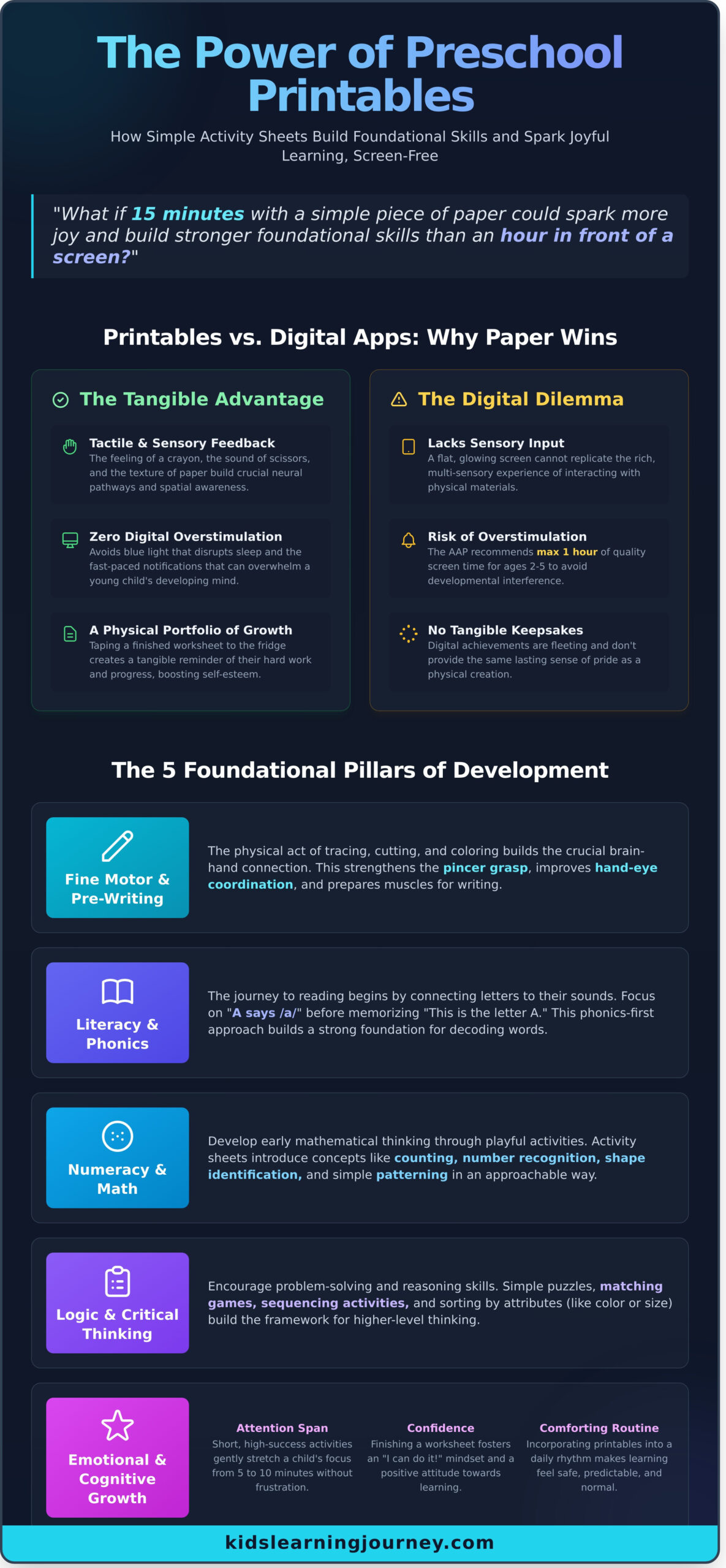
The real power lies in the brain-hand connection. When your child picks up a crayon to trace a letter or grips scissors to cut along a dotted line, they aren’t just making marks on paper. They are building crucial neural pathways between their brain and their hands. This physical act strengthens fine motor skills, improves hand-eye coordination, and refines the pincer grasp needed for writing later on. It’s a foundational process that supports everything from buttoning a coat to holding a pencil correctly in kindergarten.
The Foundational Benefits of Early Learning Printables
Beyond the ABCs and 123s, these simple pages help grow a happy, confident learner. They build the emotional and mental skills that are the bedrock of a successful educational journey. Here’s how:
- Building Attention Span: A preschooler’s focus can be short, often lasting just 5 to 10 minutes. A short, high-success activity, like a one-page matching game, meets them where they are and helps gently stretch their ability to concentrate without causing frustration.
- Developing the “I Can Do It!” Mindset: Finishing a worksheet, all on their own, gives a child a powerful sense of accomplishment. This feeling of independence builds self-esteem and fosters a positive attitude toward learning new things.
- Establishing a Comforting Rhythm: Children thrive on predictability. Incorporating a fun worksheet into your daily routine, perhaps after breakfast or before naptime, creates a comforting and stable rhythm that makes learning feel safe and normal.
Printables vs. Digital Apps: Why Paper Wins for Pre-K
While technology has its place, the core principles of Early childhood education consistently highlight the importance of hands-on, sensory experiences for development. This is where tangible preschool activity sheets truly shine. They offer unique benefits that a flat, glowing screen cannot replicate, providing a healthier and more developmentally appropriate learning tool for young children.
- Tactile and Sensory Feedback: The feeling of a crayon’s waxy resistance on paper, the sound of snipping with scissors, the texture of the page itself. This rich sensory input helps children understand the world in three dimensions and develops their spatial awareness.
- Eliminating Digital Overstimulation: The American Academy of Pediatrics recommends no more than one hour of high-quality screen time per day for children ages 2 to 5. Printables offer a zero-screen-time alternative that avoids blue-light exposure, which can disrupt sleep patterns, and the fast-paced notifications that can lead to overstimulation.
- A Physical Portfolio of Growth: There is a special joy in taping a finished worksheet to the fridge. This creates a tangible, growing portfolio of your child’s hard work, giving them a physical reminder of how much they have learned and accomplished over time.
The 5 Foundational Pillars of Preschool Activity Sheets
Truly effective learning isn’t about drilling one skill. It’s about nurturing the whole child. Think of high-quality preschool activity sheets as tools that support five key areas of development. This holistic approach ensures your child builds a balanced and strong foundation for their entire educational journey. This method is deeply rooted in established child development principles; a 2018 report from UNICEF on strengthening learning through play highlights how playful activities are essential for cognitive, social, and emotional growth.
A great way to create a well-rounded week is to gently rotate through these pillars. You don’t need a rigid schedule, just a gentle rhythm. Maybe Monday is for fine motor fun, and Wednesday is for exploring letters. Pay close attention to what your child is drawn to. If they are constantly sorting their toys by color, they’re showing a readiness for logic puzzles! Start with simple, foundational sheets in that area to build their confidence. A big win on an easy sheet makes them eager to try the next, slightly harder one.
Literacy and Phonics: The Path to Reading
The journey to reading begins not with memorizing the alphabet, but with connecting letters to their sounds. Focus on “A says /a/” before “This is the letter A.” This small shift makes a huge difference. Interactive sheets, like finding and coloring all the objects that start with the ‘B’ sound, create powerful mental connections. As they grow more confident, you can naturally integrate engaging phonics worksheets to support their first steps in decoding words.
Fine Motor Skills and Pre-Writing
Before a child can write their name, they need to build strength and control in their little hands. This development follows a natural path: from scribbling to making straight lines, then progressing to curves, circles, and finally complex shapes. Using letter tracing worksheets helps build the muscle memory needed for writing. Don’t forget activities like cutting along dotted lines, pasting shapes, and folding paper, which are fantastic for developing hand strength and coordination.
Early Math, Logic, and Social-Emotional Learning
These three pillars work together to build a resilient and curious mind. Early math is more than just counting; it’s about number sense, or understanding that the number ‘3’ represents three physical objects. Logic skills start with simple activities like pattern recognition (red, blue, red, blue) or sorting buttons by size. At the same time, Social-Emotional Learning (SEL) can be nurtured with sheets that ask children to identify emotions on cartoon faces or draw a time they felt happy or brave.
By touching on each of these areas, you give your child a rich and complete learning experience. You’re not just preparing them for school; you’re helping them grow into thoughtful, capable, and kind individuals. If you’re looking for activities that cover all these pillars, you can explore our full collection of printables to find the perfect fit for your child’s learning journey today.
How to Choose the Right Activity Sheets for Your Child’s Stage
Finding the perfect activity sheet can feel like a treasure hunt. You want something that captivates your child’s imagination without causing frustration. The secret isn’t just finding any worksheet; it’s about finding the right one for their unique developmental moment. The best choices balance three simple things: a clear design, age-appropriate challenges, and a big dose of fun.
A preschooler’s world is already full of new information. That’s why an uncluttered activity sheet is so powerful. A single, clear task on a page-like tracing one large letter or connecting five dots-prevents cognitive overwhelm. This focus is key because a typical 3- to 4-year-old has an attention span of about 5 to 10 minutes. A simple, engaging activity that can be completed in that window gives them a wonderful sense of accomplishment and encourages them to try again later.
Never underestimate the “magical charm” of beautiful graphics. High-quality, friendly illustrations spark a child’s natural sense of wonder. A worksheet with a cheerful, well-drawn animal is far more inviting than one with generic clip art. This visual appeal isn’t just for looks; it’s a hook that draws your child into the learning adventure, transforming a simple task into a delightful story.
Assessing Your Child’s Readiness
Before you print, take a moment to observe your child. Are they ready for tracing? Look for the development of their “pincer grasp,” where they confidently pick up small objects with their thumb and forefinger. This fine motor skill is the foundation for holding a crayon correctly. Start with shapes, which children often recognize around age 2-3, before introducing numbers and letters. The goal is to find their “Challenge Zone”-a task that isn’t so easy it’s boring, but not so hard it causes tears. This sweet spot is where confidence grows.
Organizing Your Learning Journey Library
Having a collection of preschool activity sheets ready to go makes learning feel spontaneous and fun. Try creating simple folders on your computer or in a cabinet, labeled with core subjects like “Math Fun” (counting, shapes), “Literacy” (letter tracing), and “Creative Play” (coloring, mazes). For even more ideas, you can explore trusted early learning resources from non-profit organizations that support childhood development. This organization helps you find the perfect activity in seconds.
Consider these two popular methods for your library:
- Printing On-Demand: This approach is flexible and saves paper. You can print exactly what your child is in the mood for that day.
- The Learning Binder: Laminate your most-used sheets and place them in a binder with a dry-erase marker. This is a fantastic, reusable tool for practicing foundational skills like writing their name.
Finally, a simple “Learning Journal” can be a beautiful way to track your journey together. It’s not for grading, but for celebrating. Paste in a completed worksheet or write a note like, “Today, you counted all 5 ducks!” It’s a powerful tool for showing your child how much they are growing.
Transforming Worksheets into Engaging Multi-Sensory Play
A worksheet doesn’t have to be the end of a lesson; it can be the beautiful beginning of a hands-on adventure. With a little creativity, you can transform a simple piece of paper into a powerful, multi-sensory experience that deepens understanding and sparks genuine joy. It’s all about seeing the page not as a test, but as a launchpad for play-based learning. Let’s explore four simple steps to bring your preschool activity sheets to life.
Step 1: Laminate for Longevity and Repeat Play
Your first step is a game-changer. Laminating a worksheet or placing it in a plastic sleeve instantly makes it durable and reusable. A simple tracing page becomes a dry-erase board where your child can practice their letters again and again. This simple act saves paper, reduces prep time for you, and gives your child the freedom to try without the pressure of a permanent mark. It’s a small investment that pays off with hours of learning.
Step 2: Add Fun Manipulatives
Engage your child’s sense of touch by adding physical objects to the activity. This tactile input is critical for brain development in children aged 3-5. Instead of just tracing a letter with a crayon, try these ideas:
- Roll playdough “snakes” to form the letters on an alphabet sheet.
- Place buttons, pom-poms, or Cheerios on counting circles to practice one-to-one correspondence.
- Use small pebbles or beads to fill in the shapes on a coloring page.
This approach helps build fine motor skills, like the pincer grasp, which are foundational for writing later on.
Step 3: Move the Activity Off the Table
Who says learning has to happen at a desk? Changing the environment can completely re-energize an activity. Tape a worksheet to a wall or an easel; writing on a vertical surface strengthens wrist and shoulder muscles. Or, spread out on the floor for some “tummy time” learning, which helps build core strength. Creating a cozy “learning nook” with pillows and good lighting can also make worksheet time feel special and inviting.
Step 4: Create Real-World Scavenger Hunts
Use a worksheet as a prompt to connect learning with the world around you. Is the sheet about the letter ‘B’? Challenge your little one to find a ball, a book, and a banana. A color-matching sheet can become a hunt for red socks, a blue car, and a green leaf from the garden. This powerful technique transforms abstract symbols on a page into tangible, meaningful concepts they can see and touch.
Creative Hacks for the Modern Parent
Turn a line-tracing sheet into a “road map” for small toy cars, making pre-writing practice feel like pure fun. Use watercolors or finger paints on alphabet sheets for a messy, memorable sensory art session that builds letter recognition. You can also create a “Quiet Time Box” filled with laminated preschool activity sheets and dry-erase markers. This provides a fantastic option for independent play that is both engaging and educational.
Building Empathy and Resilience
These activities are a perfect chance to “Grow Together.” Sit beside your child and complete a sheet with them, modeling curiosity and a can-do attitude. When a line goes astray, frame it as a happy “oops” and a chance to try again. Celebrate the effort, the focus, and the giggles along the way, not just the perfectly traced line. This teaches your child that learning is a journey, and every step is worth celebrating.
Ready to turn learning into a playful, hands-on journey? Download our free starter pack of interactive activity sheets and start creating magical moments today.
Start Your Adventure with Kids Learning Journey’s Complete Guides
Your child’s learning path is a beautiful, unfolding story, and you are their most important guide. While this article has shown you the power of individual activities, we believe in providing a complete support system for your family. Our digital library is thoughtfully designed to give you everything you need in one place, from engaging worksheets and creative journals to insightful e-books. We are committed to creating resources that are supportive, gentle, and perfectly suited for beginners, ensuring you feel empowered, not overwhelmed.
Every resource we create is built on our core philosophy: “Read, Write, Grow Together.” This isn’t just a tagline; it’s our promise. We believe learning is a shared experience that strengthens the bond between you and your child. Our materials are designed to spark conversations, inspire curiosity, and create moments of connection. You’re not just teaching letters and numbers; you’re building a foundation of confidence and a lifelong love for discovery. Join a community of over 25,000 parents and educators who are embracing this joyful approach to early education.
Our Signature Phonics and Math Collections
Ready to build foundational skills with confidence? Our best-selling phonics bundles are a perfect starting point. The 75-page “Phonics Fun” collection, for instance, includes over 50 multi-sensory activities that move beyond simple memorization to help children truly hear and understand sounds. Our math worksheets are crafted to make “number talk” a natural part of your day, using relatable scenarios to explore counting, patterns, and shapes. These collections build on essential skills, like those found in our popular alphabet tracing printables, to create a complete early learning toolkit.
E-books and Journals for a Holistic Path
Learning is so much more than worksheets. Our collection of journals helps you document the “magical charm” of your child’s growth, capturing their unique thoughts and developmental milestones in a treasured keepsake. Our e-books provide the “why” behind the “what,” offering gentle guidance on topics like emotional development and play-based learning. They give context to our preschool activity sheets, transforming a simple coloring page into a meaningful conversation about feelings. This integrated approach ensures you’re nurturing the whole child, from their academic skills to their emotional well-being.
Your journey is unique, and we’re here to support you every step of the way. Let’s build a bright future, one playful lesson at a time.
Explore our full collection of educational resources today!
Begin Your Play-Based Learning Journey in 2026
As you’ve learned, the right preschool activity sheets go far beyond simple pen-and-paper tasks. They are powerful, play-based tools for building the 5 foundational pillars of early learning, from mastering the ABCs to understanding big emotions. Remember, you have the unique ability to transform any worksheet into a vibrant, multi-sensory adventure. It’s about turning a simple page into a story, a game, or a hands-on project that captivates your child’s imagination and makes learning feel like pure fun.
You don’t have to create these moments alone. Join the supportive community of over 10,000 parents and teachers who trust our materials, all meticulously expert-designed to support early childhood development. With instant digital access to our complete library, you can stop searching and start playing in the next 5 minutes.
Download Your Complete Preschool Learning Bundle Now!
Your child’s magical journey of discovery is just beginning, and you’re the perfect guide to lead the way. We can’t wait to see you grow together.
Frequently Asked Questions About Preschool Activity Sheets
What age should a child start using preschool activity sheets?
Most children are ready to explore simple preschool activity sheets between the ages of 3 and 4. You can look for key developmental signs, like the ability to hold a crayon and an interest in pictures. The American Academy of Pediatrics notes that by age 3, many children can copy a circle. This is a great indicator they are developing the foundational fine motor skills needed for these fun learning activities, making it a perfect time to introduce them.
How many worksheets should a preschooler do in a day?
It’s best to offer a preschooler just one or two worksheets in a single day. The goal is to keep learning fun and pressure-free, so a session of 5 to 10 minutes is ideal. The National Association for the Education of Young Children (NAEYC) emphasizes that young children learn best through short, playful, and engaging activities. Always follow your child’s lead; if they lose interest after one page, that’s perfectly fine. It’s about quality, not quantity.
What is the best way to organize printable activity sheets at home?
A 3-ring binder with tabbed dividers is a fantastic way to organize your printable activity sheets. You can create sections for different learning areas like “Alphabet,” “Numbers,” “Shapes,” and “Cutting Practice” to easily find what you need. For added durability and reuse, place each sheet in a clear plastic protector. This allows your child to use dry-erase markers on them, saving paper and making practice sessions even more exciting and eco-friendly.
How can I make tracing letters more fun for a child who is struggling?
You can make tracing more fun by turning it into a hands-on sensory activity. Instead of a pencil, let your child trace letters in a shallow tray filled with sand, salt, or even colorful sprinkles. Another great idea is to use shaving cream on a baking sheet or a window. Using rainbow-colored markers or tracing with their finger over a textured surface like sandpaper letters also adds a magical, playful element to the task.
Are free printable worksheets as good as paid curriculum bundles?
Yes, high-quality free printable worksheets can be just as good as paid curriculum bundles for practicing specific skills. Free resources are perfect for targeting one concept, like the letter ‘A’ or the number ‘5’. Paid bundles usually offer a more comprehensive, structured learning path that covers multiple subjects. A 2021 survey by the EdWeek Research Center found that 96% of teachers use free online materials to support their classroom instruction, proving their value.
Can activity sheets help with my child’s social-emotional development?
Yes, activity sheets can be a wonderful tool for your child’s social-emotional development. Look for printables that ask children to identify emotions by looking at faces, draw how they are feeling today, or match feelings to different situations. According to CASEL (Collaborative for Academic, Social, and Emotional Learning), building an emotional vocabulary is a foundational skill. These activities provide a simple way to start important conversations about feelings and empathy.
What supplies do I need to get the most out of preschool printables?
You only need about 5 core supplies to bring your preschool printables to life. Start with a printer, plain paper, a pack of chunky crayons, washable markers, and a glue stick. For activities that involve cutting, a pair of child-safe scissors is essential. To make the fun last longer, you can add optional items like dot markers, fun stickers for rewards, or a personal laminator to make your favorite sheets reusable for endless practice.
How do I know if a worksheet is too advanced for my child?
A worksheet is likely too advanced if your child shows consistent signs of frustration or avoidance. Watch for cues like refusing to try, scribbling over the page instead of following directions, or repeatedly saying “I can’t do it.” A good rule of thumb: if a single step on the sheet requires more than 3 verbal prompts from you, it’s probably best to set it aside and try a simpler activity. Learning should always feel encouraging, not overwhelming.