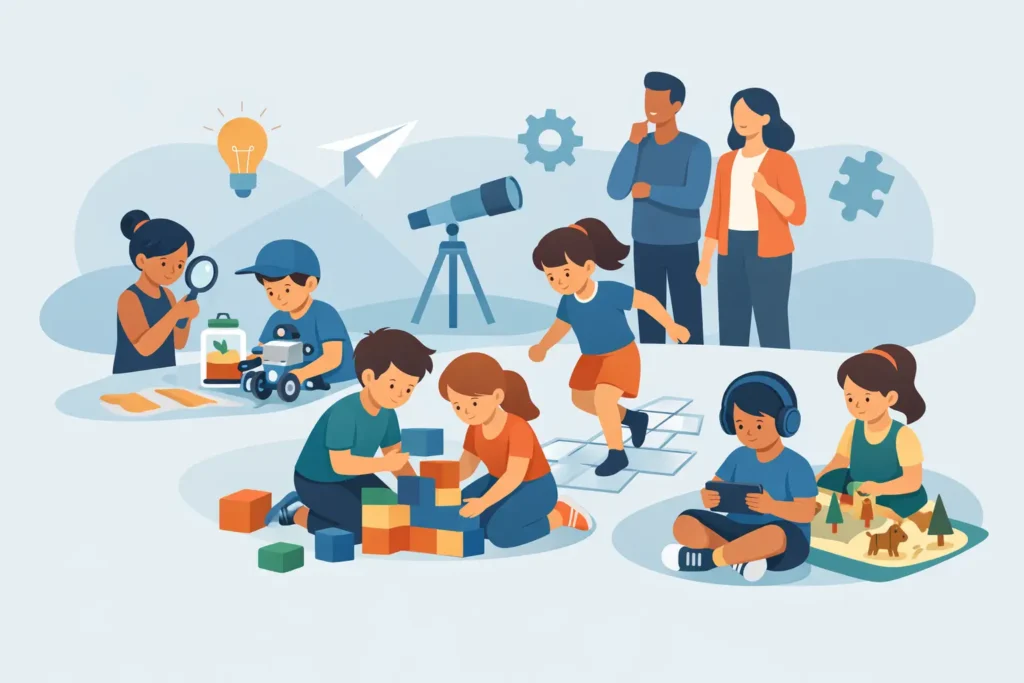
Play is one of the most natural ways children explore the world. When children build, pretend, draw, sort, experiment, ask questions, and create their own games, they are developing skills while actively engaging with their surroundings.
Play-based learning combines the enjoyment and freedom of play with opportunities to develop specific skills. It doesn’t mean turning every game into a lesson. Instead, parents and educators can create an environment where children have meaningful opportunities to explore, practice, communicate, solve problems, and learn.
This guide explains what play-based learning is, why it matters, the different types of play, age-appropriate ideas, and simple ways to bring playful learning into everyday life.
What Is Play-Based Learning?
Play-based learning is an approach in which children learn through play, exploration, interaction, and hands-on experiences.
A child playing with blocks, for example, may be practicing much more than construction. They might be:
-
Counting blocks
-
Comparing sizes
-
Solving problems
-
Learning new vocabulary
-
Planning what to build
-
Telling a story about the structure
-
Practicing fine motor skills
-
Working with another child
The learning doesn’t always need to be obvious to the child.
That’s one of the strengths of play: children can practice important skills while doing something they genuinely enjoy.
Is Play-Based Learning the Same as Free Play?
Not exactly.
Free play gives children substantial control over what they do, how they do it, and how long they continue.
Guided play gives children freedom to explore while an adult provides materials, questions, suggestions, or a learning goal.
Both can be valuable.
For example, during free play, a child might build a tower however they want. During guided play, a parent might ask:
“Can you build a bridge that your toy car can drive under?”
The child still controls much of the activity, but the question introduces a new problem to solve.
Play-based learning can include both approaches.
Why Is Play-Based Learning Important?
Children learn through doing, talking, experimenting, and repeating experiences.
Play can create opportunities to develop several areas at the same time.
Language and communication
Children use language when they:
-
Describe what they are doing
-
Ask questions
-
Tell stories
-
Pretend
-
Explain their ideas
-
Talk with other children
Pretend play can be especially useful because children often need language to create characters, describe situations, and keep a story going.
Early literacy
Literacy doesn’t have to happen only during reading or worksheet time.
A pretend restaurant can involve menus.
A pretend post office can involve names and labels.
A toy shop can involve writing prices.
A puppet activity can involve storytelling.
You can also include direct phonics practice when children are ready. Play-based learning complements explicit instruction; it doesn’t need to replace it.
Explore our [phonics resources] for activities that support early reading skills.
Early math
Play naturally creates opportunities for:
-
Counting
-
Sorting
-
Matching
-
Measuring
-
Comparing
-
Sequencing
-
Pattern recognition
-
Problem-solving
For example, children can count toy animals, sort buttons by size, compare the height of block towers, or create patterns with everyday objects.
Fine motor development
Activities such as drawing, building, threading, puzzles, play dough, cutting, and manipulating small objects can give children opportunities to practice hand and finger movements.
For children developing early writing skills, playful drawing and mark-making can also provide valuable practice.
Social and emotional development
Play can give children opportunities to practice:
-
Taking turns
-
Sharing
-
Negotiating
-
Expressing feelings
-
Handling frustration
-
Solving disagreements
-
Cooperating with others
Adults can support this learning by modeling language and helping children work through difficult moments.
7 Key Play-Based Learning Approaches Parents Should Know
The following approaches are particularly useful when creating playful learning experiences at home.
1. Literacy Through Play
Children can practice language and literacy during everyday pretend play.
Try:
-
Setting up a pretend grocery store
-
Creating a restaurant menu
-
Making signs for a pretend shop
-
Writing simple labels
-
Retelling a favorite story with toys
-
Using puppets to create stories
-
Playing letter or beginning-sound games
The important thing is to give literacy a purpose.
Instead of simply asking a child to write a word, you might say:
“Our restaurant needs a menu. What should we write on it?”
For children who are beginning to write, explore [emergent writing activities] and [creative writing activities].
2. Hands-On Math Play
Use ordinary objects to explore mathematical ideas.
Try:
-
Counting toy animals
-
Sorting objects
-
Measuring water
-
Building towers
-
Comparing quantities
-
Creating patterns
-
Playing simple board games
Ask questions such as:
“Which tower is taller?”
“How many more blocks do we need?”
“What comes next in this pattern?”
These small questions can encourage children to think mathematically without turning play into a formal worksheet.
3. Loose Parts Play
Loose parts are materials children can move, combine, redesign, and use in different ways.
Examples include:
-
Blocks
-
Cardboard tubes
-
Fabric pieces
-
Bottle caps
-
Craft sticks
-
Boxes
-
Stones or shells
-
Magnetic tiles
A cardboard box might become a house, a car, a shop, or a rocket.
There is no single correct way to use an open-ended material, which gives children opportunities to make decisions and develop their own ideas.
4. Pretend and Dramatic Play
Pretend play allows children to explore real-life situations and imaginary worlds.
Ideas include:
-
Grocery store
-
Doctor’s office
-
Restaurant
-
School
-
Post office
-
Animal rescue center
-
Airport
-
Construction site
Add simple props such as paper, boxes, old bags, toy dishes, puppets, or stuffed animals.
Pretend play can also become a powerful storytelling opportunity.
5. Nature-Based Play
Learning doesn’t have to happen indoors.
Try:
-
Nature scavenger hunts
-
Gardening
-
Collecting leaves
-
Water play
-
Mud kitchens
-
Stick building
-
Observing insects
-
Looking for shapes outdoors
-
Counting natural objects
Outdoor play can combine movement, vocabulary, observation, curiosity, and problem-solving.
6. Creative Play
Creative play gives children opportunities to experiment with materials and express ideas.
Offer:
-
Paper
-
Crayons
-
Paint
-
Play dough
-
Recycled materials
-
Child-safe scissors
-
Glue
-
Fabric scraps
Try not to focus too heavily on making the “correct” finished product.
A child’s unusual-looking creation may represent a carefully imagined story or idea.
7. Guided Play
Sometimes a small amount of adult guidance can make an activity more meaningful.
Instead of taking over the activity, try asking questions:
-
“What do you think will happen?”
-
“How could we make it stronger?”
-
“What could we add?”
-
“Can you find another way?”
-
“What should happen next?”
The goal is to extend the child’s thinking while allowing the child to remain an active participant.
Play-Based Learning Ideas by Age
Toddlers
Toddlers benefit from simple activities involving movement, exploration, language, and hands-on manipulation.
Try:
-
Stacking blocks
-
Sorting large objects
-
Water play
-
Board books
-
Simple puzzles
-
Pretend cooking
-
Singing games
-
Drawing with chunky crayons
Keep activities simple and prioritize safe, age-appropriate materials.
Preschoolers
Preschoolers can handle more imaginative and structured play.
Try:
-
Pretend shops
-
Storytelling with puppets
-
Counting games
-
Letter-sound games
-
Play dough
-
Building challenges
-
Nature hunts
-
Matching and sorting activities
-
Cutting and pasting activities
You can also combine literacy and play by creating pretend signs, menus, labels, or story props.
Explore more preschool activities.
Early Elementary Children
Older children may enjoy activities involving more complex problems and longer projects.
Try:
-
Building challenges
-
Board games
-
Creative writing
-
Reading-related games
-
Craft projects
-
Map-making
-
Dramatic storytelling
-
Design-and-build challenges
The goal is to increase the complexity of the play as children’s skills and interests develop.
Toy Rotation and Play-Based Learning
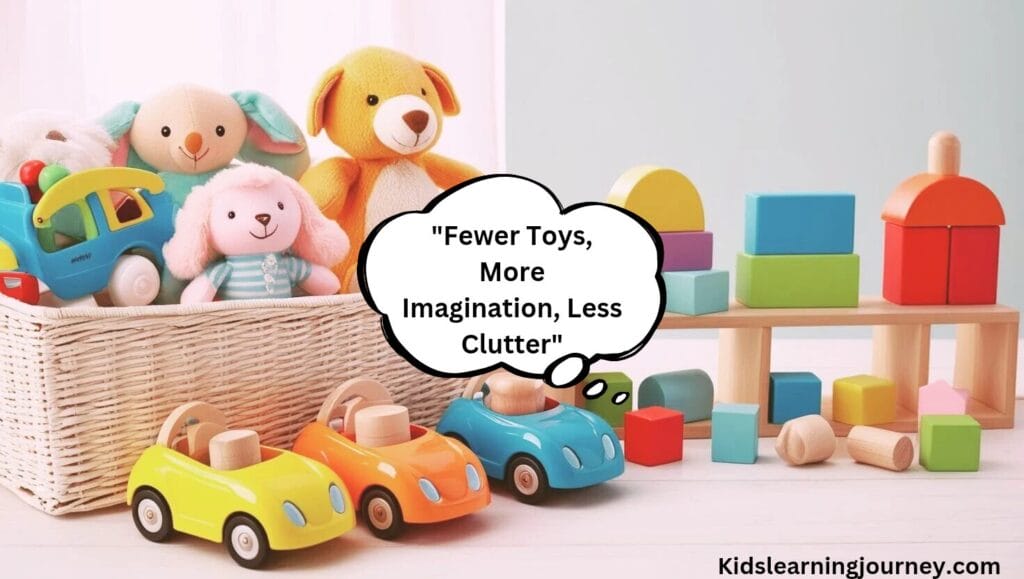
You don’t need dozens of toys to create a strong play-based learning environment.
In fact, a smaller, carefully chosen selection can make it easier for children to see what is available and decide what they want to explore.
Toy rotation is one way to organize the play environment.
You can keep some toys stored away and periodically bring different ones into the play area.
For example, one rotation might include:
-
Building blocks
-
A puzzle
-
Picture books
-
Pretend-play materials
-
An art activity
Another rotation might include:
-
Construction materials
-
Puppets
-
Matching games
-
Different books
-
Play dough
How to Set Up Play-Based Learning at Home
You don’t need a dedicated playroom.
Start with a small, accessible area.
Step 1: Observe Your Child
Notice what your child naturally enjoys.
Do they:
-
Build?
-
Pretend?
-
Draw?
-
Look at books?
-
Sort objects?
-
Ask questions?
-
Move constantly?
Use those interests as your starting point.
Step 2: Choose a Simple Learning Goal
Pick one skill you would like to encourage.
For example:
Language: New vocabulary
Literacy: Beginning sounds
Math: Counting to 10
Fine motor: Cutting
Social skills: Taking turns
Step 3: Choose Open-Ended Materials
Use what you already have whenever possible.
You might need only:
-
Blocks
-
Paper
-
Crayons
-
Books
-
Containers
-
Toys
-
Recycled cardboard
Step 4: Let Your Child Explore
Don’t explain every step.
Give your child time to experiment.
Step 5: Add Gentle Guidance
Ask questions or introduce a small challenge when appropriate.
Then step back and let the child continue.
How to Combine Play With Reading and Writing
Because early literacy is a central part of children’s learning, play can provide opportunities to use reading and writing skills in meaningful situations.
Reading through play
Keep books accessible and connect stories to play.
After reading a story about animals, for example, children could create their own animal world using toys.
Writing through play
Create opportunities for purposeful writing:
-
Make a shopping list
-
Write a pretend menu
-
Create signs
-
Label toys
-
Make invitations
-
Write a short story
-
Create a treasure map
If your child is reluctant to write, start with drawing, labeling, storytelling, and short writing tasks rather than demanding a long paragraph.
You can also explore our [guide to helping reluctant writers].
Phonics through play
For children learning letter sounds, try:
-
Sound hunts
-
Letter matching
-
Beginning-sound games
-
CVC word building
-
Alphabet games
-
Picture sorting
For more ideas, visit our [phonics worksheets and resources].
How Toy Rotation Can Make Play-Based Learning Easier
A crowded play area can make it difficult for children to decide what to do.
Toy rotation can help you create smaller collections of materials with different learning possibilities.
For example:
Building rotation: Blocks + toy animals + books about buildings
Storytelling rotation: Puppets + picture books + drawing materials
Fine-motor rotation: Puzzles + play dough + threading activities
Pretend-play rotation: Toy kitchen + menus + paper + pencils
This allows you to change the play environment without constantly buying new toys.
Play-Based Learning Does Not Mean “No Structure”
One common misunderstanding is that play-based learning means children should simply play all day without guidance.
That’s not the goal.
Children can benefit from:
-
Direct instruction
-
Practice
-
Repetition
-
Books
-
Phonics instruction
-
Writing instruction
-
Play
-
Exploration
The strongest approach depends on the child’s age, developmental stage, learning goal, and individual needs.
Play can make learning more meaningful, but it doesn’t have to replace every other form of instruction.
Common Mistakes to Avoid
Turning Every Activity Into a Lesson
Children need time for unstructured exploration too.
Buying Too Many Educational Toys
More materials don’t automatically mean more learning.
Taking Over the Play
Allow children to make choices and try their own solutions.
Expecting a Perfect Result
Creative play is about exploration, not producing an identical finished product.
Using Screens as the Entire Activity
If technology is used, consider extending it into hands-on play.
For example, after watching a short alphabet activity, go on a letter hunt around the house.
Forgetting Your Child’s Interests
A simple activity connected to a child’s interests can be more engaging than an elaborate activity they don’t care about.
Simple Play-Based Learning Activities
Here are some easy ideas to try at home.
Letter Sound Hunt
Choose a letter sound and search for objects that begin with that sound.
Pretend Grocery Store
Use empty food containers, paper, pencils, and a basket to create a pretend shop.
Children can practice vocabulary, counting, writing labels, and social interaction.
Storytelling Box
Put a few unrelated objects in a box.
Ask your child to choose three and create a story using them.
Block Challenge
Give your child a building challenge such as:
“Can you build a bridge for this toy car?”
Nature Collection
Collect safe natural objects and sort them by size, shape, texture, or color.
Play Dough Letters
Use play dough to form letters, names, or simple shapes.
Story Retelling
After reading a favorite book, use toys or puppets to retell the story.
How Parents Can Support Play Without Taking Over
You don’t have to be your child’s play director.
Often, your role can simply be to:
-
Provide interesting materials
-
Keep the environment safe
-
Observe
-
Ask occasional questions
-
Introduce vocabulary
-
Help when your child gets stuck
-
Give your child time to explore
Sometimes the best thing you can say is:
“Tell me about what you’re making.”
That gives the child an opportunity to explain their thinking.
Final Thoughts
Play-based learning doesn’t require a perfect playroom, expensive toys, or a complicated lesson plan.
It starts with something much simpler: giving children opportunities to explore, imagine, create, communicate, and solve problems.
Parents can support this process by providing thoughtful materials, noticing children’s interests, asking meaningful questions, and connecting play with skills such as reading, writing, math, and language.
And remember, play doesn’t have to look academic to be valuable.
A child building a tower, pretending to run a restaurant, creating a story with puppets, sorting leaves outside, or drawing a map may be developing important skills while simply enjoying being a child.
For more ideas, explore our [phonics worksheets], [creative writing prompts], and [toy rotation for kids].
Frequently Asked Questions
What is play-based learning?
Play-based learning is an approach where children develop knowledge and skills through play, exploration, hands-on experiences, interaction, and meaningful activities.
What are examples of play-based learning?
Examples include pretend play, building with blocks, storytelling, nature exploration, sorting games, art activities, puzzles, board games, sensory play, and playful literacy or math activities.
Is play-based learning good for preschoolers?
Yes. Preschoolers can use play to explore language, early literacy, math, problem-solving, creativity, movement, and social skills.
Does play-based learning replace phonics?
No. Play-based learning and explicit instruction can complement each other. Children learning to read may benefit from direct phonics instruction as well as playful opportunities to practice sounds and words.
How can I start play-based learning at home?
Start with your child’s interests, choose one simple learning goal, provide a few accessible materials, and give your child time to explore. Add gentle guidance when it is useful.
Do I need expensive educational toys?
No. Many play-based activities can use books, blocks, paper, cardboard boxes, household objects, art materials, and other simple resources.