What if the key to unlocking your child’s love for reading wasn’t about memorizing endless lists of words, but about discovering a secret code hidden within the alphabet? A code that, once cracked, turns letters on a page into magical stories and grand adventures.
It’s completely normal to feel a little overwhelmed when thinking about how to teach reading. You worry about doing it the “right” way, you see your child get frustrated with books, and you just want to help them find that spark of confidence. That’s where the power of phonics for kids comes in. In this guide, we promise to gently walk you through the essentials, turning what feels like a challenge into a joyful, play-based journey you can share together. You’ll gain the confidence to guide your child and access fun, ready-to-use activities that actually work.
We’ll cover exactly what phonics is, why it’s the most effective method according to decades of research from the National Reading Panel, and share our favorite printable worksheets to get you started on this exciting reading adventure today.
Key Takeaways
- Understand the simple science behind the ‘Reading Brain’ and why phonics is the key to unlocking your child’s literacy potential.
- Go beyond the ABCs to learn about the 44 foundational sounds of English that form the true building blocks of reading.
- Receive a practical, step-by-step guide for teaching phonics for kids at home, starting with just a handful of high-frequency sounds.
- Cut through the confusion between different teaching methods and discover the most effective and widely-used approach for early learners.
What is Phonics for Kids and Why Does it Matter?
Watching your child begin to unlock the magic of reading is one of the most rewarding parts of parenthood. Suddenly, the squiggles on a page transform into stories, ideas, and entire worlds. But how does this incredible leap happen? The secret ingredient is phonics, the foundational skill that turns letters into sounds and sounds into words. It’s the powerful engine behind lifelong literacy.
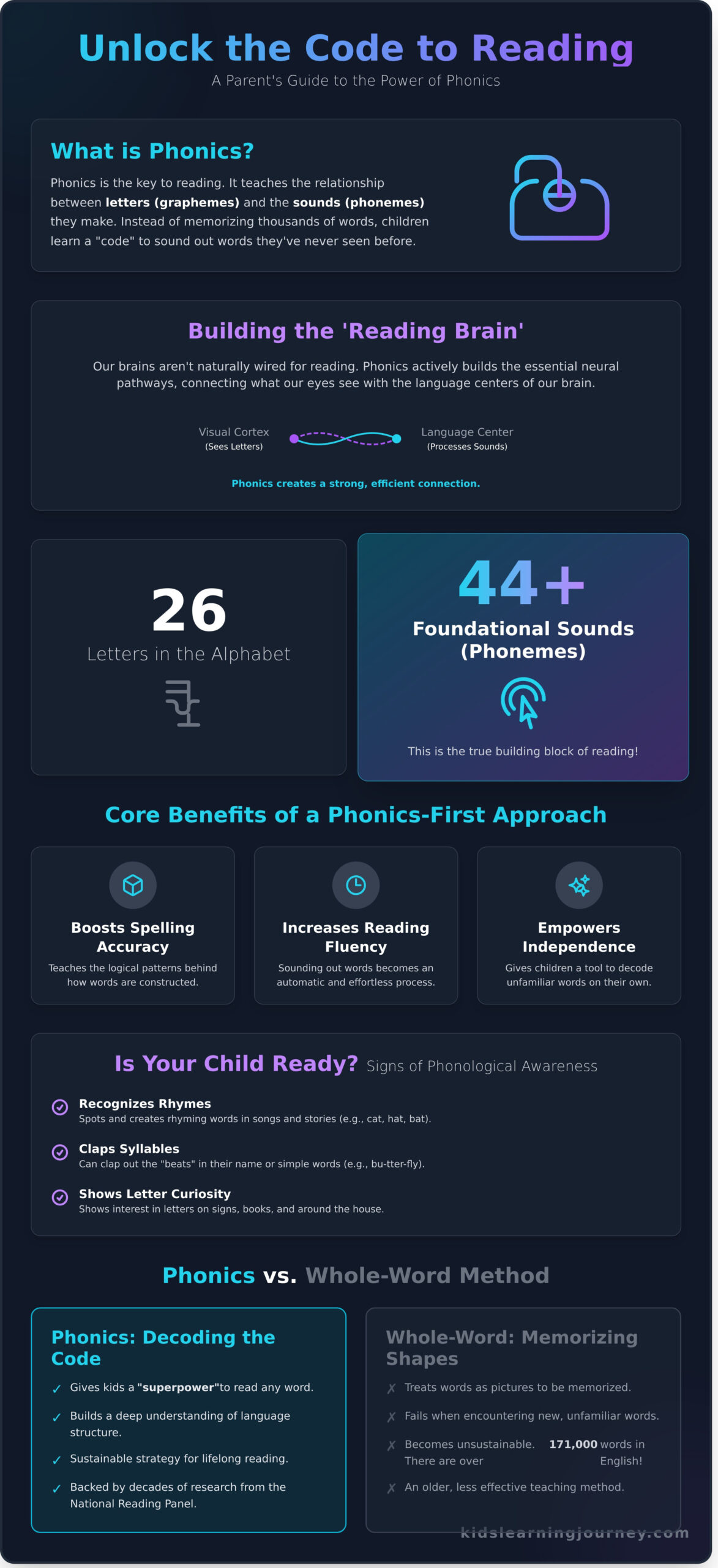
At its core, phonics is simply the relationship between letters and sounds. Think of it as a code. Each letter or group of letters (called a grapheme) represents a specific sound (a phoneme). When children learn the code, they can sound out words instead of just memorizing them. For a deeper look at the methodology, the Wikipedia entry on What is Phonics? offers a complete overview. This systematic approach is crucial because, as neuroscientists like Stanislas Dehaene have shown, our brains are not naturally wired to read. Phonics instruction actively builds the essential neural pathways that connect what our eyes see with the language centers of our brain.
This method stands in stark contrast to older “look-and-say” or whole-word approaches, where children were taught to memorize the shape of entire words. While that works for a few dozen words, it’s not a sustainable strategy for the estimated 171,476 words in the English language. Phonics gives your child a decoding superpower. It equips them with a reliable tool to confidently tackle words they’ve never seen before, building true reading independence.
Looking ahead to 2026 and beyond, in an age saturated with digital content and AI-driven communication, this foundational skill is more critical than ever. Strong decoding ability is the bedrock of reading comprehension, critical thinking, and effective communication. The best programs for phonics for kids don’t just teach reading; they build the framework for a lifetime of learning.
The Core Benefits of a Phonics-First Approach
When children learn through a systematic phonics program, they gain more than just the ability to read. This powerful approach builds a deep understanding of how language works, leading to several key benefits:
- Boosts spelling accuracy by teaching the logical patterns and rules behind how words are constructed.
- Increases reading speed and fluency as sounding out words becomes an automatic, effortless process.
- Empowers children to decode unfamiliar words independently, fostering confidence and a love for reading.
Is Your Child Ready? Signs of Phonological Awareness
Before diving into letters, children first need to be able to hear and play with the sounds in language. This skill is called phonological awareness, and it’s the first step on the phonics journey. You’ll know your child is developing this readiness when you spot these exciting signs:
- Recognizing and creating rhyming words in favorite nursery rhymes or songs (like star and car).
- Clapping out the syllables or “beats” in their name or simple words (e.g., “el-e-phant”).
- Showing curiosity about letters on signs, book covers, and other print in their environment.
The Mechanics of Reading: Sounds, Blending, and Beyond
Diving into the world of phonics for kids can feel like learning a new language, but it’s really about cracking a secret code. You might be surprised to learn that while the English alphabet has 26 letters, they combine to create approximately 44 unique sounds, or phonemes. This is the foundational magic of reading. It’s why we teach children the sound a letter makes (like the /b/ sound in ‘ball’) before we worry too much about its name (‘bee’). Focusing on sounds first gives them the direct tools they need to start building words and unlocking the stories all around them.
Decoding the Basics: Phonemes and Graphemes
At the heart of phonics is the relationship between sounds (phonemes) and the letters or letter groups that represent them (graphemes). This connection is called Grapheme-Phoneme Correspondence (GPC). It’s a simple idea with a powerful impact. This systematic approach, which connects letters to sounds, is the foundation of phonics instruction in schools, as detailed in the UK government’s explanation of phonics. The learning journey progresses logically, building from simple to more complex sound patterns.
- Individual Letter Sounds: The journey begins with the most common sounds for each of the 26 letters. Think of the first sounds in sun, apple, and top. Mastering these single sounds is the first big step.
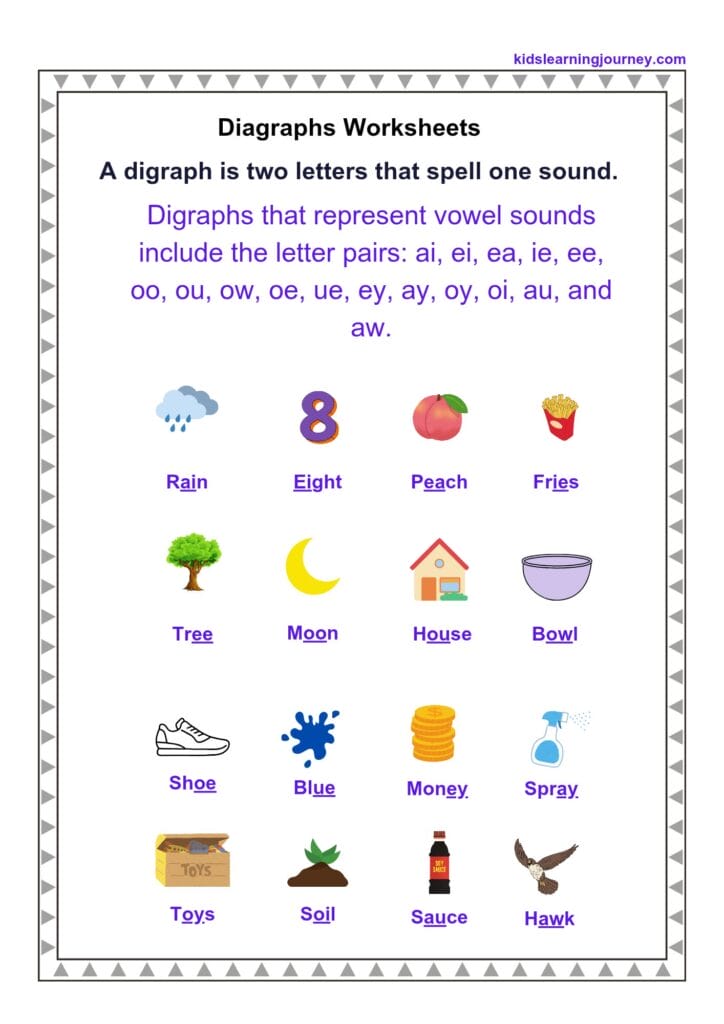
- Digraphs: Next, children discover that two letters can team up to make one brand-new sound. These are called digraphs. Fun examples include sh in ship, ch in chin, and th in thumb.
- Trigraphs and Vowel Teams: As they grow more confident, kids learn about even more letter teams. Trigraphs are three letters that make one sound, like igh in light. Vowel teams are pairs like oa in boat or ai in rain that work together to create a single vowel sound.
The Magic of Blending and Segmenting
Once your child starts recognizing these sounds, two magical skills come into play: blending and segmenting. Think of them as two sides of the same coin. Blending is the process of pushing individual sounds together to read a word. For example, your child sees ‘c-a-t’, says the sounds /k/, /a/, /t/, and then blends them to say the word “cat.” It’s the ‘aha!’ moment when letters on a page become a real word.
Segmenting is the reverse and is essential for spelling. It’s the skill of hearing a word and breaking it down into its individual sounds. If you say “sun,” your child can segment it into its three phonemes: /s/, /u/, /n/. This helps them identify which letters they need to write it down. You can practice this anywhere, from the car to the kitchen.
Here’s a simple and fun ‘arm-blending’ technique you can try today with a word like “mop”:
- Ask your child to hold out their arm.
- For the first sound, /m/, tap their shoulder.
- For the middle sound, /o/, tap their elbow.
- For the final sound, /p/, tap their wrist.
- Finally, slide your hand smoothly from their shoulder to their wrist while saying the blended word: “mop.”
Mastering these mechanics is a huge confidence booster. As your child gets comfortable with these foundational skills, you can support their growth with engaging activities. Our collection of play-based phonics worksheets is designed to make this practice both fun and rewarding, helping them build a strong foundation for a lifetime of reading.
Synthetic vs. Analytic Phonics: Choosing the Best Method
If you’ve spent any time in parenting forums, you’ve likely seen the debate: synthetic vs. analytic phonics. It sounds complicated, but don’t worry. Understanding these two main approaches is a powerful first step in supporting your child’s reading journey. Both methods have the same goal, but they get there in very different ways. Let’s demystify them so you can find the perfect fit for your little learner.
Synthetic phonics is a “bottom-up” approach. Think of it like building with LEGOs. Your child first learns the individual sounds of letters (the phonemes), like /c/, /a/, and /t/. Then, they are taught how to blend, or synthesize, those sounds together to form a word: “c-a-t” becomes “cat.” It’s direct, structured, and the most common method you’ll find in schools today.
Analytic phonics, on the other hand, is a “top-down” method. Instead of starting with sounds, children start with a group of words they already know, often a word family like cat, hat, and mat. They are then encouraged to analyze the words to identify the common sound, in this case, “-at.” This approach relies more on guessing and context, which can be a fun supplement but is often less effective as a primary teaching tool for new readers.
So, which one is right for your child? If your child thrives on clear rules and step-by-step instructions, the structure of synthetic phonics will likely be a perfect match. If your child is a strong visual learner who already recognizes several words, the pattern-spotting in analytic phonics can be an engaging way to expand their skills alongside a more structured program.
Why Synthetic Phonics is the Gold Standard in 2026
Synthetic phonics is a systematic method where children are taught individual letter sounds and then how to blend them together to read whole words. Its power lies in consistency. The evidence is so compelling that the UK’s 2021 Reading Framework mandates its use in schools. By 2026, it’s projected that over 95% of US and UK primary classrooms will prioritize this evidence-based approach to build strong, confident readers from day one.
Supporting the Advanced Reader: When Basic Phonics Isn’t Enough
What about the child who is already reading? If your little one has mastered the basics, it’s time to introduce the wonderful complexities of English. This is where you can explore digraphs (like sh and ch), tricky trigraphs (like igh), and alternative spellings. You’ll also encounter ‘tricky words’ that don’t play by the rules, such as the, was, and said. To keep them challenged and excited, it’s vital to provide engaging materials. Our growing library of E-books & Journals is designed for just this stage, offering fun stories that reinforce these new rules naturally.
How to Teach Phonics at Home: A Practical Step-by-Step
Transforming your home into a learning haven doesn’t require a classroom-sized budget or a teaching degree. It just takes a little creativity and a lot of love. Teaching phonics for kids at home can be one of the most rewarding parts of your child’s early development, building a powerful foundation for a lifetime of reading. The key is to keep it light, playful, and full of connection.
This simple, five-step approach will help you introduce phonics in a way that feels like pure fun.
- Create a Cozy Learning Nook. Designate a special spot in your home just for reading. It could be a corner with comfy pillows, a soft rug, and a basket of books. When you say, “Let’s go to our reading nook,” it signals a time for calm, focused connection, turning learning into a special treat instead of a chore.
- Start with a Small Sound Group. Don’t overwhelm your child with all 26 letters at once. Begin with a group of 6 high-frequency sounds that can be used to build several words. A great starting point is the group: s, a, t, p, i, n. Mastering these allows your child to feel successful right away by blending them into words like ‘sat,’ ‘pin,’ ‘tap,’ and ‘ant.’
- Incorporate Multi-Sensory Play. Children learn best when they can engage all their senses. Pour salt or sand into a shallow tray for tracing letters with a finger. Use playdough to roll and form letter shapes. Go on sound hunts, asking, “Can you find something in this room that starts with the /p/ sound?” This makes letter-sound connections tangible and memorable.
- Transition from Sounds to CVC Words. Once your child is confident with the initial sound group, you can begin blending. CVC (Consonant-Vowel-Consonant) words are the perfect next step. Write the letters for ‘sun’ on separate blocks or cards. Help your child say each sound individually (/s/…/u/…/n/) and then slide them together to say the word ‘sun.’ Celebrate every success!
- Use Daily ‘Micro-Lessons.’ Consistency is more effective than intensity. Just 10-15 minutes of focused, fun phonics play each day is far better than one stressful hour-long session. These short bursts of learning keep your child engaged, prevent frustration, and build a positive, daily habit.
Fun and Engaging Phonics Activities
Ready to put these steps into action? Here are a few simple games that bring the magic of phonics to life and make learning feel like playtime. These activities reinforce sound recognition and blending skills in a joyful, pressure-free way.
- The ‘Sound Scavenger Hunt’: Give your child a target sound, like /m/. Together, search the house for objects that start with that sound: mug, mat, milk, mouse. This connects abstract sounds to the world around them.
- I Spy with Phonics: A classic game with a phonics twist. Instead of colors, use sounds. Say, “I spy with my little eye, something that ends with the sound /g/.” They might guess ‘dog,’ ‘leg,’ or ‘mug.’
- Connect Writing to Sound: As your child learns sounds, help them practice forming the letters. Using our Alphabet Tracing Worksheets is a fantastic way to build the crucial link between a sound and its written symbol.
Overcoming Common Challenges
The learning journey will have a few bumps, and that’s perfectly okay. The goal is progress, not perfection. Here’s how to navigate a couple of common hurdles with patience and a positive mindset, staying true to our ‘Grow Together’ philosophy.
- When ‘b’ and ‘d’ get confused: This is one of the most common reversals. A helpful visual trick is the ‘bed’ method. Have your child make a fist with each hand, thumbs up. When they put their fists together, the left hand forms a ‘b’ and the right hand forms a ‘d,’ spelling the word ‘bed.’
- When blending doesn’t ‘click’: If a child struggles to blend sounds into a word, don’t panic. Gently stretch the sounds out. For ‘cat,’ you can say “caaaaaat” in one continuous breath instead of a choppy “c-a-t.” This helps them hear how the sounds flow together. Remember, your calm and encouraging presence is the most powerful tool you have.
To support this journey, explore our complete library of phonics and literacy resources designed to make learning a joyful adventure.
Building a Joyful Journey with Kids Learning Journey Resources
At Kids Learning Journey, our mission is simple. We want to make learning foundational skills feel less like a task and more like a magical adventure. We believe that every child deserves access to tools that spark curiosity and build confidence from the very first letter sound. That’s why we’ve poured our hearts and educational expertise into creating resources that empower you, the parent or teacher, to guide your child with joy and ease. You don’t have to be a phonics expert. You just need a little support.
We understand that life is busy. Finding time to create effective, engaging learning materials from scratch can feel impossible. Our curated Phonics Worksheets are designed to solve that exact problem. As instant digital downloads, they give you back precious hours. Trusted by over 10,000 families, our activities are thoughtfully designed by early childhood educators to ensure a quality learning experience. Forget endless searching and prep work; you get a complete, play-based system for teaching phonics for kids that you can print and use in less than five minutes.
Our Best-Selling Phonics Tools
We’ve developed a core set of tools designed to support your child at every stage of their reading journey. Each resource is crafted to be fun, effective, and easy for you to implement.
- Printable Phonics Worksheets: Our comprehensive collection provides step-by-step practice covering all 44 foundational phonics sounds. From CVC words to tricky digraphs, each worksheet builds on the last, creating a clear path to reading fluency.
- Alphabet Journals: These journals offer a creative and personal way for children to document their learning. They combine writing practice, drawing, and sound recognition, turning phonics into a treasured keepsake of their progress.
- Reading Comprehension Guides: Perfect for early finishers or children ready for a new challenge. These simple guides introduce the concept of reading for meaning, helping kids build confidence and think critically about the stories they decode.
Start Your Learning Adventure Today
Are you ready to transform phonics practice into a moment of connection and fun? We invite you to see the magic for yourself. You can download a free sample pack to try with your child or explore our full shop to find the perfect tools to support their unique needs. Every resource is designed to make your teaching journey simpler and more rewarding.
Remember, every child learns at their own pace, and that is more than okay. The goal isn’t speed; it’s understanding, confidence, and a lifelong love for reading. Our resources are here to support that gentle, individual process. You’ve got this, and we’re here to help.
Explore our Phonics Worksheets and start your child’s journey!
Your Path to Reading Success Starts Now
You now have the tools to build a strong foundation for your child’s literacy. Remember that teaching phonics for kids isn’t about drills; it’s about connecting sounds to letters in a way that feels like play. By following a simple step-by-step approach and choosing activities your child loves, you’re setting them up for a lifetime of confident reading. You are their most important teacher, and this journey can be filled with joy and discovery.
Ready to put these ideas into action? At Kids Learning Journey, we support thousands of families with our trusted, play-based learning resources. Our Complete Beginner-Friendly Guides and downloadable multi-sensory worksheets are designed to make learning feel magical. Download our Joyful Phonics Worksheets and help your child grow! You’re not just teaching reading; you’re creating wonderful memories together.
Frequently Asked Questions
What is the best age to start teaching phonics to kids?
The best age to begin introducing phonics is typically between 3 and 4 years old. You can start with foundational, play-based activities like listening games and learning initial letter sounds. More structured phonics instruction, as outlined in programs like the UK’s Phase 2 Letters and Sounds, often begins around age 5 in kindergarten. The most important thing is to follow your child’s developmental readiness and keep the learning experience joyful and pressure-free.
How is phonics different from the “whole language” reading approach?
Phonics teaches children to decode words by sounding out individual letters and letter groups, which is a bottom-up approach. In contrast, the whole language method encourages recognizing entire words by sight and using context clues. A landmark 2000 report by the National Reading Panel concluded that systematic phonics instruction is a more effective and reliable component for developing strong early reading skills than methods that do not include it.
Can I teach phonics at home if I am not a trained teacher?
Yes, you can absolutely teach phonics at home. You don’t need to be a trained teacher to make a huge impact on your child’s reading journey. Start with simple, fun activities for just 10-15 minutes each day. You can play “I Spy” with letter sounds or use magnetic letters on the fridge to build simple words. Consistency and a playful attitude are the most powerful tools you have to support your little learner.
What should I do if my child is struggling to blend sounds into words?
If your child is finding it difficult to blend sounds, try a method called “continuous blending.” Instead of pausing between sounds like c-a-t, you stretch and hold each sound to connect them smoothly, like “cccaaat.” This helps your child hear the word emerge. You can also make it physical by sliding a finger or a toy car under the letters as you say the connected sounds. Keep it positive and be patient; this skill takes practice!
How many phonics sounds are there in the English language?
The English language is built on 44 distinct sounds, known as phonemes, which are represented by only 26 letters. These sounds can be written with single letters or groups of letters called graphemes. For example, the /k/ sound can be spelled with a ‘c’ (cat), ‘k’ (kid), or ‘ck’ (duck). A good phonics program introduces these 44 sounds in a systematic, step-by-step way to build a child’s reading confidence.
Do phonics worksheets really help with reading progress?
Phonics worksheets can be a useful tool for reinforcing skills, but they are most effective when they are not the only tool you use. Think of them as a way to practice a concept you’ve already explored through a hands-on activity. For truly effective learning in phonics for kids, balance worksheet time with multi-sensory fun like building words with play-doh, writing in sand, or playing sound-sorting games. This makes learning both fun and memorable.
Is phonics still relevant for kids who are already reading fluently?
Yes, phonics remains a valuable skill even for fluent readers. A strong understanding of phonics helps older children decode complex, multi-syllable words they’ll encounter in books, such as “transportation” or “information.” This advanced decoding skill is directly linked to better spelling abilities, as it gives them the tools to break down challenging words into smaller, manageable sound parts. It’s a foundational skill that keeps on giving.
What are “tricky words” and how should I teach them?
Tricky words, often called sight words, are common words that don’t follow standard phonics rules, so they can’t be sounded out. Words like “was,” “said,” and “the” must be learned through memorization. The best approach is frequent, fun exposure. You can use flashcards for games, find the words in a favorite storybook, or write one on a sticky note for a “word of the day.” Introduce just 2-3 new words a week to keep it manageable.