
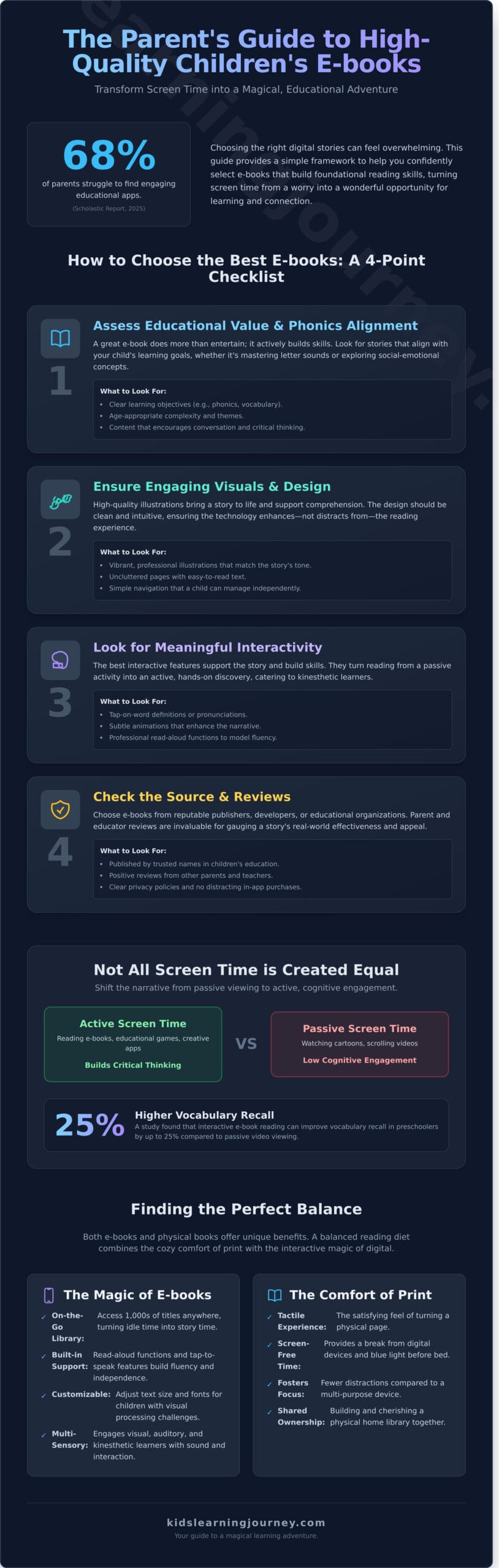
What if screen time wasn’t the enemy, but the secret to unlocking your child’s love for reading? It’s a worry every parent shares. You want to build foundational reading skills, but the allure of a glowing screen often wins. The fear of wasting money on low-quality digital downloads or choosing stories that don’t support their phonics journey is completely valid, especially when a 2025 Scholastic report found that 68% of parents struggle to find engaging educational apps.
This guide is here to change that. We’ll show you how to confidently choose and use high-quality childrens ebooks to transform that screen time into a magical, educational adventure. You’ll learn how to build a curated digital library that grows with your child and makes reading feel like play. We’ll walk you through everything, from identifying phonics-aligned stories to using interactive features that boost comprehension and create cozy reading moments together.
Key Takeaways
-
Learn a simple 4-point checklist to confidently choose e-books that are both educational and visually engaging for your child.
-
Discover how to create the perfect reading balance, blending the cozy comfort of physical books with the interactive fun of digital stories.
-
Understand how high-quality childrens ebooks can transform on-the-go moments into powerful and convenient learning opportunities.
-
Uncover a simple 2-step method for using e-book features to actively build your child’s foundational reading skills.
Table of Contents
-
Why Children’s E-books are a Magical Addition to Your Home Library
-
How to Choose High-Quality Children’s E-books (The 4-Point Checklist)
-
Explore the Kids Learning Journey E-book & Journal Collection
Why Children’s E-books are a Magical Addition to Your Home Library
Picture this: you’re curled up with your child, the glow of a screen illuminating their curious face as a story unfolds with sound, movement, and wonder. While we’ll always cherish the feel of a paper book, the world of childrens ebooks offers a unique and powerful kind of magic for today’s young learners. These aren’t just digital words on a page; they are interactive stories thoughtfully designed to build foundational literacy skills in a fun, engaging way. In 2026, digital storytelling is an incredible tool for sparking a lifelong love of reading.
A single tablet can hold an entire library, ready for any "on-the-go" moment. Think about the long wait at the doctor’s office or a rainy afternoon stuck indoors. Instead of handing over a device for passive entertainment, you can open up a world of adventure. With access to over 1,000 titles in your bag, you can transform idle time into an opportunity to learn, explore, and connect. This portability makes consistent reading routines easier than ever before.
Digital books also have a special way of supporting different learning styles. For visual learners, the vibrant, often animated illustrations bring characters to life. Auditory learners thrive with professional narration and sound effects that add emotional depth to the story. Many e-books even cater to kinesthetic learners by allowing them to tap on objects or words to see what happens, turning reading into an active, hands-on discovery.
The long history of e-books has led to this moment where technology can create truly enchanting experiences for our kids. What began as simple text files has blossomed into the dynamic, responsive stories we see today. This evolution has given modern childrens ebooks a magical charm that captures attention and makes learning feel like play.
The Benefits of Digital Reading for Early Learners
These digital tools are designed with powerful features that directly support your child’s growth. They offer more than just a good story; they provide a scaffold for developing readers. Here are a few key benefits:
-
Instant Access to a World of Stories: A digital library breaks down geographical barriers. You can instantly download a new release or a classic tale that might not be available at your local bookstore, exposing your child to diverse cultures and ideas.
-
Built-in Reading Support: Features like professional read-aloud functions help children hear correct pronunciation and cadence, which is vital for fluency. Many e-books also allow kids to tap on a difficult word to hear it spoken, supporting independent decoding.
-
Customizable for Individual Needs: For children with visual processing challenges, the ability to increase text size or change the font can make a world of difference. This simple adjustment removes a common barrier to reading, building confidence and reducing frustration.
Overcoming the Screen Time Hesitation
For many parents, the term "screen time" can bring up feelings of guilt. It’s helpful to distinguish between passive screen time, like watching cartoons, and active screen time, where a child is engaged in an educational activity. A 2025 study from the Erikson Institute found that interactive reading on a tablet can improve vocabulary recall in preschoolers by up to 25% compared to passive video viewing. Reading an e-book is an active, cognitively demanding task that builds critical thinking skills.
Setting healthy boundaries is key. You can establish a "digital storytime" for 20 minutes each evening as a calm-down activity. By reframing the tablet as a tool for learning and connection, you can shift the narrative in your home. Try reading an e-book together, taking turns swiping the page and talking about the story. It’s a wonderful way to grow together.
How to Choose High-Quality Children’s E-books (The 4-Point Checklist)
The digital library is endless, which can feel a little overwhelming for parents. How do you know which childrens ebooks will truly support your child’s growth and spark a love for reading? This simple 4-point checklist is a powerful tool to help you confidently choose amazing digital stories that are both fun and foundational.
Think of it as your guide to finding the gems. By looking at a book’s educational core, illustrations, interactive features, and source, you can ensure screen time is quality time.
Assessing Educational Value & Phonics Alignment
A great e-book does more than just tell a story; it actively builds skills. Before downloading, ask yourself if the content aligns with your child’s current learning goals. Is the focus on exploring big feelings (Social-Emotional Learning) or mastering letter sounds? A 2023 report from the Harvard Graduate School of Education highlights that thoughtful e-book design can boost parent-child conversation, a key factor to help kids build foundational literacy skills. Look for these powerful features:
-
Repetitive Text Patterns: Simple, repeating phrases help young readers predict what comes next. This builds incredible reading confidence.
-
Age-Appropriate Vocabulary: The words should be mostly understandable but also introduce a few new concepts to gently expand their world.
-
"Decodable" Digital Stories: These magical books primarily use words that match your child’s phonics level, allowing them to practice sounding out words successfully. Our phonics worksheets and activities are designed to pair perfectly with these types of stories.
Interactive Features vs. Distractions
Many childrens ebooks come with interactive bells and whistles, but not all of them are helpful. Research from the Joan Ganz Cooney Center found that "enhanced" e-books with too many distracting games can actually hinder reading comprehension. This is known as the "distraction effect." The key is finding a healthy interactive balance where features support the story instead of stealing the show.
Look for features that deepen understanding, not derail it:
-
Helpful Hotspots: Prioritize e-books where tapping on a tricky word defines it or says it aloud. Skip the ones that just play random, unrelated sound effects that break the story’s flow.
-
Thoughtful Engagement: The best interactive elements encourage your child to think. Do they ask the reader to predict what happens next? Or to tap on the character who feels sad? This type of engagement supports the plot and builds comprehension.
Beyond these points, also consider the quality of the illustrations-are they engaging without being chaotic?-and always verify the source. High-quality content often comes from trusted educational publishers like Scholastic or platforms developed by early childhood educators. A quick look at the developer’s credentials gives you peace of mind that the content is safe, appropriate, and designed with real learning in mind.
E-books vs. Physical Books: Finding the Perfect Balance
Nothing can truly replace the magical charm of a physical book. We all remember the distinct smell of paper, the satisfying weight of a hardcover, and the quiet rustle of turning a page. Those tactile experiences are powerful and build a deep, lifelong love for reading. The cozy vibes of a bedtime paperback are a cherished part of childhood.
But that doesn’t mean digital stories don’t have a valuable place in your child’s learning journey. Instead of viewing it as a competition, we see it as a partnership. E-books offer interactive excitement that can complement traditional reading. To support well-rounded development, we suggest a simple guideline: aim for a 70/30 split, with about 70% of reading time dedicated to physical books and 30% to high-quality digital options. This balance ensures your child gets the sensory benefits of print while also exploring the engaging world of technology.
For some children, especially reluctant readers, an e-book can be the "hook" that finally sparks their interest. The animations, sound effects, and read-aloud features can transform reading from a chore into a captivating game, building foundational confidence that often transfers back to physical books.
When to Reach for a Digital Story
E-books are not just for fun; they are a powerful tool when used intentionally. Think of them as a specific resource you pull out to meet a specific need. Here are a few moments when childrens ebooks truly shine:
-
Travel and Waiting Rooms: A single tablet or phone can hold an entire library, making it the ultimate portable educational tool. Instead of packing five heavy books for a trip, you have hundreds of stories ready to go for any flight delay or doctor’s office wait.
-
Quick Phonics Drills: Digital platforms are perfect for 10-minute "micro-learning" sessions. Many e-books allow a child to tap on a word to hear it sounded out, reinforcing letter-sound connections in a fun, low-pressure way. In fact, a 2021 analysis of 14 different studies published by the National Institutes of Health explored the impact of e-books on literacy skills, highlighting their potential to support foundational learning when designed well.
-
Interactive Exploration: Is your child curious about how a dinosaur might sound? Or do they want to hear a story read in different character voices? Interactive e-books provide an immersive experience that paper books can’t, satisfying a child’s curiosity and making the story come alive.
Creating a "Cozy" Digital Reading Routine
Screen time doesn’t have to feel cold or distant. With a few simple adjustments, you can make your digital reading sessions just as warm and connecting as snuggling up with a paperback.
-
Set the Mood: Before bed, switch the device to "night mode" or use a warm-light filter. This reduces blue light exposure, making the experience gentler on your child’s eyes and signaling to their brain that it’s time to wind down.
-
Use the "Grow Together" Approach: Don’t just hand the tablet over. Sit side-by-side with your child, holding the device together. Point to pictures, ask questions, and share in the discoveries. This turns passive screen time into an active, shared family moment.
-
End with a Summary: When the story is over, put the screen away and ask your child to tell you what happened in their own words. This simple two-minute exercise is fantastic for building memory, sequencing skills, and reading comprehension.
Using E-books to Build Foundational Literacy Skills
Digital stories are more than just a convenient way to read; they are powerful, interactive tools for building the foundational skills every young learner needs. When used thoughtfully, childrens ebooks can transform screen time into a dynamic, engaging learning session. Research from the Joan Ganz Cooney Center shows that interactive media can significantly support literacy development when a caring adult is involved. Let’s walk through a simple, five-step approach to make every digital reading experience a chance to learn and grow together.
Follow these steps to create a fun and supportive reading routine:
-
Step 1: Preview the E-book Together. Before you even read the first word, build excitement. Look at the cover and title. Ask gentle questions like, “What do you think this story will be about?” or “Who is this character on the cover?” This simple act sets the stage for active listening and comprehension.
-
Step 2: Use the "Read Aloud" Feature First. Most e-books have a narration feature. Let your child listen to the story once to hear the correct pronunciation and rhythm of the text. Then, mute the sound and encourage them to try reading the words themselves. It’s a wonderful way to model fluency without pressure.
-
Step 3: Pause and Ask Questions. Use the vibrant digital illustrations to your advantage. Pause the story and ask open-ended questions. You might ask, “Why do you think the bear looks so happy in this picture?” or “What colors do you see on this page?” This builds visual literacy and helps your child connect images to meaning.
-
Step 4: Connect the Story to a Physical Activity. Bridge the gap between the screen and the real world. If you read a book about planting a garden, spend the afternoon planting a seed in a small pot. This multi-sensory approach helps solidify concepts from the story, making learning stick.
-
Step 5: Track Progress with a Journal. Celebrate every book finished! Use a simple reading journal or a chart with digital stickers to track progress. This provides a tangible sense of accomplishment and motivates your child to keep reading and exploring new stories.
Phonics Practice Through Digital Stories
Many e-books include a feature that highlights words as they are read aloud. You can use this to focus on specific letter sounds. Pause on a word and say, “Can you hear the ‘p’ sound in ‘puppy’?” For a hands-on approach, encourage your child to gently trace the letters on the screen with their finger. To take this skill off-screen, connect the story’s theme to our library of phonics worksheets for powerful, reinforced learning.
Enhancing Reading Comprehension
Reading comprehension is the ability to process text, understand its meaning, and integrate it with what you already know. Interactive childrens ebooks offer unique ways to build this skill. Use the "search" function to find recurring words, asking your child to count how many times they see the word “friend.” You can also pause before turning a digital page and ask, “What do you think will happen next?” Then, flip the page to see if their prediction was right. This turns reading into an exciting and engaging discovery game.
Ready to build these foundational skills? Explore our complete collection of fun and engaging learning activities to support your child’s reading journey from start to finish.
Explore the Kids Learning Journey E-book & Journal Collection
Finding the right educational tools for your child can feel overwhelming. That’s why we’ve built our own special library of childrens ebooks and journals, designed from the ground up for parents and teachers like you. We believe a resource should be more than just a single activity; it should be a complete experience. This is the "Complete Guide" philosophy behind every digital book and worksheet we create. Each one is a carefully crafted toolkit meant to support you and your little one on your learning adventure, providing everything you need in one simple, engaging package.
Our entire collection is built on a simple yet powerful cycle: Learn, Read, Write – Grow Together. We know that true, lasting learning happens when different skills connect. It’s not just about screen time or just about worksheets. It’s about creating a bridge between the two. Your child starts by learning foundational concepts and reading an engaging story in one of our e-books. Then, they take that inspiration from the screen to the page with our printable journals, turning passive consumption into active creation and reflection. This process doesn’t just build academic skills; it builds connection and creates moments for you to grow right alongside them.
Our Phonics-First Digital Library
We introduce letters and their sounds with a gentle, story-driven approach. Instead of drills, your child will meet a cast of charming characters in stories designed to be cozy and fun. These aren’t just phonics lessons. They are tales that intentionally build resilience by showing characters who overcome small challenges and stories that nurture empathy by exploring feelings and friendship. We designed our library to be "beginner-friendly" for everyone involved, ensuring you don’t need a degree in education to become your child’s best reading coach.
Interactive Learning Journals for Growing Minds
Our printable journals are where the magic of our e-books comes to life. They are the essential link that transforms a digital reading experience into a physical writing habit. Each journal pairs directly with an e-book, featuring prompts that encourage your child to think more deeply about the story. You’ll find questions that spark creativity ("Draw what you think the character will do next!") and activities that build emotional intelligence ("How did the fox feel? Draw a picture of his face."). These prompts make writing feel like a natural, exciting extension of the story. Download your first e-book and journal set today!
Start Your Digital Reading Adventure Today
Navigating the world of digital reading can feel like a big task, but you’re now equipped with the tools to make wonderful choices for your family. Remember the core of our 4-point checklist: choose stories that are interactive, age-appropriate, and spark curiosity. Finding that perfect balance between screen time and classic page-turning is the secret to fostering a lifelong love for stories in any format. Thoughtfully selected childrens ebooks are more than just a convenience; they are powerful, engaging tools for building foundational reading skills.
You don’t have to search for these resources alone. The Kids Learning Journey collection is built on an expert-designed phonics curriculum that makes learning feel like play. With our complete guides for parents and teachers, you’ll feel supported every step of the way. Explore our E-books & Journals to start your learning journey today!
Happy reading, and enjoy every magical moment of discovery together.
Frequently Asked Questions About Children’s E-books
What age is best to start using children’s e-books?
The best age to introduce children’s e-books is typically between 2 and 3 years old, when shared reading is most beneficial. The American Academy of Pediatrics recommends co-viewing digital media with children in this age group, which turns screen time into a wonderful bonding activity. At this stage, you can focus on simple, interactive stories that you explore together. This helps build foundational literacy skills in a fun, engaging way and makes for a positive first experience.
Can e-books really help my child learn to read as well as physical books?
Yes, e-books can absolutely support your child’s reading journey just as well as physical books. A 2019 review of 39 different studies published in Review of Educational Research found that well-designed digital books can even be slightly better for building vocabulary. This is thanks to helpful features like text highlighting and audio narration. The key is to choose e-books with high-quality, interactive elements that support the story rather than distract from it.
Are there safe, ad-free e-book platforms for toddlers?
Absolutely, there are wonderful, safe platforms designed just for little ones. Services like Epic!, Vooks, and various other reputable subscription platforms offer curated libraries of childrens ebooks that are completely free of ads and in-app purchases. These platforms are compliant with the Children’s Online Privacy Protection Act (COPPA), ensuring your child’s data is safe. They provide a secure environment where your toddler can explore stories without any unwanted distractions, giving you complete peace of mind.
How do I find free children’s e-books that are high quality?
You can find thousands of high-quality, free e-books through your local public library’s digital services, like the Libby or OverDrive apps. These apps give you access to a huge catalog of modern and classic titles with just your library card. Additionally, websites like the International Children’s Digital Library and Project Gutenberg offer extensive, free archives of classic children’s literature that you can download legally and safely for your family to enjoy together.
Will reading e-books on a tablet hurt my child’s eyes?
Reading on a tablet doesn’t have to hurt my child’s eyes if you follow a few simple guidelines. The American Academy of Ophthalmology recommends the 20-20-20 rule: every 20 minutes, take a 20-second break to look at something 20 feet away. Also, ensure the screen brightness matches the room’s lighting and that your child holds the tablet about 18 to 24 inches from their face. These small habits make digital reading comfortable and safe.
How can I stop my child from clicking out of the e-book into other apps?
You can easily prevent your child from leaving the e-book app by using your device’s built-in features. On an iPhone or iPad, enable "Guided Access" in your Accessibility settings to lock the screen to a single app. On Android devices, you can use the "Screen Pinning" feature, which is typically found in Security settings. Both tools temporarily restrict the device to just the reading app, creating a focused, distraction-free environment for story time.
Do standard e-books work for early learners who need phonics support?
Standard e-books can be helpful, but they often aren’t the best tool specifically for phonics instruction. While some titles have read-aloud narration that highlights words as they are spoken, they usually lack the direct, systematic phonics activities that early learners need to build foundational skills. For this purpose, you’ll find that dedicated reading apps designed with a structured curriculum provide more targeted and effective support than a standard e-book.
What is the difference between an e-book and a reading app?