Most parents know tic tac toe as a quick way to pass time at a restaurant or fill a quiet moment at home. But Tic tac toe can be much more than a simple game. For preschoolers and early elementary kids, it can become an easy tool for building focus, turn-taking, early strategy, and even basic academic skills without making learning feel heavy.
That is part of what makes it so useful. You do not need special supplies, a long setup, or extra planning. With just paper and a pencil, you can turn a familiar game into a playful learning activity that fits into real family life or a busy classroom routine.
Why tic tac toe is more valuable than it looks
At first glance, tic tac toe seems almost too simple to matter. The board is small, the rules are easy, and many games end quickly. For young children, though, that simplicity is exactly the benefit.
A child does not have to juggle too many directions at once. They can focus on understanding turns, noticing patterns, and thinking one step ahead. Those are important early learning skills. Children are practicing how to pause before acting, pay attention to what another player is doing, and make a choice based on what they see.
It also supports social development. Many young children need practice with waiting, handling small disappointments, and playing fairly. A short game like tic tac toe gives them repeated chances to build those habits in a low-pressure way.
For educators and homeschooling families, there is another advantage. The game is easy to adapt. Once a child understands the basic format, you can swap in letters, numbers, sight words, shapes, or pictures. That turns one simple game into a flexible teaching tool.
How to play tic tac toe with young children
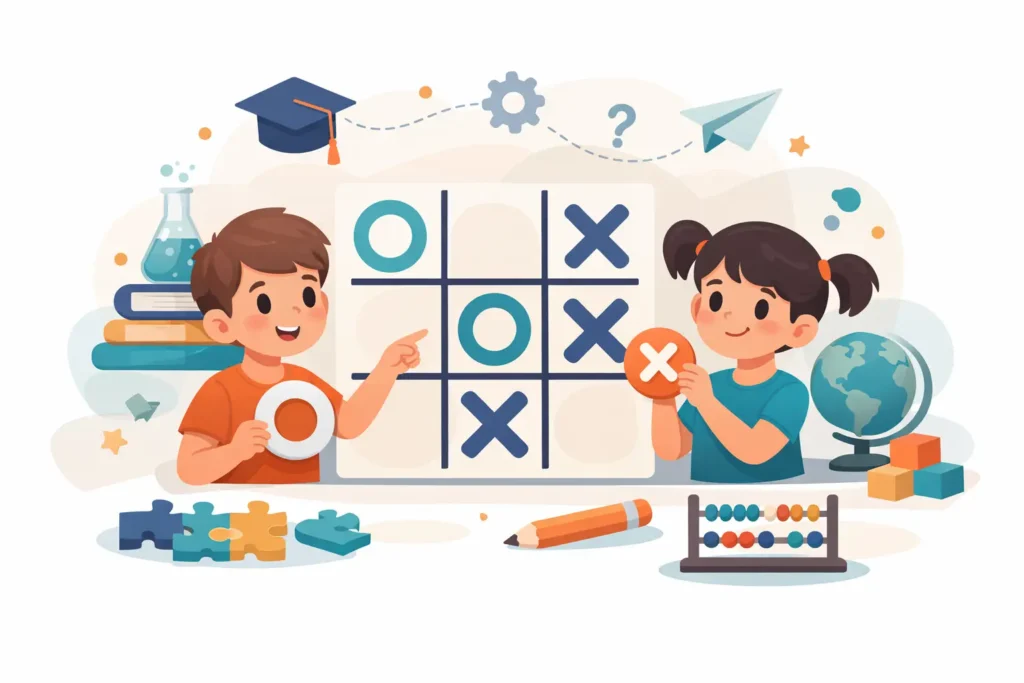
The traditional version is still the best place to start. Draw a board with two vertical lines and two horizontal lines to make nine spaces. One player uses X and the other uses O. Players take turns marking one empty square at a time. The goal is to get three in a row across, down, or diagonally.
If your child is very young, model a full round slowly. Say what you are doing out loud. You might say, “I am putting my X here because I want to try for three in a row,” or “I see you already have two Os, so I need to block that space.” This kind of simple narration helps children connect actions to thinking.
Some children become frustrated when they lose, especially if they are still learning how games work. In that case, keep the tone light. You can talk about trying again, noticing a smart move, or celebrating that they remembered the rules. The goal is not just winning. The goal is learning how to play thoughtfully.
Skills kids practice through tic tac toe
One reason tic tac toe works so well in early learning is that it develops several skills at once. It supports visual scanning because children have to look across the board and notice open spaces, matching symbols, and possible lines. It strengthens logical thinking because they begin to understand cause and effect. If I place my mark here, what might happen next?
It also encourages self-control. A child may want to choose the first open square they see, but the game rewards slowing down and considering options. That kind of pause-and-think behavior matters in school settings, especially during early math, reading, and group activities.
Language can grow through the game too. When adults ask gentle questions like “What do you notice?” or “Where could you go next?” children practice explaining their thinking. That builds vocabulary and confidence.
There is even a prewriting benefit. Making X and O shapes gives younger children light fine motor practice. It is not a handwriting lesson, but it does reinforce pencil control in a meaningful context.
Tic tac toe learning variations to try
Once your child enjoys the classic version, you can use the same board idea in creative ways. This is where the game becomes especially helpful for parents and teachers who want learning activities that are simple to set up.
An alphabet version works well for letter recognition. Instead of X and O, players can use target letters. You might call out a letter sound and have the child cover the matching letter on a prepared board. For children learning uppercase and lowercase matching, one player might mark uppercase letters while the other marks lowercase partners.
A sight word version is great for early readers. Fill the board with common sight words and let children read the word before claiming a square. If reading all nine words at once feels overwhelming, use a small set they already know well.
Math tic tac toe can be just as effective. Some families use simple addition facts, number recognition, or counting prompts in each square. A child solves the problem before marking the space. For kindergarten learners, you might keep it very basic with numbers, shapes, or sets of dots.
You can also use picture-based boards for preschoolers. Instead of words or numbers, add colors, animals, or seasonal images. That keeps the game accessible for children who are not yet reading but are ready to practice matching, naming, and attention skills.
When tic tac toe gets too easy
A common issue is that older kids quickly realize many rounds end in a draw. They are not wrong. Once both players understand the game, regular tic tac toe can become predictable.
That does not mean it has lost its value. It just means you may need to adjust the challenge. One option is to use a larger grid, such as a 4-by-4 board, and require four in a row. Another is to add a learning task before each move, like solving a math problem or reading a word card.
You can also shift the focus from outcome to strategy. Ask questions such as, “How did you know to block that square?” or “What move would help you next time?” This keeps the child engaged in the thinking process, not just the result.
For some children, speed rounds add excitement. For others, themed boards make the game feel fresh again. A child who loves dinosaurs, space, or ocean animals may stay interested longer when the visuals match their interests.
Using tic tac toe at home or in the classroom
This game works best when it feels easy to use, not like one more complicated task to manage. At home, tic tac toe can fit into small moments during the day. It works well before dinner, during a sibling quiet-time break, or while waiting for an appointment. Because it is short, it can hold a child’s attention without creating a long transition.
In classrooms, it can be used during centers, partner work, or early finisher time. Teachers can laminate boards and use dry-erase markers for repeated practice. If the goal is academic reinforcement, each board can match a current skill such as beginning sounds, counting to 20, or shape identification.
If you are supporting multiple ages, the flexibility matters. One child might play the classic version while another uses a letter-sound board. The basic game stays the same, but the learning target changes.
That is one reason activity-based learning tools remain so helpful for families and educators. A familiar structure gives children confidence, while small changes keep the experience meaningful.
Simple tips for making tic tac toe more educational
The best learning moments often come from how you guide the game, not just the board itself. Try to keep your language encouraging and specific. Instead of saying “Good job,” you might say, “You noticed I had two in a row and blocked my space.” That shows the child exactly what thoughtful play looks like.
It also helps to let children make mistakes. If they miss an obvious move, you do not need to correct it immediately. Sometimes the strongest lesson comes from seeing what happens next. Real understanding grows when children connect their choices to the outcome.
Keep sessions short enough that the game stays fun. A few rounds are often enough, especially for younger learners. If a child starts losing interest, that is a good time to stop and return later.
You can also invite children to create their own boards. When kids choose the letters, draw the pictures, or decide on a theme, they become more invested. That adds creativity to the activity and gives them another chance to practice ownership and decision-making.
Tic tac toe may be small, but that is part of its strength. In a few minutes, children can practice thinking, waiting, noticing, and trying again. Sometimes the simplest games are the ones children return to most, especially when an adult turns them into a chance to grow.