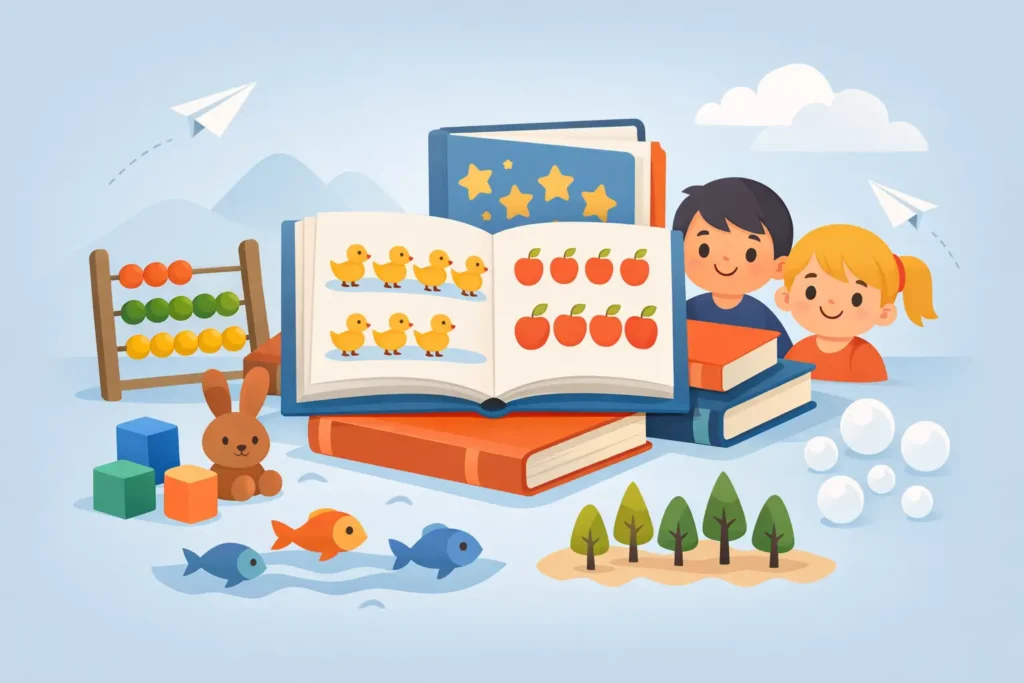
A child who happily counts crackers at snack time may still freeze when a worksheet asks for the number 7. That is exactly why the best counting books kindergarten learners use can make such a difference. A good counting book turns numbers into something children can see, say, touch, and remember – and that matters when you are building early math confidence.
For parents, homeschoolers, and teachers, counting books are one of the easiest ways to add math to the day without making it feel heavy. You can read one during circle time, keep a few in a basket for quiet reading, or pair them with manipulatives for a simple hands-on lesson. The key is choosing books that do more than recite numbers. The strongest options help children notice quantity, patterns, sequencing, and one-to-one correspondence.
What makes the best counting books kindergarten-ready?
Not every number book works well for kindergarten. Some are visually busy, some move too quickly, and some focus more on cute illustrations than actual number learning. For this age group, the best books keep the counting clear while still feeling playful.
A strong kindergarten counting book usually has large, easy-to-track objects, predictable number progression, and illustrations that support the text instead of distracting from it. It also helps when the book invites children to participate. If kids can point, count aloud, guess what comes next, or spot groups on the page, the reading becomes a math activity instead of just a story.
It also depends on where your child is starting. Some children need practice counting from 1 to 10 with real objects. Others are ready to count higher, compare quantities, or recognize that the number 8 means the same amount whether it is shown as dots, animals, or blocks. The best fit is not always the flashiest book. It is the one that matches your child’s current stage while gently stretching their skills.
12 best counting books for kindergarten
1. Chicka Chicka 1, 2, 3 by Bill Martin Jr., Michael Sampson, and Lois Ehlert
This is a lively choice for children who enjoy rhythm and repetition. The numbers climb the apple tree, which gives kids a clear visual sequence while keeping the story playful. It is especially helpful for children who learn well through sound and pattern.
The trade-off is that the action can feel fast for kids who are still mastering number recognition. Slowing down to point at each number helps.
2. Ten Black Dots by Donald Crews
This classic does more than count. It shows children how the same number of dots can become different pictures, which encourages flexibility in thinking. That is useful for number sense because kids begin to understand quantity in a visual way, not just as memorized words.
It also opens the door for extension activities. After reading, children can make their own dot pictures for each number.
3. Mouse Count by Ellen Stoll Walsh
This book works beautifully as a read-aloud because it adds a simple story to the counting. A snake collects mice one by one, and children count each mouse as the number grows. The suspense keeps kids interested while reinforcing forward counting.
It is best for children who already have some comfort counting to ten. If a child is very new to counting, you may need to pause often and recount together.
4. Ten Apples Up On Top! by Dr. Seuss, Roy McKie, and Theo. LeSieg
This one is silly, energetic, and easy to revisit. Children count apples as they stack higher and higher, and the repeated structure gives them lots of chances to join in. If you have a child who resists math but loves funny books, this can be a smart pick.
Because the pages get more crowded as the numbers grow, some children benefit from using a finger to track the apples.
5. How Do Dinosaurs Count to Ten? by Jane Yolen and Mark Teague
For dinosaur fans, this is often an easy win. The counting is wrapped inside a theme many children already love, which can make reluctant learners more willing to participate. The illustrations are big and engaging, and the numbers stay accessible for younger kindergarten students.
This book leans more playful than instructional, so it works best when paired with a follow-up counting activity.
6. Fish Eyes by Lois Ehlert
This is one of the best counting books kindergarten teachers often use when they want clear visuals. The bright fish illustrations help children count sets on the page, and the design supports one-to-one correspondence well. It also introduces color and comparison naturally.
If your child gets overwhelmed by dense text, this is a strong option because the layout feels clean and simple.
7. Feast for 10 by Cathryn Falwell
This book combines counting with everyday family life, which makes it especially relatable. Children count groceries, family members, and dinner items as the story builds toward a shared meal. That real-world context helps kids understand that numbers are part of daily routines.
It is a good fit for families looking to connect reading and practical math. You can easily extend it by counting items at home during meals or shopping.
8. Rooster’s Off to See the World by Eric Carle
This book adds subtraction into the counting experience in a gentle way. Rooster begins with a group of animal friends, then one leaves at a time. Children practice counting up and noticing how the group changes.
That makes it a helpful bridge for kindergarteners who are ready for early addition and subtraction ideas. It may be less ideal if your current focus is only counting forward from 1 to 10.
9. 1, 2, 3 to the Zoo by Eric Carle
This is a simple, dependable counting book with bold illustrations and a familiar structure. Each train car adds more animals, so children can count with confidence and see the pattern grow. It is especially useful for younger kindergarten students or preschoolers preparing for kindergarten.
Sometimes the simplest books are the most effective, and this is one of them.
10. Over in the Meadow by various authors and illustrators
There are many editions of this counting song book, and several work well for kindergarten. The pattern and rhyme make it easy for children to predict what comes next, while the illustrations usually support counting groups of animals.
Because editions vary, it helps to preview the artwork. Some versions are clearer for counting than others.
11. Bear Counts by Karma Wilson and Jane Chapman
This book blends a gentle story with counting opportunities throughout. It feels less like a traditional math book, which can be helpful for children who prefer story-centered reading. The woodland setting and repeated phrases also make it a cozy read-aloud choice.
The counting is not as structured as in some other titles, so it works best as a supplement rather than your only counting book.
12. Counting Kisses by Karen Katz
For children who learn best through connection and routine, this book brings counting into a comforting bedtime setting. It counts kisses on different body parts, which feels playful and affectionate while still reinforcing number order.
This one is especially useful for younger kindergarteners or children who need low-pressure counting practice.
How to use counting books so the math sticks
Reading the book once is helpful. Reading it interactively is where the learning grows. When you pause to ask, “How many do you see now?” or “Can you point to the group of six?” you help children connect spoken numbers to actual quantities.
It also helps to bring in objects after the read-aloud. If a book counts apples, use pom-poms, blocks, or paper circles and build the same sets together. That extra step strengthens one-to-one correspondence and makes the number concept more concrete.
Repetition matters too. Kindergarten children usually do not need a brand-new counting book every day. They benefit from hearing the same book multiple times, noticing more with each reading. One week with the same title can be more powerful than five different books read once.
Best counting books kindergarten families can pair with simple activities
If you want more than a read-aloud, pair each book with a quick hands-on task. After reading Ten Black Dots, children can create dot art for a chosen number. After Feast for 10, they can count snack items into groups. After 1, 2, 3 to the Zoo, they can line up toy animals and count each one as it “boards” a train.
These activities do not need to be fancy. In fact, simple is often better. Young children learn math best when the task is clear and the materials are familiar. A short activity done consistently tends to work better than a complicated lesson done once.
If you use printables or number practice pages, books can be the perfect warm-up. At Kids Learning Journey, this kind of pairing works especially well because it connects playful reading to structured skill practice without making math feel dry.
Choosing the right book for your child or classroom
If your child is just beginning, choose books with clear objects and counting to 10. If your students are ready for more challenge, look for titles that include number comparison, backward counting, or visual grouping. Interest matters too. A dinosaur-themed counting book may hold one child’s attention better than a beautifully written classic.
That is why there is no single best book for every kindergarten learner. The best choice is the one your child wants to hear again, the one that makes them point to the page and count with confidence, and the one that helps numbers feel friendly instead of frustrating.
A well-chosen counting book does more than teach 1 through 10. It gives children a calm, enjoyable way to practice early math – and that steady confidence is what makes later learning easier.