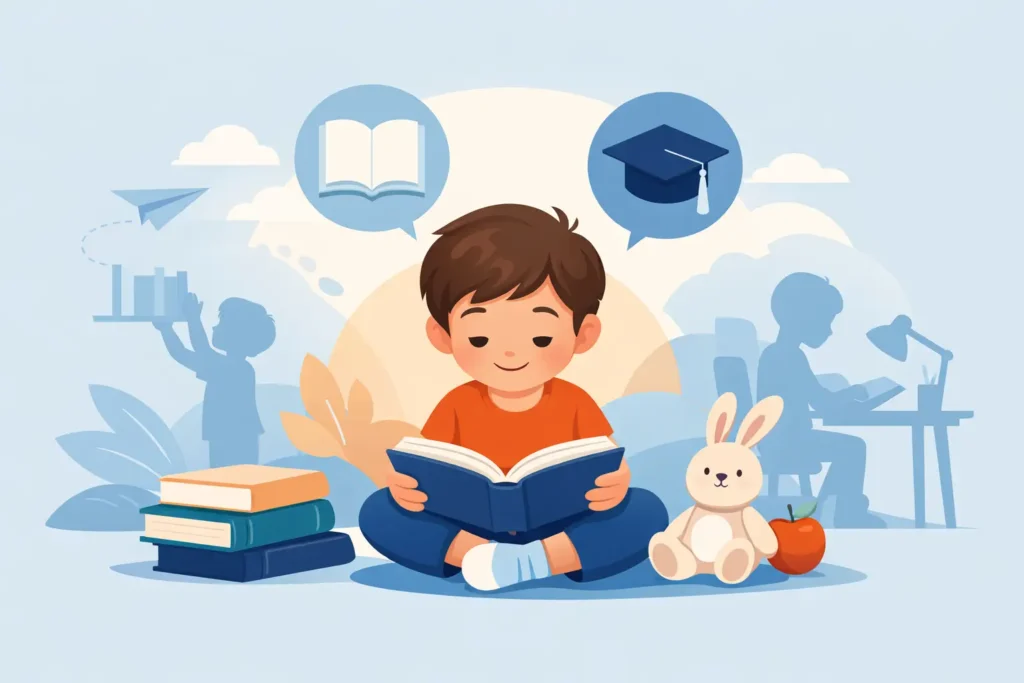
A child pretending to read a favorite picture book, reciting a story from memory, and pointing to a few familiar letters can make parents wonder: when should kids start reading, really? It is a common question, especially when preschool classmates seem to be doing very different things. Some children are sounding out simple words at 4, while others are still building letter knowledge at 6. That range can be completely normal.
The most helpful answer is this: kids start reading in stages, not all at once. Reading is not a single milestone that appears on a birthday. It grows from a set of smaller skills, including language, listening, memory, print awareness, phonics, and confidence. When those pieces begin to come together, reading starts to happen.
When should kids start reading by age?
Most children begin developing pre-reading skills long before they can read a full sentence. In the toddler and preschool years, they are learning that books carry meaning, that print moves from left to right, that letters represent sounds, and that stories have structure. These early building blocks matter just as much as reading actual words.
By around ages 4 to 7, many children begin decoding simple text. That is the stage most adults think of as “starting to read.” Some children get there earlier, and some later. A child who reads simple books at 5 is not automatically ahead in every way, and a child who starts at 6 or 7 is not necessarily behind.
What matters more than the exact age is whether a child is steadily developing the skills that support reading. A preschooler who enjoys rhyming games, recognizes some letters, and listens closely during read-alouds is already on the reading path. A kindergartener who can identify beginning sounds and blend a few simple words is moving forward too.
What reading readiness really looks like
Parents often look for one clear sign, but reading readiness is usually a pattern of behaviors. A child may be ready to begin reading instruction when they show interest in books, recognize some letters, notice print in everyday life, and can hear sounds in words. They may also start asking what signs say, pointing out letters in their name, or trying to “read” familiar books aloud.
Strong oral language is another big clue. Children learn to read words more easily when they already understand lots of spoken words. If a child can tell you about their day, answer questions about a story, and play with language through songs and rhymes, those are positive signs.
Attention span matters too. Early reading takes focus. A child does not need to sit still for an hour, but they do need enough patience to listen, look, and try. That is one reason reading readiness can vary so much from child to child.
Why some kids read earlier than others
Children do not all develop on the same timetable, and reading is no exception. One child may have strong phonemic awareness early on and quickly learn to connect sounds with letters. Another may need more repetition, more movement-based learning, or simply more time.
Exposure also plays a role. Children who are read to often, who hear nursery rhymes, and who have regular access to books usually build pre-reading skills more naturally. That does not mean parents need to create a formal school setting at home. It simply means that small, consistent literacy experiences add up.
Temperament can influence the process as well. Some children love sitting with books. Others learn better through songs, games, sensory activities, or short bursts of instruction. A child who does not want to sit for a story is not doomed to struggle with reading. They may just need a different approach.
There can also be developmental factors at play, including speech delays, hearing issues, or learning differences. If reading feels unusually hard compared with other areas of development, it is worth paying attention early rather than waiting and hoping it resolves on its own.
When should kids start reading instruction?
Formal reading instruction often begins in preschool or kindergarten, but that does not mean every child needs worksheets and structured lessons at age 3. For younger children, the best instruction is often playful and simple. Singing alphabet songs, clapping syllables, noticing environmental print, tracing letters, and reading aloud together are all meaningful forms of early literacy teaching.
As children get closer to kindergarten, it helps to introduce more direct phonics support. That might look like learning letter sounds, matching sounds to pictures, or blending simple consonant-vowel-consonant words. The key is to keep instruction short, consistent, and encouraging.
If a child resists formal lessons, that is useful information. Pushing too hard can make reading feel stressful before it ever feels rewarding. There is a difference between gentle structure and pressure. Most children benefit from routine, but very few benefit from feeling judged.
Signs a child may need more support
A wide range of reading development is normal, but there are times when extra support makes sense. If a child is in kindergarten or first grade and is having persistent difficulty learning letter names and sounds, hearing rhyme patterns, or blending simple sounds into words, it may be time to take a closer look.
You may also want to ask questions if your child avoids all print, becomes very frustrated during reading activities, or seems to forget skills they have practiced many times. None of these signs automatically mean there is a serious problem. They do suggest that more targeted help could be useful.
For families, that might mean speaking with a teacher, pediatrician, or reading specialist. For educators, it may mean adjusting instruction, adding multisensory practice, or screening for underlying challenges. Early support is usually more effective than waiting until a child feels far behind.
How to help before a child is reading independently
The good news is that a child does not need to be reading books alone for you to make real progress at home or in the classroom. Some of the most powerful reading support happens before independent reading begins.
Reading aloud every day is one of the best places to start. It builds vocabulary, listening comprehension, print awareness, and positive associations with books. It also gives children a model for fluent reading that they cannot yet provide for themselves.
Talking about sounds helps too. You can ask what sound a word starts with, play rhyming games in the car, or stretch out simple words like cat and listen for each sound. These quick moments build phonemic awareness, which is a major foundation for decoding.
Hands-on practice can make early literacy feel easier and more fun. Children often learn better when they can trace letters, move magnetic alphabet pieces, match pictures to beginning sounds, or use simple phonics worksheets for short, focused practice. If you want structured activities, resources from Kids Learning Journey can help turn reading practice into something manageable and engaging.
It also helps to keep books visible and accessible. A basket of picture books in the living room, a few familiar favorites in the bedroom, or alphabet cards near a play area can encourage natural interaction with print throughout the day.
What not to worry about too much
It is easy to compare. If another child the same age is reading early reader books, it can make your own child’s progress feel too slow. But early reading alone does not tell the full story of long-term literacy success. Comprehension, motivation, language development, and confidence all matter.
It is also common for children to show uneven skills. A child might know many letter names but struggle with letter sounds. Another might understand stories beautifully but resist trying to decode words. Uneven development does not always mean something is wrong. Often, it simply shows where more practice is needed.
Parents should also know that memorizing books is not fake reading. It is an early literacy behavior. When children retell a story from memory while turning pages, they are learning how books work. That kind of pretend reading supports real reading later.
A realistic answer for parents and teachers
So, when should kids start reading?
Most begin building reading skills from infancy, and many start decoding words somewhere between ages 4 and 7. That is a broad window, but it reflects real child development. There is no single perfect age that fits every learner.
A better question is whether a child is being supported in ways that match their stage. If the answer is yes, progress can happen without rushing. Children need exposure to books, playful sound practice, explicit phonics when they are ready, and adults who notice growth instead of only watching the clock.
If your child is curious, eager, and picking up early literacy skills, keep going. If your child needs more time, that is not failure. Reading is a journey, and steady support often matters more than an early start. The goal is not to raise the earliest reader in the room. It is to help a child become a confident one.